Introduction to the Theory of Computing - Stanford
Explore fundamental concepts of theoretical computer science, including automata, computability, and complexity theory, with practical applications and algorithmic fairness.
The Origin of Life - From Chemistry to Information Theory
Explore the enigma of life's origin through information theory and complexity, examining the transition from chemistry to biology and its implications for life in the universe.
The Inevitability of Life: Geochemistry and the Emergence of Living Systems
Explore the inevitability of life's emergence and persistence on Earth through geochemistry, challenging the notion of improbable events in life's origin.
The Conceptual Framework of Urban Scaling - 2014
Explore the theoretical foundations of urban scaling, examining how cities grow and evolve over time through complex systems analysis and mathematical modeling.
Framing the Rise and Variability of Past Complex Societies
Explore principles of complexity in ancient civilizations, examining societal development, scale, and variability through archaeological and anthropological perspectives.
Complexity: Life, Scale, and Civilization
Explore the nature of complexity across scales, from genes to civilizations, with leading thinkers discussing fundamental questions about the universe, life, and human existence.
10 Lessons from 20 Years in Building a Complexity-Informed Archaeology - 2012
Explore 20 years of complexity-informed archaeology with Timothy Kohler, uncovering key insights and future directions in this field at the intersection of science and history.
Emergence, Self-Organization, and Complexity
Explore the interconnected concepts of emergence, self-organization, and complexity with Carlos Gershenson, gaining insights into how these phenomena shape our world and understanding of systems.
Prim Dreams of Order vs. Messy Vitality in Economics, Math, and Physics - Part 2
Exploring the limitations of algebraic theory in economics and advocating for algorithmic approaches to capture the evolving nature of innovation and exchange in complex systems.
Global Catastrophic and Existential Risks - The Weightiest Complex Phenomena?
Explore the interdisciplinary field of global catastrophic and existential risks, their complex dynamics, and potential mitigation strategies for ensuring a safer future for humanity.
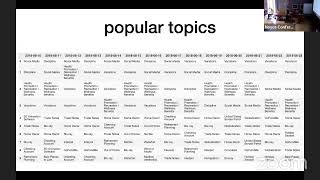
Scaling of Information Costs in Firms
Explore the scaling dynamics of information costs within organizations, examining how firms manage and process data as they grow and evolve in size and complexity.
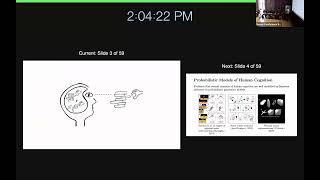
Meaning Through Modeling
Explore how modeling can create meaning and understanding in complex systems, with insights from Zenna Tavares on innovative approaches to scientific inquiry and knowledge representation.
Balance: Philosophical Implications
Explore the philosophical implications of balance, examining its role in various aspects of life, nature, and society through interdisciplinary perspectives.
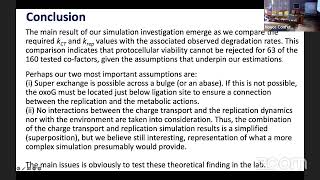
Origin of Biological Information in a Bottom-Up Physicochemical Protocell
Explore the emergence of biological information in protocells through a physicochemical perspective, unraveling the mysteries of life's origins.
Media Complexity: Towards a Research Agenda to Study News Media Ecosystems
Explore how complexity theory can revolutionize journalism research, offering new insights into digital media ecosystems, narrative evolution, and audience engagement in the modern news landscape.
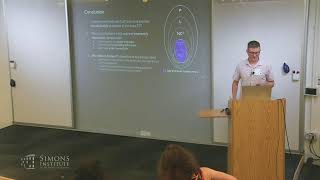
The Parallelism Tradeoff: Understanding Transformer Expressivity Through Circuit Complexity
Explore transformer neural nets' computational power and limitations through circuit complexity analysis, revealing insights into parallelism tradeoffs in large-scale model architectures.
Subgroup Tests and the Aldous-Lyons Conjecture
Explore the refutation of the Aldous-Lyons conjecture through novel interactive proof systems and subgroup tests, connecting complexity theory to probability theory and group theory.
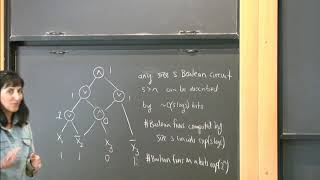
Lower Bounds in Complexity Theory, Communication Complexity, and Sunflowers - Toniann Pitassi
Explore lower bounds in complexity theory, communication complexity, and sunflowers. Delve into Boolean circuits, formulas, and key lemmas with expert insights from Toniann Pitassi.
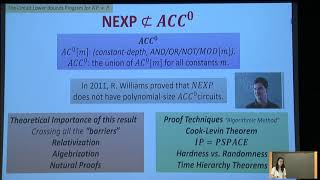
Strong Average-Case Circuit Lower Bounds from Non-trivial Derandomization - Lijie Chen
Explore advanced topics in computational complexity, including circuit lower bounds, derandomization, and their connections. Gain insights into cutting-edge research and theoretical developments in computer science.
Proofs, Circuits, Communication, and Lower Bounds in Complexity Theory - Robert Robere
Explore advanced concepts in complexity theory, including proofs, circuits, and communication, with a focus on lower bounds and their implications for computational limits.
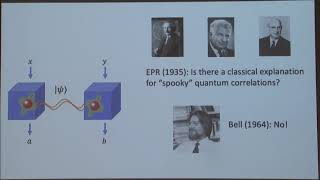
MIP* = RE - Henry Yuen
Explore quantum correlations, nonlocal games, and entanglement models in this seminar on MIP* = RE, delving into complexity theory and efficient tests for quantum phenomena.