
Why Black Holes Eat Information
Explore the fascinating phenomenon of black holes and their information-consuming nature with physicist Vijay Balasubramanian in this engaging lecture on theoretical physics.
Engineering Thermodynamics
Explore fundamental thermodynamic principles, laws, and applications in engineering contexts, covering energy systems, power cycles, and property relations.
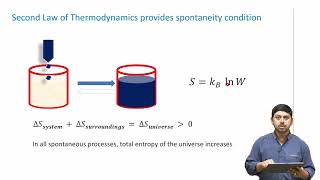
Chemical Principles II
In this course, a holistic approach covering three different approaches (classical, statistical, and postulate-based) of thermodynamics will be covered. The objective of this course is demystification the enigma of entropy.
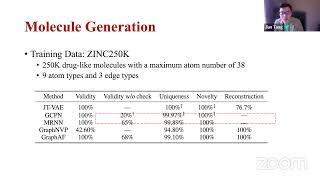
Geometric Deep Learning for Drug Discovery
Explore geometric deep learning techniques for drug discovery, covering graph neural networks, molecule generation, and retrosynthetic prediction. Gain insights into cutting-edge research and applications in pharmaceutical development.

Reconciling Thermodynamic and State Definitions of Entropy - Physics
Explore the connection between thermodynamic and state definitions of entropy in this mind-blowing, math-focused video. Gain deep insights into entropy as a measure of system states.

Chemical and Biological Thermodynamics - Principles to Applications
The course is designed to benefit students of chemistry, chemical engineering, biotechnology and pharmaceutical sciences to learn from basic concepts of chemical thermodynamics to applications in chemical and pharmaceutical industries including protein f…
Information Theory of Deep Learning - Naftali Tishby
Explores the connection between deep learning and information theory, offering new insights into neural network design, generalization, and optimization through an information bottleneck framework.
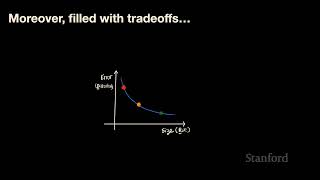
Data Compression I - Course Introduction and Lossless Compression Basics - Lecture 1
Introduction to lossless data compression fundamentals, covering key concepts and techniques for efficient information storage and transmission.
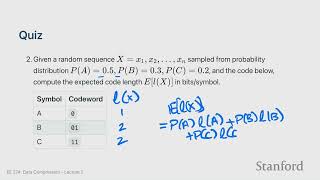
Data Compression I - Lecture 2: Prefix Free Codes
Explore prefix-free codes in data compression, covering theory and applications. Gain insights from Stanford experts on efficient information encoding techniques.
Data Compression I - Lecture 5: Asymptotic Equipartition Property
Explore the Asymptotic Equipartition Property in data compression, a fundamental concept for understanding information theory and efficient coding techniques.
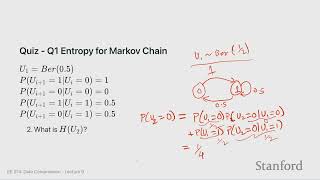
Context-based Arithmetic Coding and LLM Compression - Stanford EE274 Lecture 9
Explore context-based arithmetic coding and compression techniques for large language models in this advanced lecture on data compression theory and applications.
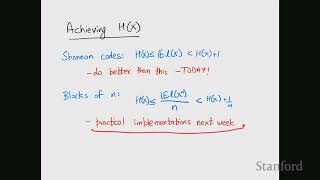
Data Compression I - Lecture 4: Huffman Codes
Explore Huffman coding, a fundamental data compression technique, in this Stanford lecture. Learn its principles, implementation, and applications in information theory.
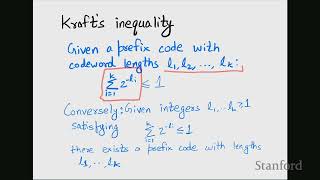
Data Compression I - Lecture 3: Kraft Inequality, Entropy, and Introduction to SCL
Explore Kraft Inequality, entropy, and Source Coding Limit in data compression. Gain insights into fundamental concepts and their applications in information theory and coding.
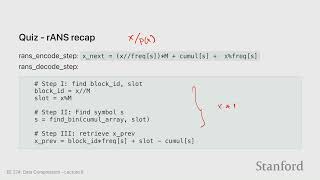
Stanford EE274: Data Compression - Beyond IID Distributions: Conditional Entropy - Lecture 8
Explore conditional entropy and advanced data compression techniques beyond IID distributions in this Stanford lecture, enhancing understanding of complex information theory concepts.
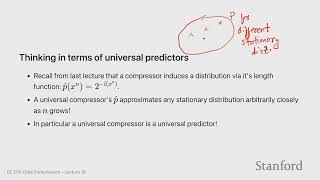
LZ and Universal Compression - Lecture 10
Explore Lempel-Ziv algorithms and universal compression techniques in this Stanford lecture, delving into advanced data compression theory and applications.
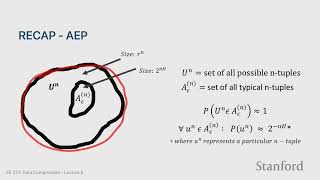
Arithmetic Coding - Stanford EE274 Data Compression I Lecture 6
Explore arithmetic coding in data compression, covering theory and applications. Learn from Stanford experts about this advanced technique for efficient information encoding.
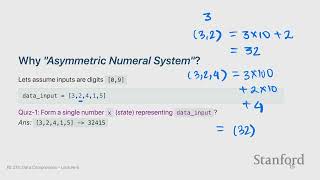
Asymmetric Numeral Systems (ANS) - Data Compression Lecture 7
Explore Asymmetric Numeral Systems (ANS), an advanced data compression technique, in this Stanford lecture. Gain insights into its principles, applications, and advantages in modern compression algorithms.
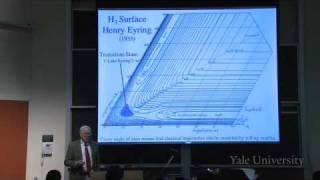
Potential Energy Surfaces, Transition State Theory and Reaction Mechanism - Lecture 37
Explore reaction rates, potential energy surfaces, and transition state theory in organic chemistry. Learn to predict equilibria and rates using bond energies and statistical mechanics principles.

The Second Law of Thermodynamics and Carnot's Engine - Lecture 23
Explore the Second Law of Thermodynamics, entropy, and Carnot's engine. Learn about irreversibility, heat engine efficiency limits, and how entropy arises from macroscopic considerations in thermodynamics.

Coding Theory
This course provides an introduction to traditional and modern coding theory. Topics covered include linear block codes, cyclic codes (BCH and RS codes), convolutional codes, turbo codes and low-density parity-check (LDPC) codes.
Concepts of Thermodynamics
Comprehensive exploration of thermodynamic principles, covering properties, laws, processes, and cycles. Includes problem-solving techniques and computer-aided analysis for practical applications.