David Krakauer on Emergent Political Economies and A Science of Possibility
Exploring emergent political economies through complexity science, examining historical tensions, mathematical approaches, and collective computation to understand societal dynamics and possibilities.
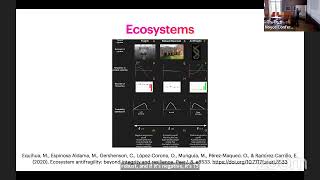
Antifragility - Dynamical Balance
Explore antifragility, dynamical balance, and their applications in software, creativity, and AI. Gain insights into measuring fragility and understanding robust systems.
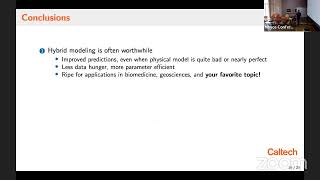
A Framework for Machine Learning of Model Error in Dynamical Systems
Explore a framework for machine learning to model error in dynamical systems, focusing on linear oscillators, partial information, and hybrid modeling techniques.
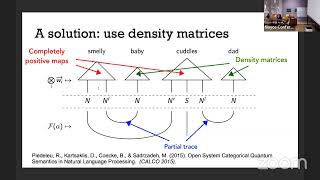
Compositionality in Vector Space Models of Meaning
Explore compositional structures in vector space models of meaning, focusing on deep neural networks, grammar, and role-filler bindings to understand language representation.
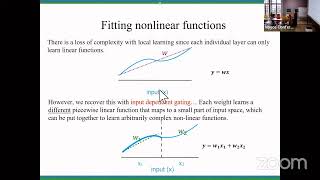
Training Machines to Learn the Way Humans Do - An Alternative to Backpropagation
Explore an alternative to backpropagation in machine learning, focusing on biologically-inspired local learning methods and their applications in neural networks and the cerebellum.
Modeling the Distributional Epidemic-Economic Effects of the Covid-19 Pandemic
Explore a data-driven Agent-Based Model simulating Covid-19's impact on industries, occupations, and income levels, revealing insights for effective and equitable interventions.
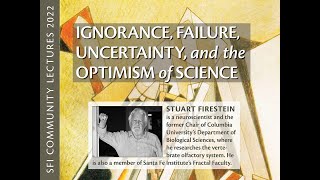
Ignorance, Failure, Uncertainty, and the Optimism of Science
Explore how ignorance, failure, and uncertainty drive scientific progress, fostering an optimistic outlook that embraces complexity and opens new possibilities for understanding and innovation.
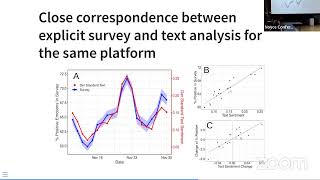
Validating Daily Social Media Macroscopes of Emotions
Explore how social media sentiment analysis can accurately measure daily emotional dynamics of online communities, validated through surveys and applied to COVID-19 impact studies.
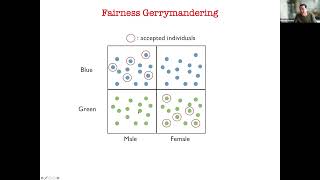
Can Algorithms Bend the Arc Toward Justice?
Explore algorithmic fairness, intersectionality, and the challenges of balancing accuracy with equity in machine learning and public safety applications.
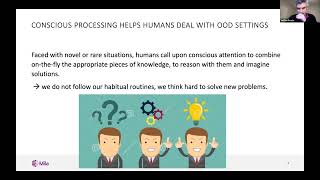
Yoshua Bengio- System 2 GFlowNets- Induction Biases Towards Machines that Understand and Think
Explore Yoshua Bengio's insights on System 2 GFlowNets, examining induction biases for AI that understands and thinks. Delve into deep learning, cognitive theories, and innovative approaches to machine intelligence.
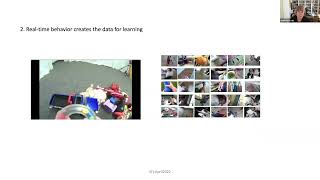
Why "Self-Generated Learning" May Be More Radical and Consequential Than First Appears
Explore self-generated learning's radical impact on cognitive development through data-driven insights, experiments, and complex dynamic systems analysis with Linda Smith.
Could a Purely Self-Supervised Foundation Model Achieve Grounded Language Understanding?
Exploring the potential of self-supervised foundation models for grounded language understanding, discussing semantics, multi-modal streams, and causal abstraction in large networks.
Penny Pexman - Multimodal Grounding for Concrete and Abstract Concepts
Explore multimodal grounding for concrete and abstract concepts with Professor Penny Pexman, examining lexical-semantic processing, sensorimotor experience, and dimensions of meaning in language comprehension.
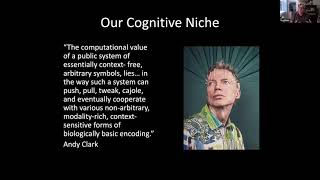
Guy Dove- Language Is a Neuroenhancement
Explore how language enhances cognitive abilities, examining embodied cognition, abstract concepts, and the elastic mind. Gain insights into human intelligence and its implications for AI development.
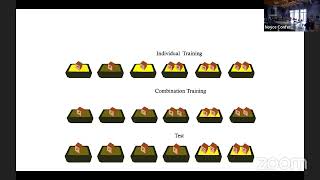
Imitation vs Innovation: Large Language and Image Models as Cultural Technologies
Explore the impact of large language and image models as cultural technologies, examining the balance between imitation and innovation in AI development.
Using Computation to Drive the Self-Assembly of Complex Structures
Explore computational approaches for driving self-assembly of complex structures, unlocking new possibilities in materials science and nanotechnology.

Bounded-Confidence Models of Opinion Dynamics on Networks
Explore opinion dynamics on networks using bounded-confidence models, examining how beliefs spread and evolve within interconnected social systems.

The Many Worlds of Quantum Mechanics
Explore quantum mechanics' puzzling nature and the intriguing idea of branching realities with physicist Sean Carroll. Delve into fundamental physics, cosmology, and the emergence of spacetime.
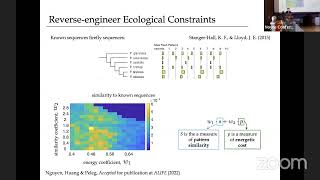
Physical Computation in Insect Swarms
Explore the fascinating world of collective behavior in insect swarms and discover how physical principles govern their complex interactions and decision-making processes.
Hierarchy and Conflict in Human and Other Societies
Explore how social hierarchies reduce conflict through an agent-based model, examining emergent properties and potential applications in various societal contexts.
Language, Perception and Action Shape the Human Conceptual System
Explore how language, perception, and action influence human conceptual systems with Louise Connell, a leading researcher in complex cognition and embodied intelligence.