
Data Art and the Future of Science Communication
Explore data art's role in science communication with Kirell Benzi. Learn how visual representation enhances understanding, bridges disciplines, and shapes the future of scientific dissemination.
The Future of the Economy - Technology Evolution and AI Impact
Exploring technology's evolution through biology, this talk examines how AI reshapes labor and finance, offering insights into designing human systems that align with physical and biological laws.
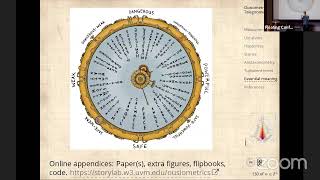
Ousiometrics and Telegnomics - Measuring Essential Meaning and Remote Knowledge
Explore the study of essential meaning and remotely sensed knowledge through innovative frameworks, examining language patterns, storytelling, and temporal dynamics in various contexts.

Combining Historical and Philosophical Approaches to Understand the Concept of Information in Animal Behavior
Exploring how biologists use "information" in animal studies, examining experimental practices, historical context, and debates to clarify its meaning and implications for comparing animal and machine behavior.

Global Catastrophic and Existential Risks - The Weightiest Complex Phenomena?
Explore the interdisciplinary field of global catastrophic and existential risks, their complex dynamics, and potential mitigation strategies for ensuring a safer future for humanity.
Reconstructing Ancient Superhighways - Modeling Prehistoric Human Migration
Explore how advanced technologies and agent-based modeling revolutionize archaeological research, revealing ancient migration routes and deepening our understanding of human-landscape interactions and prehistoric voyages.
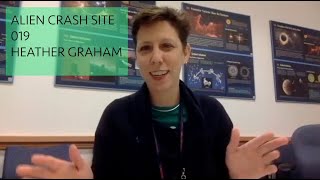
Detecting Agnostic Biosignatures in Space Exploration - Interview with Heather Graham
Exploring agnostic biosignatures and life detection methods with NASA researcher Heather Graham, discussing challenges in recognizing extraterrestrial life and innovative approaches to astrobiology.
Models of Identity Signaling
Explore mathematical models of identity signaling, examining their impact on cooperation, conflict, and social learning in complex human behavior and communication strategies.
An Example Application of Artificial Neural Networks in Archaeology
Exploring artificial neural networks in archaeology to predict site occupation dates from ceramic assemblages, enabling finer-grained demographic reconstructions and deeper insights into human experiences in the past.
Evolutionary Conundrums - Cooperation and Traversing Fitness Landscapes
Explore evolutionary biology: cooperation via social norms, fitness landscapes in rapidly evolving populations, and optimal antibiotic use against pathogens using Markov Decision Processes.
Semantic Information and the Physics of Meaning
Exploring the physics of meaning, this talk delves into semantic information, examining how systems process and organize information, and the fundamental constraints on energy required for information processing.
Text-Based Timeline Analysis and New Instruments for the Science of Stories
Exploring Twitter data as a telescope for observing collective human thought, revealing insights into sentiment, narrative power, and social dynamics through innovative text analysis techniques.
Introducing Alien Crash Site - A New SFI Podcast
Explore hypothetical alien technologies with scientists, artists, and athletes in this intriguing podcast inspired by sci-fi. Guests discuss potential discoveries and their implications for human knowledge and capabilities.
Calling Bullshit: The Art of Skepticism in a Data-Driven World
Learn to navigate the tidal wave of misinformation in our data-driven world. Discover techniques for skepticism, identifying fake news, and understanding the role of networks in spreading disinformation.
The Information Theory of Biology and Origins of Life - Sara Imari Walker Interview
Exploring information theory's role in understanding life's origins and nature. Discusses complex systems, the relationship between information and matter, and how this perspective reshapes our approach to defining and detecting life.
Fighting Hate Speech with AI and Social Science
Exploring AI and social science approaches to combat hate speech online, discussing research on classifying hate and counter speech patterns to promote civility in digital spaces.
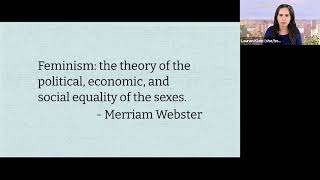
What Is Feminist Data Science? - Incorporating Feminist Thinking into Data-Driven Research
Explore feminist data science principles and their application in humanities research, including case studies on women's invisible labor, Black activism, and innovative data visualization techniques.
Algorithmic Bias in AI: Implications and Challenges - A Discussion with Cristopher Moore and Melanie Moses
Explore algorithmic bias in AI, its societal impacts, and the quest for transparency in decision-making systems. Delve into facial recognition flaws and implications for algorithmic justice.
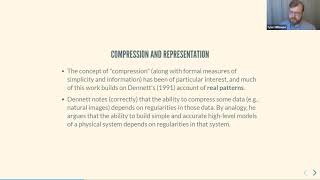
Patterns and Parsimony - High-Level Representations in Scientific Modeling
Explore the role of compression in developing effective high-level representations for scientific modeling, and discover why good representations require more than simplicity alone.
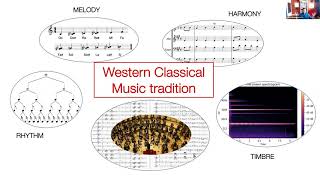
Topology of Networks in Generalized Musical Spaces
Explore the intersection of topology, networks, and music theory in generalized musical spaces, uncovering universal features and evolutionary perspectives across cultures.
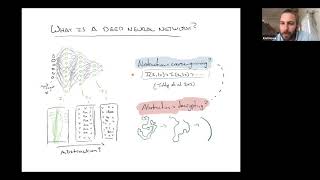
Swimming Without a Lifeguard in the Ocean of Ideas - Abstraction and Unsupervised Deep Learning
Explore unsupervised deep learning techniques for discovering hierarchical latent feature spaces, improving interpretability and performance in downstream tasks, and bridging neural and symbolic learning systems.