
On Building General, Zero-Shot Robot Policies - EI Seminar
Explore the development of zero-shot robot policies for real-world tasks. Gain insights into Robot Utility Models (RUMs) and their ability to generalize to new environments without finetuning, achieving 90% success in novel settings.

Building an 8-Bit Breadboard Computer
Learn to build an 8-bit computer from scratch using breadboards, covering clock design, registers, ALU, RAM, program counter, and CPU control logic. Gain hands-on experience in digital electronics and computer architecture.

Machine Learning with Python
Comprehensive Python tutorial covering machine learning concepts, algorithms, and deep learning with TensorFlow. Includes hands-on projects and real-world applications.
The Evolution of the Symphony and Orchestra - Lecture 20
Explore the evolution of symphonies and orchestras from Mozart to Mahler, examining historical changes in instruments, orchestral size, and concert venues, with musical examples from renowned composers.
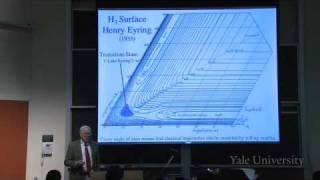
Potential Energy Surfaces, Transition State Theory and Reaction Mechanism - Lecture 37
Explore reaction rates, potential energy surfaces, and transition state theory in organic chemistry. Learn to predict equilibria and rates using bond energies and statistical mechanics principles.
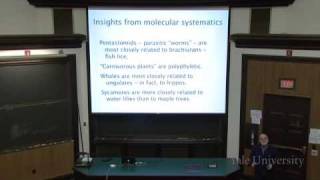
Phylogeny and Systematics - Principles of Evolution, Ecology and Behavior
Explore genetic analysis techniques for constructing accurate evolutionary trees, understanding common ancestry, and avoiding misleading analogies in phylogenetic grouping.

The Structures of Power in Early Modern England - Politics, Religion, and Society under the Tudors
Explore the dynamics of royal power in early Tudor England, examining institutions, political culture, and the impact of Henry VII and Henry VIII's reigns on monarchy and government.

Queer Theory and Gender Performativity - Lecture 23
Explore Judith Butler's queer theory, gender performativity, and their relation to Foucault's work. Examine key concepts, methodologies, and implications for identity politics and literary analysis.

Language in the Brain and Mouth - How We Communicate
Explore the fascinating world of language, from its basic structures to complex theories of acquisition, and discover how our brains process and produce speech.

Introduction to Plato's Phaedo - Arguments for the Existence of the Soul, Part II
Explore arguments for the soul's existence, focusing on free will as a key defense. Delve into dualism vs. physicalism and examine consciousness, emotions, and creativity in machines.
Evolution and Rationality: An Evolutionary Perspective on Psychology
Explore how natural selection shapes human psychology, examining evolutionary perspectives on mental phenomena, instincts, and decision-making processes in this insightful lecture on the origins of human behavior.

Imperfect Information: Information Sets and Sub-game Perfection in Game Theory - Lecture 18
Explore game theory concepts like information sets, imperfect information games, and subgame perfection. Learn to analyze complex strategic interactions and refine equilibrium notions in sequential games.

Don Quixote - Introduction to Part II - Lecture 12
Explore the transition between Don Quixote's Parts I and II, examining themes, cultural context, and Cervantes' writing process in this insightful lecture on the classic novel.
Reality and the Orbital Approximation in Freshman Organic Chemistry - Lecture 10
Explore quantum mechanics in organic chemistry, from probability density to hybrid orbitals, and the challenges of describing multi-electron systems using one-electron models.
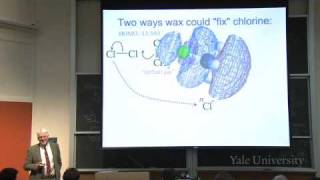
Radical and Type Theories in Organic Chemistry (1832-1850) - Lecture 22
Explores radical and type theories in organic chemistry, covering historical developments, key figures, and fundamental concepts like HOMO-LUMO mechanism and free-radical chain reactions.
Technology and Invention in Finance - Risk Management and Financial Innovation
Explore how technology and innovation shape finance, from risk management to insurance contracts, and their impact on societal systems like social security and welfare.

Modeling Mortgage Prepayments and Valuing Mortgages
Explore mortgage prepayment modeling and valuation, including refinancing complexities, forecasting methods, and risk management strategies for investors and banks.

Heroes and Villains - Benedict Arnold and Social Mobility in the American Revolution
Explore Benedict Arnold's treason as a case study of regionalism, social rank, and gender dynamics in Revolutionary America, examining motivations, plot details, and consequences.
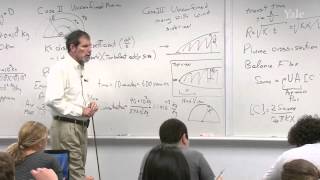
Horizontal Transport in Atmospheric Mixing - Lecture 8
Explore atmospheric pollutant mixing through confined, unconfined, and wind-influenced scenarios. Learn about diffusion, wind effects, and temperature changes with altitude in this comprehensive lecture.

Why Are People Different? Understanding Personality and Intelligence - Lecture 13
Explore theories on personality and intelligence differences, including measurement methods, genetic and environmental influences, and their impact on individual and group variations.

The Second Law of Thermodynamics and Carnot's Engine - Lecture 23
Explore the Second Law of Thermodynamics, entropy, and Carnot's engine. Learn about irreversibility, heat engine efficiency limits, and how entropy arises from macroscopic considerations in thermodynamics.