Deep Generative Models - Autoregressive Models - Lecture 3
Explore autoregressive models in deep learning, focusing on their architecture, training, and applications in generating sequential data like text and images.
Deep Generative Models - Discrete Latent Variable Models - Lecture 17
Explore discrete latent variable models in deep generative modeling, covering key concepts and applications in AI and machine learning.
Stanford CS236: Deep Generative Models - Lecture 13 - Score Based Models
Explore score-based models in deep generative modeling, covering theoretical foundations and practical applications in this advanced Stanford lecture on AI and machine learning.
Deep Generative Models - Lecture 5: Variational Autoencoders
Explore Variational Autoencoders (VAEs) in deep generative modeling, covering theoretical foundations and practical applications in this comprehensive Stanford lecture.
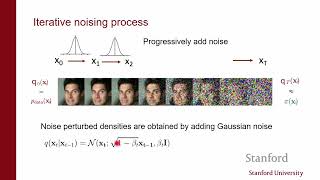
Stanford CS236: Deep Generative Models - Score Based Diffusion Models - Lecture 16
Explore score-based diffusion models in deep generative modeling, covering theoretical foundations and practical applications in AI and machine learning.
Deep Generative Models - Maximum Likelihood Learning - Lecture 4
Explore maximum likelihood learning in deep generative models with Stanford's Stefano Ermon. Gain insights into advanced AI techniques and their applications in this comprehensive lecture.
Deep Generative Models - Diffusion Models for Discrete Data - Lecture 18
Explore diffusion models for discrete data in this Stanford lecture, covering advanced techniques in deep generative modeling for AI applications.

Deep Generative Models - Lecture 2: Background
Explore fundamental concepts and background for deep generative models, covering essential topics to build a strong foundation in this advanced machine learning field.
Deep Generative Models - Energy Based Models - Lecture 12
Explore energy-based models in deep learning, their applications, and theoretical foundations. Gain insights into this powerful approach for modeling complex data distributions.
Deep Generative Models - Normalizing Flows - Lecture 9
Explore normalizing flows in deep generative models, focusing on their principles, applications, and recent advancements in this Stanford lecture by Prof. Stefano Ermon.
Deep Generative Models - Energy Based Models - Lecture 14
Explore energy-based models in deep learning, their applications, and theoretical foundations. Gain insights from Stanford's expert on advanced generative modeling techniques.
Deep Generative Models - Lecture 6: Variational Autoencoders
Explore Variational Autoencoders (VAEs) in deep generative modeling, covering theoretical foundations and practical applications in this Stanford lecture by Prof. Stefano Ermon.
Evaluation of Generative Models - Stanford CS236 Deep Generative Models Lecture 15
Explore evaluation methods for deep generative models, including metrics and techniques to assess model performance, quality, and effectiveness in various applications.
Deep Generative Models - Energy Based Models - Lecture 11
Explore energy-based models in deep learning, their applications, and theoretical foundations. Gain insights from Stanford's expert on advanced generative modeling techniques.
Stanford CS236: Deep Generative Models - Lecture 7 - Normalizing Flows
Explore normalizing flows in deep generative models with Stanford's Stefano Ermon. Learn advanced techniques for creating flexible and expressive probability distributions in machine learning.

Stanford CS236 - Deep Generative Models - Lecture 1: Introduction
Explore deep generative models with Stanford's Prof. Ermon. Learn key concepts, applications, and cutting-edge techniques in this comprehensive introduction to a rapidly evolving field of AI.
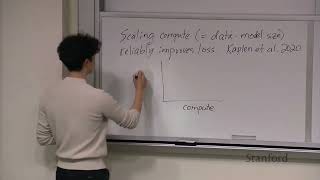
Intuitions on Language Models and Shaping AI's Future - Stanford CS25 Lecture
Explore intuitions on language models and the evolution of Transformer architectures with OpenAI researchers. Gain insights into next-word prediction, scaling laws, and the future of AI development.
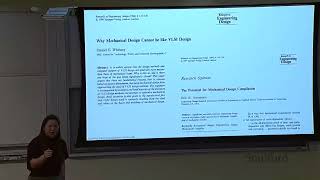
When Design Equals Planning - Computational Approaches to Robot Design
Exploring the intersection of robot design and planning, this seminar discusses computational approaches to simplify design processes and make formal statements about design feasibility across various robotic systems.
The Human Factors of Formal Methods - Stanford Seminar
Exploring human-centered approaches to improve formal methods' usability in software development, addressing cognitive challenges and misconceptions to enhance adoption by non-experts.
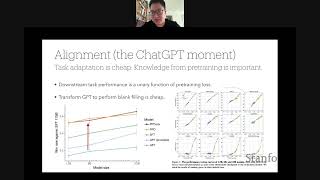
From Large Language Models to Large Multimodal Models - Stanford CS25 - Lecture 4
Explore the evolution from large language models to multimodal AI, focusing on CogVLM and CogAgent. Learn about integrating visual perception with language capabilities and future research directions.
Leveraging Social Theories to Enhance Human-AI Interaction
Explores challenges in human-AI partnerships, focusing on interpretability tools' limitations and cognitive heuristics. Proposes incorporating social theories to improve decision-support systems and human-AI interaction.