The Landauer Limit and Thermodynamics of Biological Computation
Explore the intersection of physics, information theory, and biological computation, focusing on the Landauer limit and its implications for engineered and natural systems.
Modeling Computer Networks from Chips to the Internet
Explore network modeling strategies for the Internet, from chip-level communication to global-scale simulations, examining scaling laws, biological concepts, and socio-economic factors shaping its future.
Exponentials, Economics, and Ecology with David Krakauer
Explore exponential changes, nonlinear dynamics, and interconnected systems in ecology and economics. Gain insights on aligning individual and public good in a complex world.
Complex Time - Cognitive Regime Shift II - When-Why-How the Brain Breaks
Exploring brain function loss through complexity science, from cellular to cognitive levels, discussing indicators, mechanisms, and analytical approaches for understanding aging and diseased brains.
Maria del-Rio Chanona on Modeling Labor Markets & Tech Unemployment
Exploring labor market dynamics and technological unemployment through network analysis and agent-based modeling. Insights on job security, skill transferability, and adapting to automation in the evolving workforce.
Artificial Intelligence: A Guide for Thinking Humans
Explore AI's achievements, failures, and ethical implications with researcher Melanie Mitchell. Gain insights into machine learning, self-driving cars, and the challenges of imbuing computers with human-like qualities.
The Collective Computation of Reality in Nature and Society
Explore how nature computes through collective processes, challenging traditional views on complexity and information processing in biological and social systems.
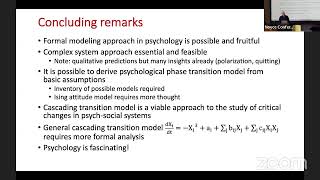
Cascading Transitions in the Behavioral and Social Sciences
Explore cascading transitions in psycho-social systems, focusing on opinion change, learning, and addiction. Discover how these multilevel processes work and their potential impacts on society.
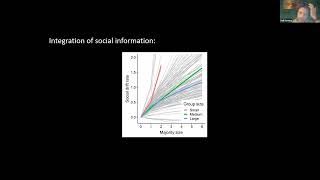
From Individual-Level Cognition to Collective Dynamics - Ralf Kurvers
Explore collective dynamics in social systems through evidence accumulation models, evolutionary algorithms, and real-world applications in resource finding, predictions, and robotics.
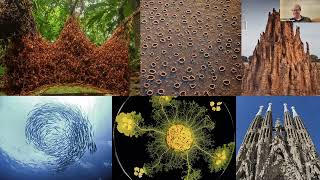
Self-Organization at the Origin of Biological Construction - Corina E Tarnita
Explore self-organization in biological systems, focusing on ants and social complexity. Learn how evolutionary biology explains the emergence of intricate structures and behaviors in nature.
Rational Ignorance - Optimal Learning from Complex Mechanistic Models
Explore optimal Bayesian learning from complex models, challenging traditional approaches and proposing a new method to maximize expected information while avoiding bias in multiparameter systems.
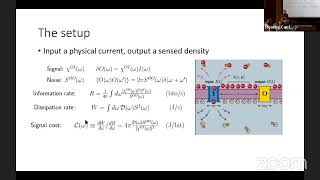
Connecting Molecular Details to Macroscopic Behaviors with Thermodynamics and Information Theory
Explore how molecular details connect to macroscopic behaviors using thermodynamics and information theory, focusing on E. coli chemotaxis and the energetic costs of biological information processing.
James Evans on Social Computing and Diversity by Design
Exploring social computing's impact on scientific research, team diversity, and human-AI collaboration in the pursuit of novel insights and wisdom.
Cris Moore on Algorithmic Justice and The Physics of Inference
Exploring algorithmic justice and inference physics, this talk delves into the limits of AI decision-making, emphasizing transparency, model suitability, and the importance of understanding technology's boundaries in complex problem-solving.
Tina Eliassi-Rad on Democracies as Complex Systems
Exploring democracy as a complex system, examining its challenges and potential solutions through the lens of complexity science and machine learning.
Good Explanations & Diseases of Epistemology
Exploring the nature of explanations, epistemology, and societal knowledge processing. Balancing understanding and prediction in science, and adapting to rapid changes in a complex world.
Lauren Klein on Data Feminism - Tracing Linguistic Innovation
Exploring linguistic innovation and cultural change through data analysis, challenging traditional narratives of individual genius and highlighting collaborative processes in idea creation and dissemination.
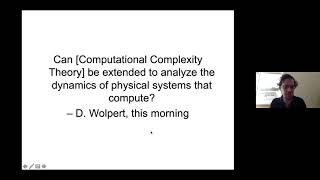
Tutorial on Computer Science - Josh Grochow
Explore key concepts in computer science, from model independence to computational complexity theory, with insights on P vs NP and various computational models.
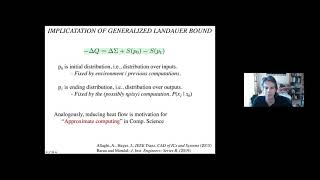
Tutorial on Stochastic Thermodynamics - David Wolpert
Explore stochastic thermodynamics with David Wolpert, covering Landauer's principle, approximate computing, performance constraints, and thermodynamic complexity in computational systems.

Co-Ordination - On Time Between Worlds
Panel discussion exploring complex time, interplanetary life, and social-technical systems. Experts examine time-scales, collaboration methods, and sustaining life beyond Earth, considering diverse perspectives on time's nature and impact.
Mathematical and Computational Foundations for Enabling Predictive Digital Twins at Scale
Explore mathematical foundations for scalable digital twins, focusing on probabilistic graphical models and physics-based reduced-order models in scientific and engineering applications.