
Sexual Selection in Evolution, Ecology, and Behavior - Lecture 13
Explore sexual selection's role in evolution, including intersexual and intrasexual selection, sexual dimorphism, and costly signaling in mate choice and competition.
Genomic Conflict in Evolution, Ecology and Behavior - Lecture 10
Explore genomic conflicts within cells, organisms, and between species. Learn about meiosis fairness, uniparental inheritance, and evolutionary strategies to resolve conflicts in sexual species.
Life History Evolution - Principles of Evolution, Ecology and Behavior
Explore evolutionary tradeoffs in organism traits: maturity, offspring, and lifespan. Understand how genes and environment shape life history strategies for survival and reproduction.

Interactions with the Physical Environment - Principles of Evolution, Ecology and Behavior
Explore how organisms adapt to their environments through thermoregulation, internal regulation, water management, and niche specialization in this ecology and evolution lecture.

Population Growth - Density Effects and Mathematical Models
Explore factors influencing population growth, including density effects, predators, and resources. Learn mathematical models and real-world examples to understand population dynamics and ecological interactions.

Species and Speciation - Principles of Evolution, Ecology and Behavior
Explore the process of speciation, including definitions, mechanisms, and stages. Learn about reproductive isolation, ecological specialization, and genetic factors in species divergence.
Ecological Communities - Evolution of Concepts and Modern Perspectives
Explore ecological communities: from classical views to modern concepts like trophic cascades and meta-communities. Discover how predation and interconnected ecosystems shape our understanding of nature's complex web.
Economic Decisions for the Foraging Individual - Lecture 32
Explore foraging behaviors, from marginal value to group hunting, and how organisms make economic decisions when seeking food or mates. Learn about risk management and predator-prey dynamics in ecology.
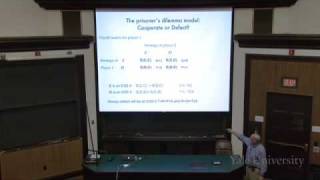
Evolutionary Game Theory: Fighting and Contests - Lecture 33
Explore how game theory applies to evolution and behavior, analyzing encounters between organisms as mathematical games to infer fitness payoffs and strategy proportions in populations.
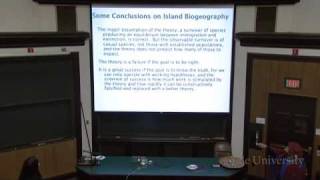
Island Biogeography and Invasive Species - Principles of Evolution, Ecology and Behavior
Explore island biogeography, metapopulations, and their ecological significance. Learn how these concepts apply to species distribution, extinction risks, and even epidemiology in this insightful lecture.
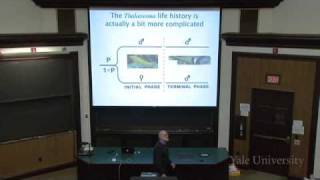
Sex Allocation in Evolutionary Biology - Principles of Evolution, Ecology and Behavior
Explore sex allocation in organisms, including optimal ratios, hermaphroditism, and offspring sex control. Learn how environmental factors influence reproductive strategies across species.

The Fossil Record and Life's History - Principles of Evolution, Ecology and Behavior
Explore the fossil record's insights into evolutionary history, including extinctions, speciation, and long-term trends in life's development on Earth.

Principles of Evolution, Ecology and Behavior: Coevolution - Lecture 20
Explore coevolution at various levels, from intracellular organelles to species interactions. Learn about symbiosis, parasitism, and factors influencing evolutionary relationships in nature.
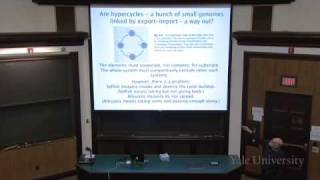
Key Events in Evolution - Lecture 17
Explore key evolutionary events from non-life to eukaryotic cells, including symbiosis and new levels of selection. Gain insights into the history of life and biological complexity.
Mating Systems and Parental Care in Evolution and Ecology - Lecture 34
Explore diverse mating systems and parental care strategies across species, examining environmental and behavioral factors influencing reproduction and offspring protection in evolutionary biology.

Major Events in the Geological Theatre - Principles of Evolution, Ecology and Behavior
Explore how geology and climate have shaped life's evolution, from atmospheric changes to mass extinctions, and how life has impacted Earth's geology through various processes.
Phylogeny and Systematics - Principles of Evolution, Ecology and Behavior
Explore genetic analysis techniques for constructing accurate evolutionary trees, understanding common ancestry, and avoiding misleading analogies in phylogenetic grouping.

AIDS: A Clinician's Perspective on the Modern Epidemic - Lecture 23
Dr. Margaret Craven explores AIDS as a modern epidemic, discussing its rapid global spread, medical and social factors, challenges in public health response, and future directions in treatment and prevention.

AIDS: Global Impact and Public Health Strategies - Lecture 1
Explore the global AIDS pandemic, its transmission, epidemiology, societal impacts, and public health strategies, with a focus on regional differences and local factors affecting the epidemic.

Malaria - The Case of Italy and Its Global Impact
Explore malaria's profound impact on human biology, society, and global health disparities. Discover its etiology, symptoms, and the mosquito theory of transmission in this comprehensive historical overview.

The Germ Theory of Disease - Epidemics in Western Society Since 1600
Explore the revolutionary germ theory of disease, its preconditions, key figures like Pasteur and Koch, and its profound impact on medical science and public health.