The Laws of Life, Time and Chance
Explore the intersection of physics and biology, uncovering mathematical frameworks for understanding life, time, and probability. Discover how chance governs cellular behavior and impacts complex biological phenomena.
Darwin's Extra Sense - Mathematics in Life Sciences
Explore how modern mathematics enhances our understanding of life sciences, bringing an "extra sense" to biological research as envisioned by Charles Darwin.
Emerging Diseases, Deadly Lessons - Preventing Future Epidemics
Insights from recent epidemics on preventing future outbreaks, exploring ecological, social, political, and economic factors in disease spread and their implications for global health security.
Models for Interdisciplinarity Inspired by Mathematical Biology
Explore frameworks for interdisciplinary modeling, including "Rule-of-Five" and disciplines as coevolving networks, to improve teaching and research across fields.
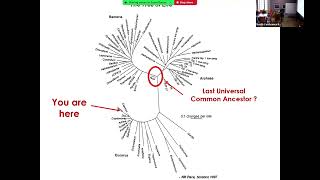
Topological Scaling Laws and the Mathematics of Evolution
Explore topological scaling laws in evolutionary biology, examining phylogenetic tree structures and their implications for understanding large-scale evolutionary patterns and processes.
Why There Are No Three-Headed Monsters
Explore developmental constraints, brain tumors, and marriage dynamics through mathematical biology, offering insights into morphogenesis, medical interventions, and relationship predictions.
Mathematical Modelling in Biology - Infectious Disease Modelling - Lecture 3
Explore infectious disease spread using the Kermack McKendrick model, deriving the 'R' number and its significance in epidemiology. Gain insights into mathematical biology applications.
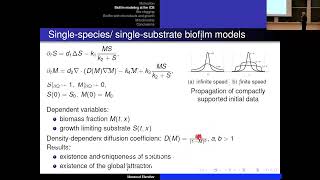
Local vs. Nonlocal Models for Mitochondria Swelling
Explore local versus nonlocal models for mitochondria swelling in this 30-minute conference talk by Messoud Efendiev from Helmholtz Zentrum München. Delve into the mathematical and computational approaches used to study mitochondrial dynamics, focusing o…
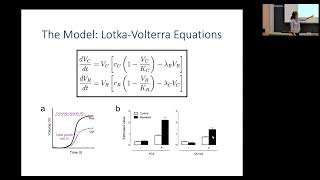
Curing Cancer with Calculus - Lecture 3
Explore the intersection of mathematics and cancer research in this 58-minute distinguished lecture by Helen Byrne from the University of Nottingham and University of Oxford. Delve into the innovative application of calculus in oncology as part of the Fr…
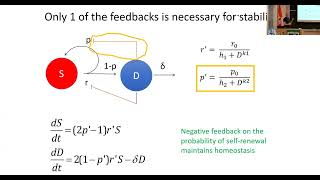
Stem Cell Dynamics and Mutant Invasion in the Hematopoietic System of Mice
Explore stem cell dynamics and mutant invasion in the hematopoietic system of mice in this 47-minute lecture by Dominik Wodarz from the University of California, Irvine. Delivered on September 23, 2024, as part of the Frontiers in Computational and Mathe…
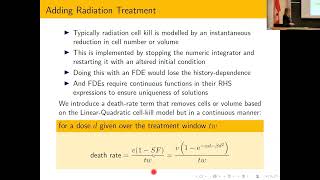
Modelling Cancer Radiotherapy: Fractional vs Ordinary Differential Equations
Explore a 19-minute conference talk on modeling cancer radiotherapy, comparing fractional and ordinary differential equations. Delivered by Kathleen Wilkie from Toronto Metropolitan University on September 23, 2024, as part of the Frontiers in Computatio…
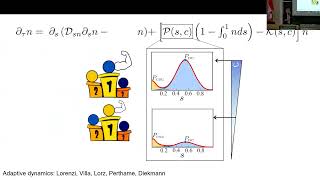
Modelling the Impact of Intra-Tumour Heterogeneity on Radiotherapy Outcomes
Explore a 39-minute lecture on the impact of intra-tumour heterogeneity on radiotherapy outcomes, delivered by Giulia Celora from University College London. Delve into the complex world of mathematical oncology as part of the Fields Institute's Thematic…
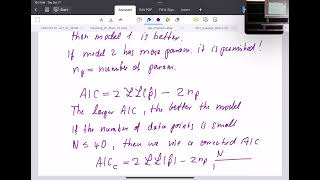
Sensitivity, Spatial Models, and Fokker-Planck Equations in Mathematical Oncology - Graduate Course
Dive into advanced mathematical concepts in oncology, exploring sensitivity analysis, spatial modeling, and Fokker-Planck equations with Dr. Thomas Hillen.
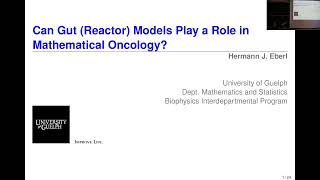
Can Gut Reactor Models Play a Role in Mathematical Oncology?
Explore the potential role of gut reactor models in mathematical oncology through Hermann Eberl's seminar on innovative approaches to cancer research.
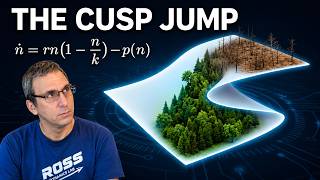
Insect Outbreak Model - A Cusp Catastrophe Population Dynamics Example
Explore insect outbreak modeling using cusp catastrophe theory, analyzing population dynamics, fixed points, and bifurcations in a budworm-fir tree ecosystem.
Topology in Computational Genomics
Exploring topological methods in genomics, focusing on their application in computational analysis of genetic data to uncover complex biological structures and relationships.
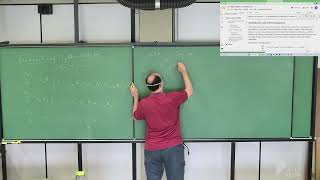
Computational Methods for Simulating and Analyzing Ecological Systems - Class 16
Explore computational methods for simulating and analyzing ecological systems, focusing on practical applications in quantitative ecology.
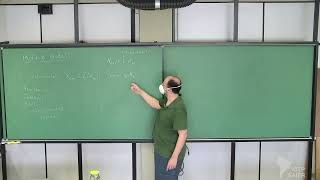
Computational Methods for Simulating and Analyzing Ecological Systems - Class 15
Explore computational methods for simulating and analyzing ecological systems, focusing on practical applications in quantitative ecology.
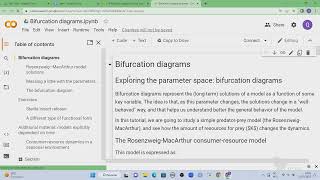
Computational Methods for Simulating and Analyzing Ecological Systems - Class 12
Explore computational methods for simulating and analyzing ecological systems, focusing on practical applications in quantitative ecology research.
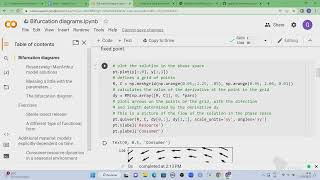
Computational Methods for Simulating and Analyzing Ecological Systems - Class 10
Explore computational methods for simulating and analyzing ecological systems, including bifurcation diagrams and predator models in seasonal environments.
Computational Methods for Simulating and Analyzing Ecological Systems - Class 1
Explore computational methods for simulating and analyzing ecological systems, focusing on practical applications in quantitative ecology.