Thermodynamics of Far From Equilibrium Systems, Biochemistry, and Life in a Warming World
Explores new thermodynamic approaches to biological temperature responses, challenging traditional enzyme stability theories and offering insights into optimum temperatures for biochemical reactions and ecological impacts.
Invasion of the Inferential Cell
Explore the evolution of intelligence on Earth, from cellular behavior to complex cognition, examining common principles across biological systems and the unique aspects of human thought.
The Collective Computation of Reality in Nature and Society
Explore how nature computes through collective processes, challenging traditional views on complexity and information processing in biological and social systems.
Aging Across Scales - Evolutionary Theories and Population Thinking
Explore evolutionary theories of senescence, recent modeling insights, and the pace-shape framework to understand why some organisms age while others don't, across different lifespan scales.

Toward a New Understanding of Aging, Adaptation, and the Arrow of Time
Explore the interplay between biological aging, adaptation, and time through examples from physics research, aiming to identify pathways for healthy aging and formulate a new concept of complex time.

On Composition and Complexity
Explore the intricate relationship between composition and complexity, delving into how elements combine to create emergent properties and complex systems across various disciplines.
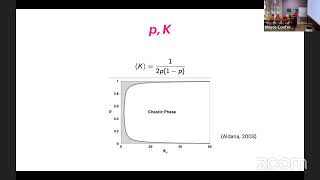
Criticality - A Balance Between Robustness and Adaptability
Explore the concept of criticality and its role in balancing robustness and adaptability in complex systems, offering insights into system behavior and optimization.
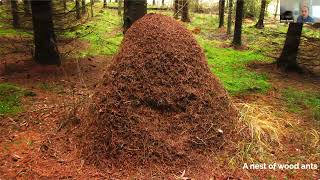
The Self-Assembling Horde: Building Functional Structures on the Move
Explore how collective organisms build functional structures while in motion, focusing on self-assembling processes and their applications in various fields of science and engineering.
Scaling Laws and Social Networks in the Time of COVID-19 - Part 1
Exploring scaling laws in biology, cities, and economies, and their implications for societal challenges like pandemics and sustainability. Insights from complex systems science for understanding human civilization.
Semantic Information and the Physics of Meaning
Exploring the physics of meaning, this talk delves into semantic information, examining how systems process and organize information, and the fundamental constraints on energy required for information processing.
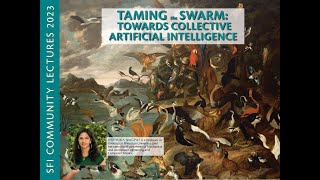
Taming the Swarm - Towards Collective Artificial Intelligence
Explore how biological swarms inspire new forms of AI and robotics, focusing on collective intelligence in nature and its potential applications in artificial systems.
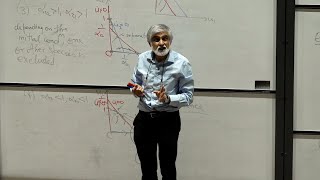
Mathematical Modelling in Biology - Enzyme Kinetics and Perturbation Theory - Lecture 2
Explore enzyme-substrate reactions using separation of timescales and perturbation analysis to derive solutions and simplify complex biological systems.
Sensor Fusion
Explore sensor fusion through biological and electronic perspectives, comparing information processing, filtering techniques, and real-world applications in this insightful presentation.
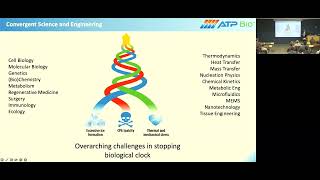
Cryogenically Suspending and Rewarming Living Biological Systems
Explore breakthrough technologies in cryogenic suspension of biological systems. Learn about engineering approaches, applications, and recent achievements in preserving cells, tissues, organs, and whole organisms.
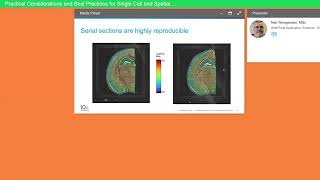
Practical Considerations and Best Practices for Single Cell and Spatial Transcriptomics
Explore best practices for single cell and spatial transcriptomics, uncovering complex biological systems with high-resolution approaches. Gain insights from an expert in genomics and earn PACE credits.
Using Algebraic Geometry to Detect Robustness in Reaction Networks
Explore algebraic geometry techniques to detect robustness in reaction networks, focusing on absolute concentration robustness and its implications for biological systems.
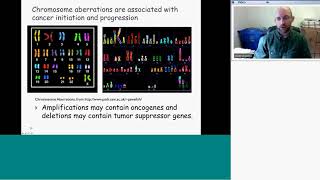
Javier Arsuaga - Applications of Computational Topology to the Analysis of Breast Cancer
Explore computational topology's role in breast cancer analysis, uncovering new insights through advanced mathematical techniques and data visualization methods.
Mathematical Analysis of Models for Living Tissues and Free Boundary Problems - Tutorial Part 1
Explore mathematical models for living tissues and free boundary problems with Professor Perthame, delving into advanced analysis techniques and applications in biological systems.
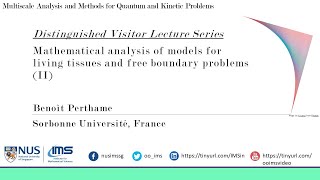
Mathematical Analysis of Models for Living Tissues and Free Boundary Problems - Tutorial Part 2
Explore mathematical models for living tissues and free boundary problems with Professor Benoît Perthame. Gain insights into advanced analytical techniques for biological systems.
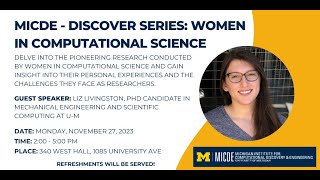
Data to Differential Equations: Discovering Mathematical Models for Biological Systems
Explore data-driven techniques for discovering governing equations in complex biological systems, focusing on PDEs and innovative mathematical methods for modeling phenomena like arterial flow and tissue fracture.
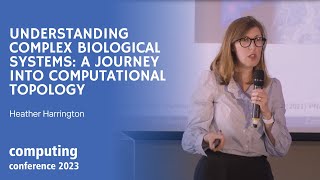
Understanding Complex Biological Systems: A Journey into Computational Topology
Explore computational topology's role in decoding complex biological systems. Learn how algorithms interpret data from molecular biology, genetics, and medicine, offering unique insights into disease progression and protein structures.