Sobolev Regularity for Maximal Operators
Explore recent developments in regularity theory for maximal operators, focusing on Sobolev and BV data. Accessible overview of an active research area with open questions.
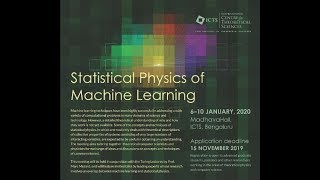
Approximate Message Passing for Statistical Inference and Estimation by Cynthia Rush
Explore approximate message passing techniques for statistical inference and estimation, focusing on applications in machine learning and data analysis.
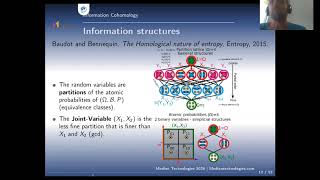
Cohomological Characterization of Information Structures
Exploring cohomological methods to quantify statistical interactions in datasets, linking information theory, statistical physics, and machine learning for improved data analysis and interpretation.
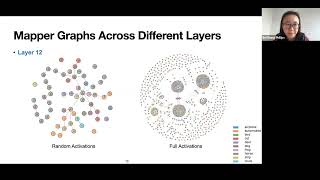
Topology of Artificial Neuron Activations in Deep Learning
Explore the topology of artificial neuron activations in deep learning, from image classification to natural language processing, with insights on convolutional neural networks and transformer-based models.
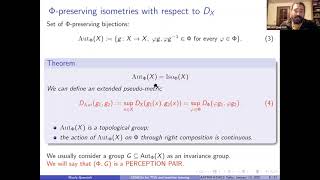
Group Equivariant Non-Expansive Operators and Their Use in Deep Learning
Explore group equivariant non-expansive operators and their applications in deep learning, focusing on topological and geometrical properties.
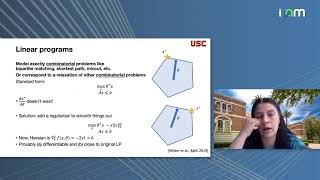
Decision-Focused Learning - Integrating Downstream Combinatorics in ML
Explore the integration of machine learning and discrete optimization to enhance problem-solving in real-world scenarios, focusing on decision-focused learning and tailored solution strategies.
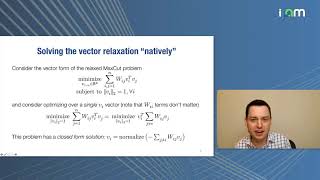
Fast Semidefinite Programming for Differentiable Combinatorial Optimization
Explore advanced techniques in semidefinite programming for combinatorial optimization, focusing on fast and differentiable methods presented by Carnegie Mellon expert Zico Kolter.
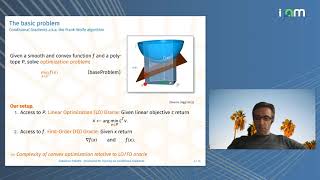
Structured ML Training via Conditional Gradients
Explore conditional gradient methods for structured optimization in machine learning, covering applications in traditional and deep learning, with a focus on incorporating polyhedral structures into solutions.

Deep Learning of Dynamical Systems for Mechanistic Insight and Prediction in Psychiatry
Explore deep learning techniques for analyzing dynamical systems in psychiatry, uncovering mechanisms, and predicting outcomes using neural and behavioral data from various sources.
What Can the Working Mathematician Expect From Deep Learning? - IPAM at UCLA
Explore deep learning's impact on mathematics, its potential applications, and insights from a pure mathematician's perspective on this emerging field's role in mathematical research.
Learning-Based Low-Rank Approximations - IPAM at UCLA
Explores learning-based algorithms for low-rank matrix approximation, focusing on optimizing sketching matrices using training data to significantly reduce approximation errors in efficient computational methods.
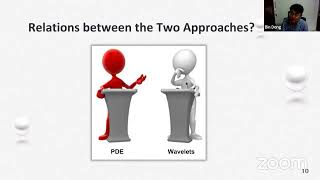
On Mathematical Modeling in Image Reconstruction and Beyond
Explores connections between wavelet frame-based and PDE-based approaches in image reconstruction, linking to deep learning and computational imaging advancements.
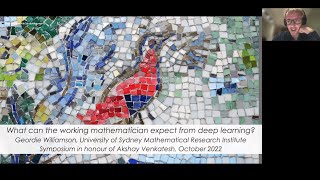
What Can the Working Mathematician Expect From Deep Learning?
Explore the potential impact of deep learning on mathematics, discussing its applications, limitations, and future prospects for researchers and practitioners in the field.
Approximation Theory of Deep Learning from the Dynamical Viewpoint
Explore deep learning approximation theory from a dynamical perspective, covering supervised learning, universal approximation, sequence modeling, and insights on various neural network architectures.
Deep Learning for Nonlinear Stability Analysis in Dynamical Systems
Explore deep learning techniques for analyzing nonlinear stability in dynamical systems, presented by Bogdan Epureanu from the University of Michigan.
Matrix Multiplication, Signals, and Convolutions
Explore matrix multiplication, natural signals, and convolutions in deep learning. Includes practical demonstrations using IPython and PyTorch.

Can Learning Theory Resist Deep Learning? - Francis Bach, INRIA
Exploring global convergence of gradient descent in non-convex optimization for deep learning, highlighting challenges in bridging theory and practice in machine learning algorithms.
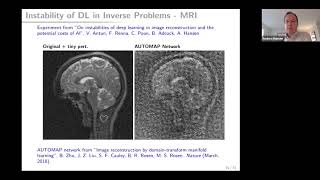
Foundations of Deep Learning and AI: Instabilities, Limitations, and Potential
Exploring deep learning's instability, AI limitations, and potential impacts on scientific computing and medical imaging. Compares AI's current state to early 20th-century mathematics, predicting similar foundational challenges.
The Unreasonable Effectiveness of Mathematics in Large Scale Deep Learning - Lecture 3
Explore the mathematical foundations of large-scale deep learning and their surprising effectiveness in this lecture by Greg Yang, delving into advanced concepts and cutting-edge research.

The Math Behind Attention Mechanisms
Demystify attention mechanisms in Transformer models through visuals, examples, and mathematical explanations, focusing on embeddings, similarity, and key-query-value matrices.
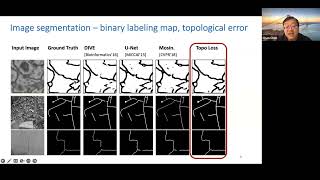
Topological Uncertainty and Representations for Biomedical Image Analysis
Innovative approach to biomedical image analysis using topological structures and uncertainty, enhancing segmentation accuracy and enabling interactive annotation for fine-scale delineation.