The Unreasonable Effectiveness of Mathematics in Large Scale Deep Learning - Lecture 2
Explore the mathematical foundations of large-scale deep learning and their surprising effectiveness in this lecture by Greg Yang, delving into advanced concepts and recent developments.
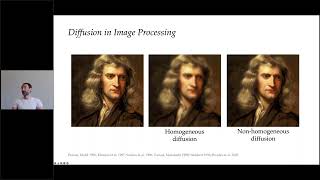
Physics-Inspired Learning on Graph - Michael Bronstein, PhD
Explore physics-inspired continuous learning models for graphs, challenging traditional message-passing paradigms. Discover new approaches using differential geometry, algebraic topology, and differential equations to revolutionize graph machine learning.
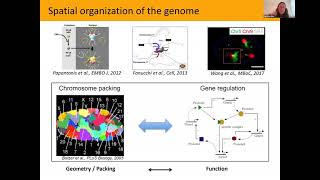
Mathematics of Genome Packing and Regulation
Explore the mathematics of genome organization and its impact on gene expression through geometric packing models and deep learning, with insights on 3D genome reconstruction and autoencoder applications in genomics.
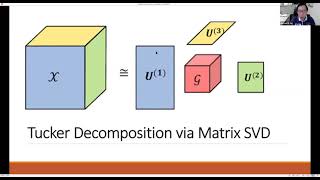
Low Rank Tensor Completion and Its Applications
Explore low rank tensor completion methods using framelet, dictionary coding, deep plug-and-play prior, and more. Gain insights into theoretical and numerical results for solving complex imaging problems.
Inverse Problems on Graphs with Geometric Deep Learning
Explores geometric deep learning for graph inverse problems, focusing on non-Euclidean geometries, physics-based approaches, and applications in particle physics and community detection.

Algorithmic Fairness and Individual Probabilities
Explore algorithmic fairness and the concept of individual probabilities, examining their implications for AI ethics and decision-making processes in machine learning applications.
Uncertainty Quantification with Physics-Informed Machine Learning
Exploring uncertainty quantification in physics-informed machine learning, focusing on architecture and learning approaches for scientific applications and complex real-world phenomena.
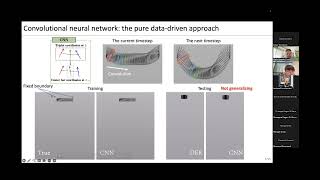
Promoting Data-Efficiency of Deep Learning for Dynamical Systems
Exploring data-efficient deep learning for dynamical systems using Euclidean symmetric neural networks, demonstrated on a 3D Slinky model for accelerated simulation and generalization.
The Curious World of Integral Polynumbers - Math Foundations 233
Explore integral polynumbers through particle physics concepts, expanding arithmetic to include integers as coefficients and exponents, and viewing polynomials as algebraic objects rather than functions.
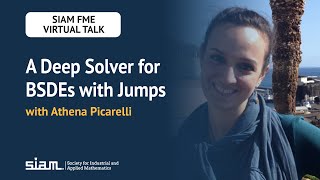
Deep Solver for Jumps in Backward Stochastic Differential Equations - Lecture
Innovative extension of deep solver for FBSDEs with jumps, using neural networks to tackle high-dimensional problems in option pricing and counterparty credit risk.
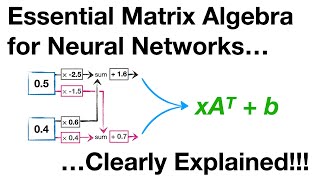
Essential Matrix Algebra for Neural Networks
Learn essential matrix algebra for neural networks, covering linear transformations, matrix operations, and their application in PyTorch and Attention mechanisms.
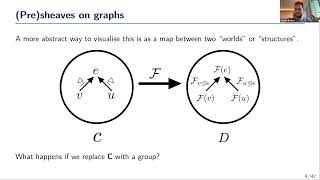
A Sheaf-based Approach to Graph Neural Networks
Explore sheaf theory's application to Graph Neural Networks, offering a novel perspective on Geometric Deep Learning beyond traditional geometric structures.
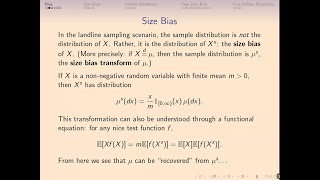
Classical and Free Zero Bias for Infinite Divisibility
Explore classical and free zero bias in infinite divisibility with Larry Goldstein, delving into probability theory and statistical concepts.
Weakly Supervised Causal Representation Learning
Explore weakly supervised causal representation learning, its theoretical foundations, and practical applications in disentangling causal variables from unstructured data like images for improved causal reasoning.
Linear Causal Representations from Interventions under General Nonlinear Mixing
Explore causal representation learning from latent interventions in nonlinear settings. Uncover geometric structures, analyze precision matrices, and evaluate a contrastive algorithm for identifying latent variables.
Likelihood Training of Schrödinger Bridge Using Forward-Backward SDEs Theory
Explore likelihood training of Schrödinger Bridge using Forward-Backward SDEs theory for deep generative modeling, offering mathematical flexibility and optimization principles.

Uncertainty Quantification and Deep Learning for Water-Hazard Prediction
Explore uncertainty quantification and deep learning techniques for predicting water hazards, focusing on storm surge impacts and urban infrastructure damage assessment.
Learning Geometry and 3D Symmetries - Day 1
Explore geometry and 3D symmetries in machine learning for drug discovery, covering key concepts like tensor products and network equivalence.

Identifying Representations for Intervention Extrapolation
Explore identifiable representations for intervention extrapolation, improving generalizability in machine learning. Learn theoretical foundations and practical applications through simulations and Q&A.

Graphs of Random Matrices in Deep Learning
Explore the intersection of random matrix theory and deep learning, focusing on graph structures and their implications for neural network performance and analysis.
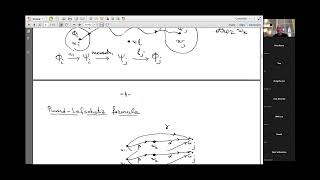
Resurgent Perverse Sheaves and Topological Resurgence Theory
Explore topological counterparts of resurgence theory using perverse sheaves on C as convolution algebras, extending beyond regular holonomic D-modules to infinitely singular cases.