
The Elusive Role of High Dimensions in Modern Optimization and Generalization
Delve into the fascinating role of high-dimensionality in deep learning optimization, exploring how modern neural networks challenge traditional theoretical constraints and achieve unprecedented success.

EfficientML.AI - Introduction to Efficient Machine Learning
Master efficient machine learning techniques and optimization strategies for deploying ML models in resource-constrained environments, focusing on practical implementation methods and performance enhancement.
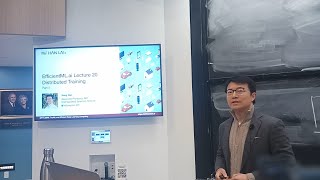
Distributed Training: Hybrid Parallelism and Gradient Optimization - Lecture 20
Delve into advanced distributed training concepts, exploring hybrid parallelism, gradient compression techniques, and strategies to overcome bandwidth and latency bottlenecks in ML systems.

Encoder-Only Transformers: Understanding BERT and RAG Architecture
Discover how encoder-only transformers power RAG, sentiment analysis, and classification through clear explanations of word embedding, positional encoding, and attention mechanisms.
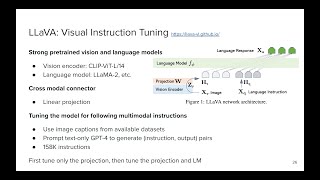
Vision and Language Large Language Models
Explore the intersection of vision and language in Large Language Models, understanding their capabilities, architectures, and real-world applications in AI systems.
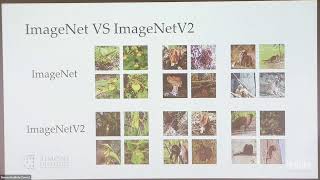
Language-Guided Domain Adaptation
Explore cutting-edge techniques in domain adaptation and language-guided methods with UC Berkeley expert Trevor Darrrell, focusing on advanced machine learning applications and methodologies.
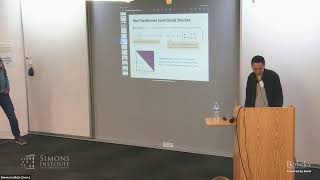
How Transformers Learn Causal Structure with Gradient Descent
Delve into the mathematical foundations of how transformer models learn and encode causal relationships through self-attention mechanisms and gradient-based training algorithms.
Exploiting Compositional Structure in Deep Learning - Theory and Applications
Delve into high-dimensional function modeling and deep learning applications for heart digital twins, exploring theoretical frameworks and practical implementations in medical risk prediction.
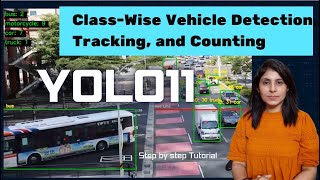
YOLOv11 for Real-Time Class-Wise Vehicle Counting and Tracking
Master real-time vehicle detection and tracking using YOLO11, implementing class-wise counting with BoT-SORT and ByteTrack algorithms for traffic analysis and smart city applications.

Build a Python AI Image Generator - Local Installation Guide
Learn to create a local AI image generator using Python, generating custom images with minimal code in just 15 minutes - no advanced programming skills needed.
Using LabVIEW and LoRa for Long-Distance Status and Control
Explore LoRa technology implementation in LabVIEW for IoT applications, focusing on long-range communication solutions and practical trade-offs in low-power systems.

Can I Hear Your Face? Pervasive Attack on Voice Authentication Systems with a Single Face Image
Explore how Foice deepfake technology generates synthetic voices from single facial images to breach voice authentication systems, demonstrating vulnerabilities in major security platforms.
VulSim: Leveraging Similarity of Multi-Dimensional Neighbor Embeddings for Vulnerability Detection
Explore advanced vulnerability detection techniques using multi-dimensional neighbor embeddings and deep learning models to enhance software security through improved pattern recognition and data analysis.
Differentially Private Diffusion Probabilistic Models for Image Synthesis
Explore how dp-promise leverages diffusion model noise to achieve differential privacy in image synthesis while maintaining high image quality and protecting sensitive training data.
Tossing in the Dark: Practical Bit-Flipping on Gray-box Deep Neural Networks for Runtime Trojan Injection
Explore practical bit-flipping techniques for runtime Trojan injection in deep neural networks, focusing on gray-box scenarios and innovative approaches to bypass memory protection systems.
Yes, One-Bit-Flip Matters! Universal DNN Model Inference Depletion with Runtime Code Fault Injection
Explore FrameFlip, a groundbreaking attack method that depletes DNN model inference through single-bit fault injections, demonstrating universal effectiveness across major machine learning frameworks.
PhishDecloaker: Detecting CAPTCHA-cloaked Phishing Websites via Hybrid Vision-based Interactive Models
Discover how PhishDecloaker uses AI and computer vision to detect CAPTCHA-protected phishing websites, improving detection rates from 0% to 74.25% and enhancing cybersecurity defenses.
Measuring Structural Limitations of Deepfake Media Datasets - A Systematic Review
Explore structural limitations in deepfake media datasets, examining metrics, generation techniques, and class distributions to understand their impact on detection systems and research reproducibility.
Neural Network Extraction Through Physical Side Channels - A Systematic Review
Explore physical side-channel analysis attacks on deep neural networks, examining threat models, attack methodologies, and practical limitations for model extraction and input recovery on hardware accelerators.

Learning Equivariant Non-Local Electron Density Functionals
Delve into advanced machine learning approaches for improving density functional theory through equivariant graph neural networks, focusing on non-local exchange-correlation functionals and molecular energy predictions.
Connecting the Dots: Biology at Scale in the Age of AI - Session 1
Explore cutting-edge AI applications in biological prediction models, featuring expert discussions on bridging computational and biological approaches to advance scientific discovery.