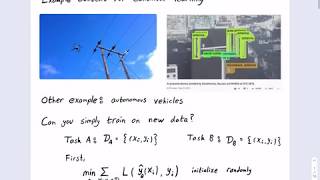
Continual Learning and Catastrophic Forgetting
Explore continual learning and catastrophic forgetting in deep neural networks, covering evaluation methods and algorithms based on regularization, dynamic architectures, and Complementary Learning Systems.
Real-Time Seizure Detection Using EEG - Hyewon Jeong
Comprehensive comparison of state-of-art models for real-time seizure detection using EEG, evaluating performance metrics and exploring optimal feature extractors for practical clinical applications.
Optimizing for Interpretability in Deep Neural Networks - Mike Wu
Explore techniques for making deep neural networks more interpretable through regularization, focusing on medical applications in critical care and HIV treatment. Insights on balancing model performance with human-understandable decision processes.
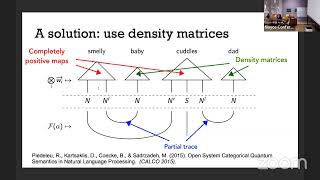
Compositionality in Vector Space Models of Meaning
Explore compositional structures in vector space models of meaning, focusing on deep neural networks, grammar, and role-filler bindings to understand language representation.
Explaining and Harnessing Adversarial Examples in Machine Learning - Spring 2021
Explore adversarial examples in machine learning, their impact on linear and non-linear models, and techniques like adversarial training to improve model robustness and generalization.
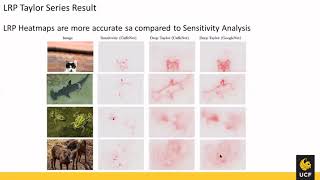
Unmasking Clever Hans Predictors and Assessing Machine Learning - Spring 2021
Unmasking clever predictors: Explore Layer-wise Relevance Propagation and SPRAY techniques to assess machine learning models' decision-making processes and identify potential biases or faults.
COMI: Correct and Mitigate Shortcut Learning Behavior in Deep Neural Networks
Explore techniques to correct and mitigate shortcut learning in deep neural networks, enhancing model robustness and generalization capabilities.

Shopping Recommendations at Pinterest
Explore Pinterest's shopping recommendation systems, including engagement-based and embedding-based candidate generation, indexing methods, and deep neural network ranking models.

Machine Learning Tools: Skyline and RL-Scope for Performance Optimization
Explore Skyline and RL-Scope, two innovative tools for optimizing machine learning performance. Learn about interactive profiling, visualization, and debugging for PyTorch networks and cross-stack profiling for deep reinforcement learning.
Multilayer Perceptron - Back Propagation in Neural Networks
This tutorial on "Multi-Layer Perceptron" will help you to master all the core concepts of multi layer perceptrons and deep neural networks.

Artificial Intelligence Tutorial for Beginners - AI Full Course
Keeping the importance of artificial intelligence in mind, we have come up with this full course on Artificial Intelligence.
Swift for TensorFlow - Google I/O 2019
Explore Swift for TensorFlow, a platform integrating deep neural networks with traditional software development. Learn its benefits for advanced machine learning research and why fast.ai chose it for their deep learning course.
Introduction to Transfer Learning
Explore transfer learning to adapt pre-trained networks for microscopy applications, enhancing accuracy with limited labeled data and reducing training time.
Understanding Deep Neural Networks - From Generalization to Interpretability
Explore deep neural networks, focusing on generalization and interpretability. Delve into graph convolutional networks, spectral filtering, and transferability. Examine fundamental questions and relevance mapping in machine learning.
Topos and Stacks for Understanding Semantic Functioning of Deep Neural Networks
Exploring topos theory and stacks to understand semantic functioning of deep neural networks, bridging advanced mathematics with AI for enhanced comprehension of machine learning processes.
Instalación de Nvidia Cudnn y Primeros Pasos con NVCC en C++
Aprende a instalar Cudnn, la biblioteca de redes neuronales profundas de CUDA, y comienza a desarrollar aplicaciones de aprendizaje automático con soporte GPU en C++.
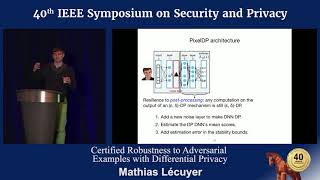
Certified Robustness to Adversarial Examples with Differential Privacy
Explore certified defense against adversarial examples using differential privacy. Scalable solution for large networks and datasets, providing robustness guarantees for various model types.
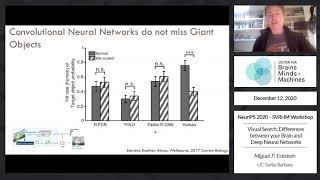
Visual Search - Differences Between Your Brain and Deep Neural Networks
Explore how human visual perception differs from deep neural networks, examining experiments, results, and implications for fields like medical imaging.
Big Data in Cybersecurity - Day 1 Academic Sessions
Explore offensive OSINT, multimedia cybersecurity, persistent tracking, and deep neural networks in this comprehensive academic session on cutting-edge cybersecurity topics.
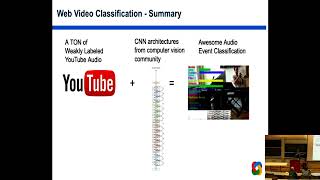
Recognizing Sound Events - 2019
Explore deep neural networks for sound classification, covering speech, music, and environmental sounds. Learn about AudioSet ontology and applications in bioacoustics and cross-modal learning.
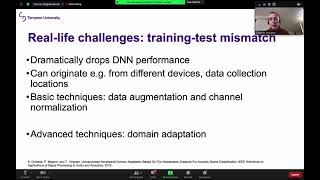
Computational Analysis of Sound Scenes - 2020
Explore computational sound scene analysis, covering tasks from basic classification to advanced localization and captioning, with deep learning techniques and data requirements.