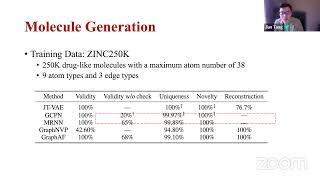
Geometric Deep Learning for Drug Discovery
Explore geometric deep learning techniques for drug discovery, covering graph neural networks, molecule generation, and retrosynthetic prediction. Gain insights into cutting-edge research and applications in pharmaceutical development.
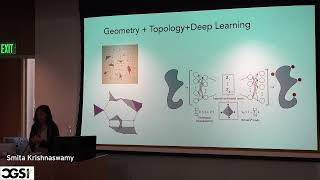
Uncovering Cellular Dynamics and Metabolism with Geometric Deep Learning and Optimal Transport
Explore geometric deep learning and optimal transport techniques for uncovering cellular dynamics and metabolism in this insightful computational genomics presentation.
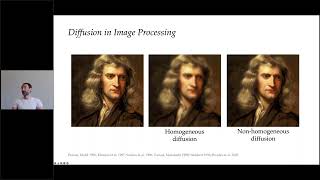
Physics-Inspired Learning on Graph - Michael Bronstein, PhD
Explore physics-inspired continuous learning models for graphs, challenging traditional message-passing paradigms. Discover new approaches using differential geometry, algebraic topology, and differential equations to revolutionize graph machine learning.
Inverse Problems on Graphs with Geometric Deep Learning
Explores geometric deep learning for graph inverse problems, focusing on non-Euclidean geometries, physics-based approaches, and applications in particle physics and community detection.
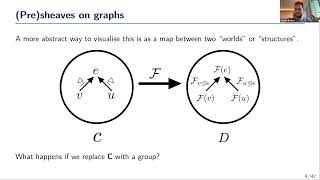
A Sheaf-based Approach to Graph Neural Networks
Explore sheaf theory's application to Graph Neural Networks, offering a novel perspective on Geometric Deep Learning beyond traditional geometric structures.
Towards Foundation Models for Graphs
Explore cutting-edge research on foundation models for graph data structures, examining their potential applications and implications for AI and machine learning.
Detection of Objects in Cryo-Electron Micrographs Using Geometric Deep Learning
Explore geometric deep learning techniques for object detection and segmentation in cryo-electron micrographs, focusing on unsupervised methods and graph-based transformers for complex structures.
Geometric Deep Learning Framework for De Novo Genome Assembly
Explore a novel geometric deep learning framework for de novo genome assembly, enhancing path identification in complex assembly graphs for improved genomic sequence reconstruction.

gRNAde: Geometric Deep Learning for 3D RNA Inverse Design
Explore gRNAde, a geometric deep learning pipeline for 3D RNA inverse design. Learn about its architecture, use cases, and advantages over traditional methods in RNA sequence design.

Distributed Mesh Processing and Geometric Deep Learning for Wind Prediction
Discover how Ray's distributed computing powers real-time wind prediction in urban design through mesh processing, geometric deep learning, and CFD data analysis for architectural innovation.
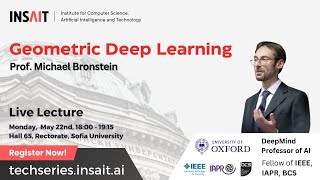
Geometric Deep Learning
Dive into geometric deep learning principles and advanced mathematical concepts with Prof. Michael Bronstein's comprehensive exploration of this cutting-edge field in artificial intelligence.
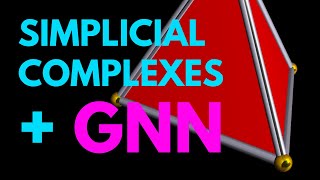
Topological Message Passing: From Graph Neural Networks to Simplicial Complexes on CW Networks
Delve into advanced Graph Neural Network concepts, exploring topological message passing, simplicial complexes, and high-dimensional interactions for computational graph networks and molecular design applications.
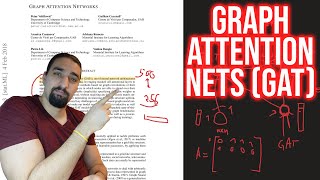
Graph Attention Networks - GNN Paper Explained
Explore Graph Attention Networks (GAT) in-depth, covering graph theory basics, GAT methodology, multi-head versions, visualizations, and applications in transductive/inductive learning scenarios.
Harnessing Geometric ML for Molecular Design - Day 3
Explore geometric machine learning techniques for innovative molecular design in drug discovery with expert Michael Bronstein.
Geometric Deep Learning for Protein Understanding
Explore geometric deep learning techniques for protein analysis and understanding, focusing on advanced computational methods in molecular biology.

Contextual AI Models for Single-cell Protein Biology
Explore PINNACLE, a geometric deep learning approach generating context-aware protein representations for enhanced understanding of protein function and interactions across biological contexts.
A New Perspective on Building Efficient and Expressive 3D Equivariant Graph Neural Networks
Explore advanced techniques for building efficient 3D equivariant graph neural networks, focusing on local substructure encoding and frame transition encoding for improved expressiveness and performance.
Is Distance Matrix Enough for Geometric Deep Learning?
Explore geometric deep learning limitations and k-DisGNNs' potential in capturing high-order geometric information, unifying models, and achieving universal function approximation for geometric graphs.
Practical Geometric Deep Learning in Python
Explore Geometric Deep Learning with StellarGraph, an open-source Python library for network-structured data analysis. Learn its applications, design philosophy, and implementation in real-world scenarios.
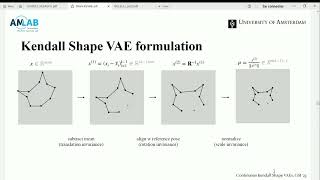
Continuous Kendall Shape Variational Autoencoders
Explore unsupervised learning of geometric representations using equivariant VAEs with hyperspherical latents, extending Kendall-shape VAEs for improved representation capacity.
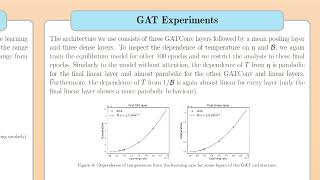
Geometric Deep Learning: A Temperature-Based Analysis of Graph Neural Networks
Explore graph neural networks through temperature-based analysis in geometric deep learning, uncovering insights into their behavior and performance.