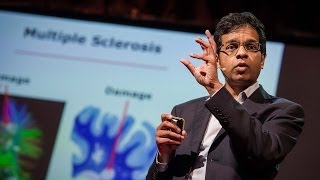
Can the Damaged Brain Repair Itself?
Explore new techniques using stem cells to accelerate brain repair after trauma and in degenerative conditions like ALS, offering hope for faster recovery and improved treatment options.
The Case for Engineering Our Food
Explore genetic engineering's role in enhancing food security through Pamela Ronald's research on flood-resistant rice and the successful preservation of Hawaiian papaya crops.

Why We Laugh
Explore the science of laughter with cognitive neuroscientist Sophie Scott, uncovering surprising facts and insights into this universal human behavior in a fast-paced, entertaining presentation.
How Mars Might Hold the Secret to the Origin of Life
Explore the search for microbial life on Mars through Earth's extreme environments. Learn how studying microbes in Andean lakes could reveal clues about potential life on ancient Mars and its evolutionary pathways.

How Our Microbes Make Us Who We Are
Explore the crucial role of microbes in human health and identity. Discover how these tiny organisms impact our well-being more significantly than our genes, offering new perspectives on personal and medical care.

Brain-to-Brain Communication Has Arrived - How We Did It
Neuroscientist explores brain-to-brain communication, showcasing groundbreaking experiments with rats and monkeys, pushing the boundaries of neural interfaces and mind-to-mind interaction.

A Neural Portrait of the Human Mind
Explore brain imaging insights with fMRI pioneer Nancy Kanwisher, uncovering specialized components and general-purpose machinery in the human brain, while highlighting the vast potential for future discoveries.
Craig Venter Unveils Synthetic Life
Groundbreaking announcement of the first fully functioning cell controlled by synthetic DNA, marking a new era in scientific research and potential applications in biotechnology.
Glimpses of a Pristine Ocean
Discover how no-take marine reserves can replenish our oceans, offering powerful ecological and economic benefits for a sustainable future.

How We Wrecked the Ocean
Coral reef ecologist reveals shocking state of overfished, overheated, and polluted oceans, presenting astonishing photos and statistics to illustrate the dire situation and future implications.
How Brains Learn to See
Groundbreaking research on brain's visual development: treating children born blind and studying how their brains interpret visual data, offering insights into neuroscience, engineering, and autism.

Growing New Organs
Explore groundbreaking lab techniques for growing human organs, from muscles to bladders. Witness cutting-edge bioengineering tools like bioreactors and tissue-printing machines in action.

Experiments That Point to a New Understanding of Cancer
Groundbreaking research challenges conventional cancer theories, revealing the crucial role of cellular microenvironment in tumor development through key experiments and innovative perspectives.

Moral Behavior in Animals
Explore surprising evidence of empathy, cooperation, and fairness in primates and mammals, challenging our understanding of moral traits as uniquely human.
Finding Life We Can't Imagine
Explore innovative approaches to detecting alien life using artificial life research and biomarkers, challenging traditional assumptions about extraterrestrial existence.

Making Matter Come Alive
Explore the possibility of creating inorganic life through chemical evolution, challenging traditional views on the origin and nature of living systems.
DNA Clues to Our Inner Neanderthal
Geneticist reveals DNA evidence of human-Neanderthal interbreeding and identifies new humanoid species through innovative analysis of a tiny bone fragment.

The Surprising Math of Cities and Corporations
Discover how simple mathematical laws govern cities' properties, from wealth to crime rates, based on population size. Explore similar patterns in organisms and corporations.
Building a Dinosaur from a Chicken
Paleontologist Jack Horner discusses his innovative approach to reconstructing dinosaurs by genetically engineering chickens to reactivate ancestral traits like teeth, tails, and hands.

A Light Switch for Neurons
Innovative neuroscience technique using light-sensitive proteins to control brain cells, offering potential treatments for PTSD and blindness, with implications for neural prosthetics.

Understanding Cancer Through Proteomics
Danny Hillis explores proteomics as the next frontier in cancer research, explaining how studying proteins in the body can lead to new insights into cancer development and potential treatments.