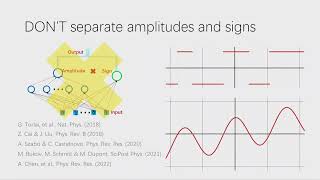
Empowering Deep Neural Quantum States Through Efficient Optimization
Explore efficient optimization techniques for deep neural quantum states, enhancing their power and performance in quantum systems modeling.

Mechanisms of Deep Learning in the Brain
Explore mechanisms of deep learning in the brain with Oxford researcher Rafal Bogacz in this insightful seminar from Imperial College London.
Multimodal Deep Learning for Protein Engineering
Explore multimodal deep learning for protein engineering, covering sequence-based models, structural approaches, and biophysical features to predict and generate functional proteins.
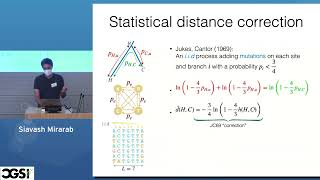
Distance-Based Phylogenetics: Past, Present, and Future - CGSI 2022
Explore distance-based phylogenetics' evolution, from theoretical foundations to cutting-edge applications in ecological sample identification and deep learning for phylogenetic placement.
Structured State-Space Sequence Models for De Novo Drug Design
Explore the potential of Structured State-Space Sequence (S4) models in advancing chemical language modeling for de novo drug design, including bioactive compound identification and natural product design.

Generalized Biomolecular Modeling and Design with RoseTTAFold All-Atom
Explore advanced biomolecular modeling using RoseTTAFold All-Atom. Learn to predict and design complex biological assemblies, including proteins, nucleic acids, and small molecules, with applications in drug discovery and synthetic biology.
PepFlow: Direct Conformational Sampling From Peptide Energy Landscapes
Explore PepFlow, a deep learning approach for direct conformational sampling of peptides. Learn about its modular design, hypernetwork integration, and applications in drug discovery.

Geometric Deep Learning Framework for De Novo Genome Assembly
Explore a novel geometric deep learning framework for de novo genome assembly, enhancing path identification in complex assembly graphs for improved genomic sequence reconstruction.

OpenFold: Lessons Learned and Insights from Rebuilding and Retraining AlphaFold2
Explore insights from rebuilding AlphaFold2, including performance analysis, learning mechanisms, and current progress in protein structure prediction.
Chemically Transferable Generative Backmapping of Coarse-Grained Proteins
Explore innovative machine learning techniques for generative backmapping of coarse-grained proteins, focusing on transferability, reliability, and efficiency in molecular simulations.
Differentiable Simulations for Enhanced Sampling of Rare Events
Explore deep learning applications in molecular simulations, including surrogate functions, sampling complex distributions, and time-propagation of differential equations. Learn about active learning, generative models, and reaction path finding.

DiffDock: Diffusion Steps, Twists, and Turns for Molecular Docking
Explore DiffDock, a novel diffusion-based approach to molecular docking that outperforms traditional and deep learning methods in predicting ligand-protein binding structures for drug design.
Equivariant 3D-Conditional Diffusion Models for Molecular Linker Design
Explore equivariant 3D-conditional diffusion models for molecular linker design in drug discovery. Learn about DiffLinker's innovative approach to connecting multiple fragments and its applications in real-world scenarios.
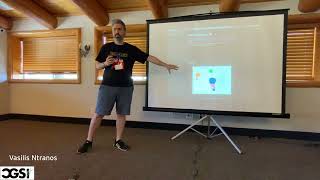
Genome-wide Prediction of Disease Variants with a Deep Protein Language Model
Explore genome-wide prediction of disease variants using deep protein language models. Learn cutting-edge techniques for identifying potential genetic causes of diseases.
Predicting the Epigenome from DNA Sequence - Are We There Yet?
Explore predicting epigenomes from DNA sequences using deep learning methods. Discover limitations, data analysis techniques, and latest research in computational genomics.
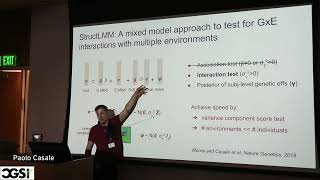
Mixed Models in Genomic Analyses and Imaging Studies
Explore mixed models in genomics and imaging, focusing on efficient set tests, Gaussian process priors, gene-environment interactions, and neural networks for histologic feature quantification.
Designing DNA with Tunable Regulatory Activity Using Discrete Diffusion
Explore DNA Discrete Diffusion (D3) for engineering regulatory DNA sequences with targeted functional activity levels. Learn about its advantages, evaluation metrics, and applications in functional genomics.

gRNAde: Geometric Deep Learning for 3D RNA Inverse Design
Explore gRNAde, a geometric deep learning pipeline for 3D RNA inverse design. Learn about its architecture, use cases, and advantages over traditional methods in RNA sequence design.
EquiReact: An Equivariant Neural Network for Chemical Reactions
Explore EquiReact, an equivariant neural network for predicting chemical reaction properties using 3D structures. Learn its advantages in flexibility, extrapolation, and data efficiency.
HyperPCM: Robust Task-Conditioned Modeling of Drug-Target Interactions
Explore HyperPCM, a robust method for predicting drug-target interactions using hypernetworks. Learn about its state-of-the-art performance on benchmarks and excellence in zero-shot inference for unseen protein targets.

MFBind - A Multi-Fidelity Approach for Evaluating Drugs in Generative Modeling
Explore MFBind, a multi-fidelity approach integrating docking and binding free energy simulations for improved drug discovery generative modeling. Learn its advantages over current methods.