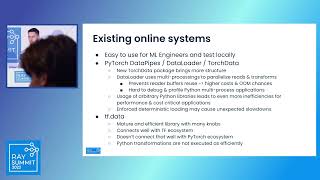
Cruise.data - A New Dataset Processing Pipeline for Cruise ML
Explore Cruise.data, a novel ML data pre-processing framework combining tf.data, PyTorch, and large-scale processing capabilities for efficient and scalable dataset handling in autonomous vehicle development.
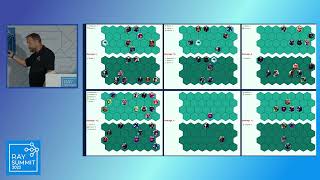
Large-Scale Deep Learning to Augment Production RL Workloads at Riot Games
Learn to leverage large-scale deep learning for building game bots, predicting outcomes, and optimizing training processes in game development. Explore supervised learning techniques and scaling with Ray tools.
Fast LLM Serving with vLLM and PagedAttention
Explore vLLM, an open-source library for fast LLM inference using PagedAttention. Learn how it achieves higher throughput and its implementation for efficient AI model serving.

Understanding the Landscape of Latest Large ML Models
Explore the evolving landscape of large ML models, from ChatGPT to open-source projects. Learn how teams use W&B to accelerate development and stay ahead in the rapidly advancing field of AI.

Large Scale Pathways Recommender Systems (PaRS) at Verizon
Explore Verizon's innovative multi-task learning recommender system, PaRS, leveraging Ray ecosystem to enhance customer experience through deep learning and efficient large-scale model training.
Ray Train: A Production-Ready Library for Distributed Deep Learning
Explore Ray Train's architecture for efficient, cost-effective distributed deep learning. Learn about resource scheduling, API simplicity, and exclusive features for LLM training, including Distributed Checkpointing.

Fast and Scalable Model Training with PyTorch and Ray
Learn distributed model training with PyTorch and Ray. Migrate code, scale AI workflows, and optimize performance for large-scale training and fine-tuning on Anyscale.
Interpreting Deep Neural Networks Towards Trustworthiness
Explore methods for interpreting neural networks, including contextual decomposition and adaptive wavelet distillation, to enhance model trustworthiness and performance.
The New Era of Image Denoising
Explore revolutionary image denoising techniques, their applications in inverse problems, and the concept of diverse solutions in image processing.
Geometry, Topology and Discrete Symmetries Revealed by Deep Neural Networks
Explore deep neural networks' ability to reveal geometry, topology, and discrete symmetries in manifolds. Learn about universal approximators and their applications in inverse problems and group actions.

A Path Towards Autonomous Machine Intelligence
Explore Yann LeCun's vision for autonomous machine intelligence, delving into cutting-edge AI concepts and potential future developments in the field.

Rapture of the Deep: Highs and Lows of Sparsity in Neural Networks
Explore sparsity in neural networks, its role in interpretability, and innovative optimization techniques beyond gradient descent for learning fast transforms.
Advanced Computational Imaging - Chassez le Naturel, Il Revient au Galop
Explorez les avancées en imagerie computationnelle, en mettant l'accent sur la stabilité et la fiabilité des réseaux neuronaux profonds pour la reconstruction d'images biomédicales.
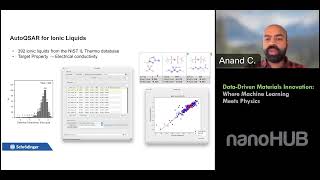
Data-Driven Materials Innovation: Where Machine Learning Meets Physics
Explore how machine learning and physics-based methods synergize to revolutionize materials science, addressing challenges in data-driven design across various technology fields with Schrödinger's innovative tools.
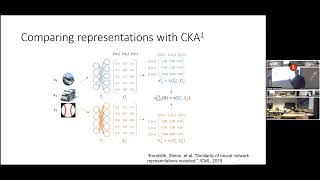
Comparing Representations Learned by Neural Networks - Deconfounded Similarity Measures
Explore improved methods for comparing neural network representations, addressing data structure confounding and enhancing functional similarity identification in transfer learning and out-of-distribution scenarios.
Elucidating the Design Space of Diffusion-Based Generative Models
Explore advancements in diffusion-based generative models, including improved sampling, training, and score network preconditioning. Learn about state-of-the-art results and modular design changes for enhanced efficiency and quality.
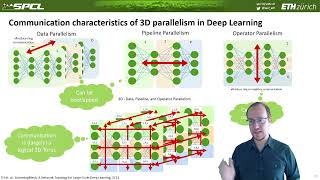
Post-Moore Spatial Computing: From Chips to Clusters
Explore spatial computing strategies for post-Moore's Law era, addressing challenges in scaling compute power from chips to clusters for AI and high-performance computing.
Next-Generation Networks for Machine Learning
Explore next-gen networks for machine learning, focusing on optical fabrics and scheduling techniques to accelerate distributed DNN training workloads and overcome datacenter network bottlenecks.
HPC and AI/ML: A Synergistic Relationship
Explore synergies between HPC and AI/ML, focusing on scalable algorithms, efficient resource use, and data-driven models for performance optimization in large-scale computing environments.
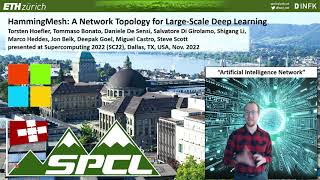
HammingMesh: A Network Topology for Large-Scale Deep Learning
Explore a novel network topology for large-scale deep learning systems, enhancing data movement efficiency and job scheduling flexibility for future AI training infrastructure.
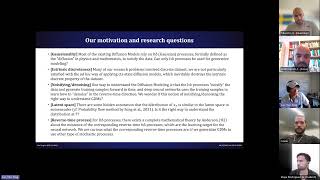
Blackout Diffusion: Generative Diffusion Models in Discrete-State Spaces
Explore generative diffusion models in discrete-state spaces through the innovative Blackout Diffusion approach, presented by researcher Yen Ting Lin.