Uber's Michelangelo: Strategic AI Overhaul and Impact - MLOps Podcast
Explore Uber's Michelangelo platform evolution, from basic ML predictions to advanced deep learning and generative AI, addressing challenges and introducing innovative features for streamlined AI operations.

Reliable LLM Products Fueled by Feedback - MLOps Podcast #251
Explore user-centric approaches for reliable LLM products. Learn to convert feedback into actionable insights, analyze root causes, and optimize AI solutions for real-world deployment across various industries.
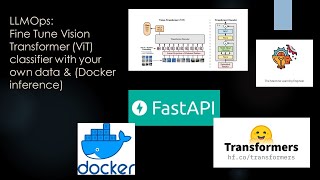
Fine-Tuning ViT Classifier with Custom Data and Docker Inference - Part 4
Fine-tune a ViT classifier with custom data and deploy using Docker and FastAPI for efficient image classification in production environments.
DALL-E and Stability.AI: Text-to-Image Models for Data Science and Machine Learning
Explore DALL-E and Stability.AI text-to-image models, learning to generate, edit, and save AI-created images using practical notebooks and hands-on examples.
MLOps MLflow: Deep Learning Frameworks - PyTorch and TensorFlow Integration
Explore integrating deep learning frameworks Pytorch and Tensorflow with MLflow for enhanced model management and tracking.
Embracing Exciting Times of Technological Evolution - Insights from LexisNexis Risk Solutions
Explore technological evolution with Flavio Villanustre, covering AI, quantum computing, and big data. Gain insights on innovation, ethical considerations, and future trends in this comprehensive overview.
Cooperative Data-driven Modeling: Addressing Catastrophic Forgetting in Neural Networks
Explore cooperative data-driven modeling techniques to address catastrophic forgetting in deep neural networks for class-incremental learning scenarios.
Foundation Models for Materials Discovery
Explore foundation models for materials discovery, focusing on their applications and potential in advancing scientific research and innovation.
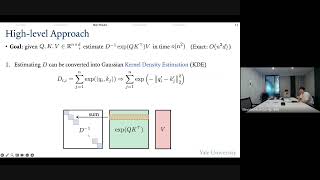
Accelerating Transformers via Kernel Density Estimation - Google TechTalk
Explore efficient Transformer acceleration using kernel density estimation. Learn innovative techniques for handling long sequences and improving performance in deep learning models.
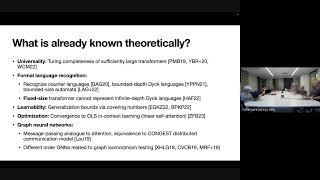
Representational Strengths and Limitations of Transformers
Explore the mathematical analysis of attention layers in transformers, comparing their representation power to other architectures and examining complexity parameters in various tasks.
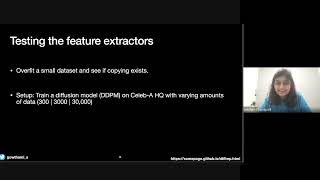
Understanding and Mitigating Copying in Diffusion Models
Explore frameworks for detecting replication in diffusion models, identify memorization factors, and learn techniques to reduce data replication during training and inference.
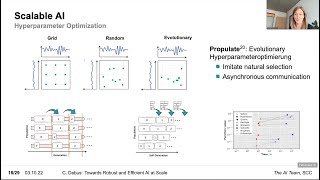
Towards Robust and Efficient AI at Scale
Explore robust, efficient AI for scientific time series forecasting. Learn scalable transformer architectures, energy optimization, and balancing performance with sustainability in large-scale AI applications.
DGEMM on Integer Tensor Cores - NHR Perflab Seminar
Explore double-precision matrix multiplication using Int8 Tensor Cores and the Ozaki scheme, focusing on high-precision computation with lower-precision hardware for machine learning applications.
Mixing Precisions in Numerical Algorithms - HPC Perspective with Modern Hardware Context
Explore mixed precision algorithms in HPC, focusing on convergence properties and performance considerations for modern hardware implementations of floating-point arithmetic.
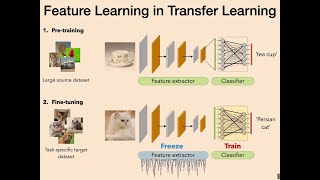
Foundations for Feature Learning via Gradient Descent
Explore the theoretical foundations of feature learning in modern machine learning models, focusing on gradient descent's role in extracting useful features and representations from data.
History of Language Models: Evolution, Frameworks, and Deployment
Explore language models' evolution from early systems to neural networks, transformers, and large-scale pretraining. Gain insights on key frameworks and real-world deployment strategies.
Overview of Image Segmentation with AI
Explore AI-powered image segmentation techniques, from basic concepts to advanced deep learning structures, and learn steps to create effective models for object identification and edge detection.
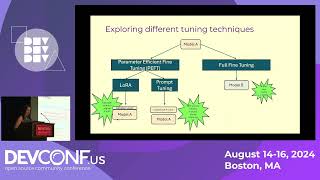
Creating Your Own LLM Tuning Platform with Open Source Technologies
Explore open-source LLM tuning techniques using FMS HF Tuning. Learn architectural integration, various tuning methods, and deployment on Open Data Hub for enhanced AI solutions.
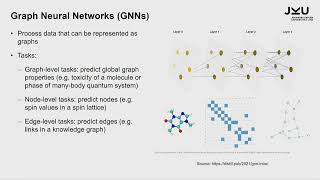
Deep Learning for Quantum Physics and Astronomy
Explore deep learning applications in quantum physics and astronomy, uncovering innovative techniques for data analysis and scientific discovery.
Introduction to Artificial Intelligence: Deep Neural Networks - Lecture 19
Explore deep neural networks, edge detection, and reinforcement learning in AI, with applications to games and image processing.
Introduction to Deep Neural Networks - Lecture 21
Explore deep neural networks, their architecture, and applications in AI. Learn key concepts and techniques for implementing advanced machine learning models.