
Convolutional Neural Networks
Explore convolutional neural networks for computer vision, covering feature extraction, convolution operations, and applications like object detection and self-driving cars.
Introduction to Deep Learning
Comprehensive introduction to deep learning fundamentals, covering perceptrons, neural networks, loss functions, gradient descent, backpropagation, and regularization techniques for building effective models.
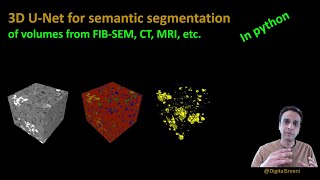
3D U-Net for Semantic Segmentation
Learn to implement 3D U-Net for semantic segmentation on volumetric data like FIB-SEM, CT, and MRI. Covers data preparation, model architecture, training, and multichannel image processing using Python libraries.
MIT: Neural Rendering
Explore neural rendering techniques, from forward and inverse rendering to 3D data representations, with insights on RenderNet, neural point-based graphics, and HoloGAN in this comprehensive lecture.

Neurosymbolic AI
Explore neurosymbolic AI, combining deep learning and symbolic reasoning to address limitations in current AI systems. Learn about out-of-distribution performance, adversarial examples, and advantages of hybrid approaches.
Deep Learning New Frontiers
Explore deep learning limitations and new frontiers, including expressivity, generalization, adversarial attacks, uncertainty, and AutoML. Gain insights into cutting-edge developments in neural networks.

Reinforcement Learning
Explore deep reinforcement learning concepts, from Q-functions to policy gradients, with applications in Atari games, real-world scenarios, and groundbreaking AI like AlphaGo.

Multi-Class Language Classification With BERT in TensorFlow
Learn to build a multi-class language classification model using BERT and TensorFlow. Covers data preprocessing, model architecture, training, and prediction with transformers for NLP tasks.
Build and Deploy Production Ready PyTorch Models
Explore Azure Machine Learning for PyTorch model lifecycle management, from data handling to deployment on Kubernetes, emphasizing scalability and production readiness.
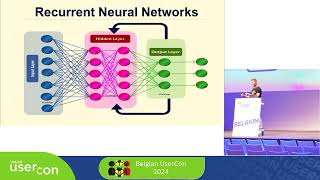
Building Cost-Effective Homelabs for AI Workloads - A Practical Guide
Discover practical insights for building budget-friendly AI homelabs, from hardware choices to workflow optimization. Learn from 7 years of hands-on experience in running AI workloads efficiently at home.

Is There a Place for Representation Learning in Generative AI?
Explore the intersection of Deep Learning, Representation Learning, and Generative AI, examining their relationships and potential synergies in advancing AI technology.

Weather Forecasting Using Deep Learning - A Paradigm Shift with MetNet-3
Explore neural network-based weather forecasting with MetNet-3, revolutionizing traditional methods for improved accuracy and reliability across various sectors.

Divide (or Convolve) and Conquer: Data Comparison with Wiener Filters
Explore Wiener filters for data comparison in machine learning, enhancing image reconstruction and translation robustness in various applications like compression and generative modeling.

Neuromancer: Differentiable Programming Library for Data-driven Modeling and Control
Explore NeuroMANCER, an open-source library for integrating machine learning with scientific computing, solving optimization problems, and creating differentiable models with physics-based constraints.

Towards Better Understanding of Contrastive Learning
Explore contrastive learning's foundations, dynamics, and applications in deep models. Gain insights into self-supervised learning, nonlinear analysis, and feature emergence through expert presentation.

Storage Policy in Continual Learning: Different Approaches for Different Scenarios
Explore storage policies in continual learning, focusing on replay-based approaches, consistency-aware sampling, and class incremental learning with repetition for adaptive AI systems.
Accelerate PyTorch Workloads with PyTorch/XLA
Optimize PyTorch performance on Google Cloud AI Accelerators using XLA compiler. Learn about high-speed training and inference for LLaMA 2 and LLM fine-tuning with PyTorch Lightning.
Workload-Optimized and AI-Powered Infrastructure for Google Cloud
Optimize AI workloads and enterprise applications with purpose-built infrastructure. Learn about supercomputing innovations, TPUs, GPUs, and AI-powered assistance for efficient operations.
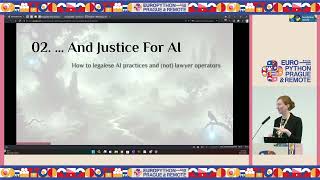
... and Justice for AI - Understanding the European AI Act
Explore the European AI Act's impact on developers, focusing on ethical AI systems, regulatory compliance, and protecting fundamental rights while fostering innovation.
Attention with Linear Biases Explained
Explore attention mechanisms with linear biases in transformer models, enabling efficient extrapolation to longer sequences without explicit positional embeddings.
LoRA Explained - Efficient Fine-Tuning of Large Language Models
Explore LoRA, a technique for efficient fine-tuning of large language models. Learn about its low-rank matrix decompositions and reduced trainable parameters for task-specific adaptations.