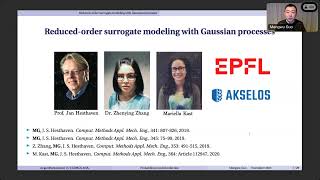
Probabilistic Methods for Data-Driven Reduced-Order Modeling
Explore probabilistic methods for data-driven reduced-order modeling, including Gaussian process regression, deep kernel learning, and Bayesian reduced-order operator inference for efficient multi-query simulations and digital twinning.
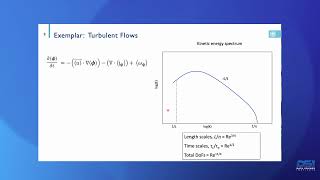
Higher-Order Multi-Variate Statistics for Scientific Data Analysis
Explore advanced multi-variate statistical techniques for scientific data analysis, focusing on higher-order methods like coskewness and cokurtosis for rare event detection and dimensionality reduction in complex systems.
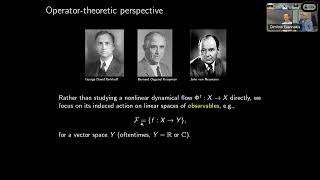
Quantum Information and Data Science for Modeling Classical Dynamics
Explore quantum information and data science approaches for modeling classical dynamics, focusing on operator-theoretic techniques and their applications in dynamical systems and climate modeling.
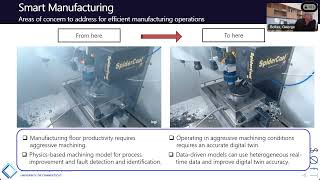
Physics Informed Machine Learning through Symbolic Regression
Explore symbolic regression for identifying PDE models from scarce, noisy data. Compare with Physics-Informed Neural Networks and discuss applications in fault detection and system health prognostics.
Ascent: In Situ Visualization and Analysis for HPC Simulations - Tutorial 2024
Learn to use Ascent, an open-source in situ visualization and analysis tool for HPC simulations. Explore its capabilities for multi-physics applications on many-core architectures.
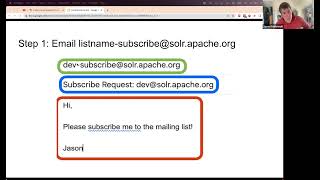
Contributing to Apache Solr - Session 1
Learn how to contribute to Apache Solr with guidance from experienced committers. Explore the contribution process, best practices, and ways to get involved in this open-source search engine project.

Solr v1 and v2 APIs - Solr Bootcamp Session 2
Explore Solr v1 and v2 APIs with Solr committers, learning how to contribute to Apache Solr and understanding the differences between API versions.
Contributing to Apache Solr - Session 1
Learn how to contribute to Apache Solr with guidance from experienced committers. Explore the contribution process, best practices, and ways to get involved in this open-source search engine project.
Lightning Talks on Search Relevance and AI - Haystack US 2024
Explore cutting-edge search and AI topics through lightning talks from Haystack US 2024. Gain insights on information retrieval, LLMs, vector search, semantic search, and more from industry experts.

Multimodal Generative AI: Technology Overview and Business Implications
Explore multimodal generative AI's technology, business applications, and limitations. Gain insights into training, costs, and open-source systems like LLaVA for text, image, and audio processing.
Productionising Data Science
Explore techniques for creating data pipelines, productionizing data science, and operationalizing machine learning with insights from experienced engineers.
Advanced Techniques for Online Advertisement Spend Optimization
Explore advanced techniques for optimizing online ad spend using Reinforcement Learning, Bayesian statistics, and Thompson sampling to improve budget allocation and maximize returns.
To See or Not to See - Is AI at Its Best When People Know It's There?
Explore the ethical implications of AI transparency in online services, examining strategies from Reddit's open-source approach to Google's partial disclosure and their impact on user trust and engagement.
From Zero to Data Hero - Take Raw Data to Curated Data in Under 90 Minutes
Discover how to efficiently manage, process, and clean data using low-code tools. Learn to connect Apache Spark, Databricks, and TimeXtender for rapid data curation and confident decision-making.
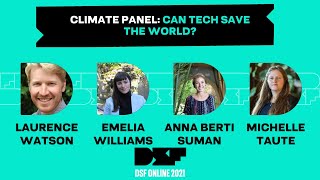
Climate Panel: Can Tech Save the World? - Lightning Talks on Climate Data and Action
Explore innovative approaches to leveraging climate data for effective action. Learn about improving data access, treating environmental data as a public good, civic monitoring challenges, and accelerating building decarbonization through actionable insi…

Introduction to Data Exploration Using Microsoft Excel
Explore data using Excel: Learn importing, cleaning, basic functions, and statistical analyses for valuable insights from a Mars Petcare Data Engineer.
Introduction to Machine Learning - Clustering - Part 3
Explore clustering in machine learning, focusing on k-means and hierarchical algorithms. Learn to uncover data relationships and apply techniques with practical considerations.
Introduction to Python Libraries and Algorithms for Machine Learning
Explore Python libraries and algorithms for machine learning, covering regression, clustering, and classification using popular tools like Pandas.
Python 101 - Introduction to Python for Data Science
Learn Python basics for data science: explore versatile programming tools, efficient data computation, and knowledge extraction techniques.
Advanced Python Libraries for Data Science
Explore advanced Python libraries for data science, focusing on scikit-learn, TensorFlow, and PyTorch Geometric. Learn implementation, methodologies, and practical applications through code exercises.
Advanced SQL Techniques for Data Science
Expand SQL knowledge with complex conditions, functions, joins, and data engineering concepts. Learn from Facebook's Data Engineering Manager in this advanced session.