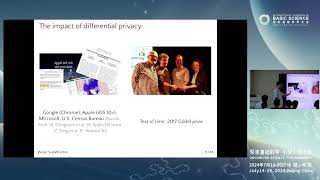
Gaussian Differential Privacy
探索高斯差分隐私:一种新的隐私保护方法,提供更精确的组合分析和子采样隐私放大,并通过中心极限定理证明其在组合下的收敛性。
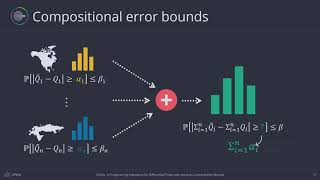
A Programming Framework for Differential Privacy with Accuracy Concentration Bounds
Explore a programming framework for differential privacy, balancing data protection and analysis accuracy through novel static tracking and taint analysis techniques.
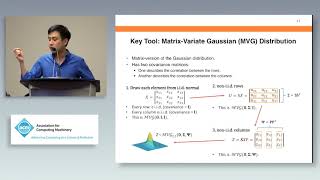
MVG Mechanism - Differential Privacy under Matrix-Valued Query
Explore a novel differential privacy mechanism for matrix-valued queries, addressing challenges in data protection and improving upon existing methods.
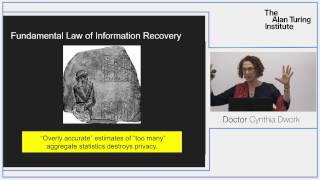
Turing Lecture - Dr Cynthia Dwork, Privacy-Preserving Data Analysis
Explore differential privacy and its role in protecting data during complex analysis. Learn about the risks of data accumulation and solutions for privacy-preserving statistical analysis of large datasets.
Utility Analysis for Differentially-Private Pipelines
Explore a methodology for estimating differential privacy's impact on data quality, aiding informed decision-making in implementing privacy-preserving pipelines.
The Promise of Differential Privacy
Explore differential privacy's role in addressing false discoveries and privacy risks in big data analysis. Learn theoretical foundations and practical applications.
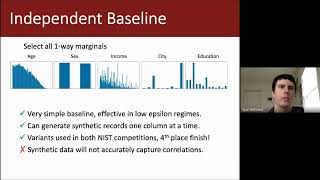
Marginal-based Methods for Differentially Private Synthetic Data - Differential Privacy for ML Series
Explore marginal-based methods for generating differentially private synthetic data, covering mechanisms, selection algorithms, and empirical findings.

The Structure of Optimal Private Tests for Simple Hypotheses
Explore optimal private tests for simple hypotheses, examining their structure and implications for data analysis in privacy-preserving contexts.
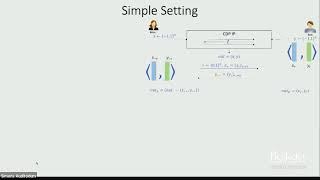
On the Complexity of Two-Party Differential Privacy
Explores limitations and cryptographic requirements for distributed differential privacy in two-party functions like inner product and Hamming distance, with implications for data analysis and privacy.
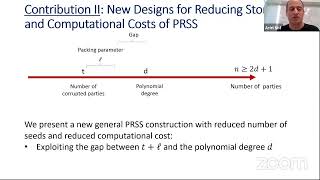
Multi-party Computation I - Session 109
Explore the fundamentals and applications of Multi-party Computation, a cryptographic protocol enabling secure collaborative computations while preserving data privacy.

Learning from Aggregate Responses
Explore aggregate learning techniques for privacy-protected data, including loss construction, bagging schemes, and iterative boosting algorithms to improve model accuracy while maintaining data privacy.

Heavy Hitter Estimation over Set-Valued Data with Local Differential Privacy
Explore local differential privacy for heavy hitter estimation on set-valued data. Learn about randomized response, RAPPOR, and the LDPMiner framework for privacy-preserving data analysis.
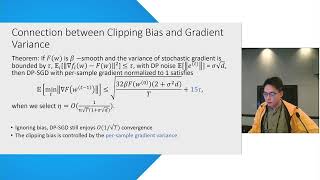
A Theory to Instruct Differentially-Private Learning via Clipping Bias Reduction
Explore a novel theory for enhancing differentially-private learning through clipping bias reduction, offering insights into privacy-preserving machine learning techniques.
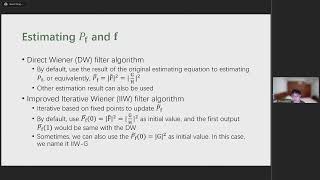
Locally Differentially Private Frequency Estimation Based on Convolution Framework
Explore innovative techniques for privacy-preserving frequency estimation using a convolution framework, enhancing data protection in statistical analysis and machine learning applications.

Membership Privacy in MicroRNA-based Studies
Explore privacy challenges in microRNA studies and learn about innovative techniques to protect individuals' genetic information while enabling valuable research.
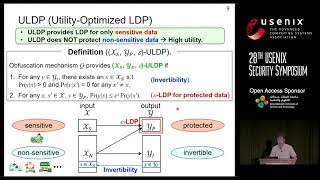
Utility-Optimized Local Differential Privacy Mechanisms for Distribution Estimation
Explores utility-optimized local differential privacy mechanisms for distribution estimation, enhancing data utility while maintaining privacy for sensitive information.
It's a Kind Of Magic - Computation on Ciphertexts
Explore practical applications of computing on encrypted data, including cross-organizational data collaboration, through demonstrations and real-world use cases in this insightful presentation.

Why AI Needs a “Nutrition Label” | Kasia Chmielinski | TED
Kasia Chmielinski uses a sandwich metaphor to explain AI systems and advocates for "nutrition labels" on AI to ensure fairer, more transparent algorithms. She discusses how data reform can improve AI development and accountability.
The most dangerous lie AI keeps repeating | Karen Colbert | TEDxBellarmineU
This talk challenges the dominant narrative that artificial intelligence is neutral, objective, and inevitable. Drawing on lived experience in education, engineering, and data science, Karen Colbert reveals how AI systems often reproduce historical inequities because they are built on incomplete dat

Giving Language a Voice Through AI | Sana Shams | TEDxSICAS DHA Youth
Mrs. Sana Shams explores how artificial intelligence can support language diversity and digital inclusion. Drawing from her own experiences, she discusses building speech-based chatbots for citizen services and regional collaborations that made computing accessible in 11 local languages. Her talk hi

Levels of Uncertainty – A Map of AI Ethics | Razvan Sandru | TEDxNoVA
An exploration of the ethical challenges of AI and how uncertainty plays a central role in decision-making Adrian Razvan Sandru completed his PhD in Phenomenology at University of Tuebingen, Germany, in 2020, with a thesis on the nature of subjectivity in liminal situations. He is currently a postdo