What's New and Improved in Wolfram Language Version 14
Explore Wolfram Language 14's enhancements in AI, graphics, engineering, math, and more. Learn about LLM integration, data visualization, PDE models, and improved computational capabilities.
Mancala: Multiway Analysis and Game GUI Development in Wolfram Language
Explore Mancala through game graphs and multiway analysis, examining complexity and fairness across configurations while building an interactive interface.
Explore the Total Solar Eclipse of 2024 with Wolfram Language
Predict and visualize the 2024 total solar eclipse using Wolfram Language. Calculate timings, create detailed sky and Earth maps, and understand the astro capabilities behind eclipse predictions.
Analyzing Real-World Networks in Wolfram Language
Explore graph theory techniques to extract insights from network data, uncover influential nodes, hidden communities, and vulnerabilities in social and infrastructure networks.
Visualizing and Computing Astronomical and Chemical Data and Historical Geography
Explore advancements in astronomical computation, 3D biomolecule representation, and historical geography using Wolfram Language 14.1's latest features and capabilities.
Combining Wolfram Language and R - Integrating R Workflows into Wolfram's Unified Computation Platform
Integrate Wolfram Language and R workflows, leveraging RLink to expand computational capabilities beyond statistics and access Wolfram's extensive algorithm base.
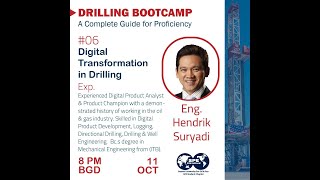
Digital Transformation in Well Construction
Explore digital transformation's impact on well construction, examining innovative technologies and strategies reshaping the industry's future.
Artificial Intelligence in Oil Fields
Explore AI applications in oil field operations, enhancing efficiency and decision-making processes in petroleum engineering and reservoir management.
Digital Transformation: A New Era of Well Construction
Explore digital transformation's impact on well construction, revolutionizing processes and enhancing efficiency in the oil and gas industry.

From One Brain to Everyone's Brain
Explore the evolution of collective intelligence and its impact on society with Dr. Omar Alfarisi's insights on brain connectivity and shared knowledge.
Practice Machine Learning for Petroleum Engineers with Little to No Code
Explore machine learning applications in petroleum engineering with minimal coding. Gain practical skills for implementing ML solutions in reservoir analysis and production optimization.
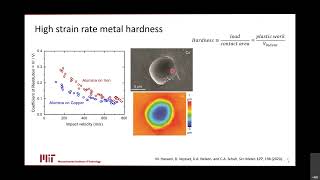
Quantitative Studies of Supersonic Microparticle Impacts on Metals
Explore quantitative analyses of supersonic microparticle impacts on metals, uncovering insights into high-energy density science and material behavior under extreme conditions.
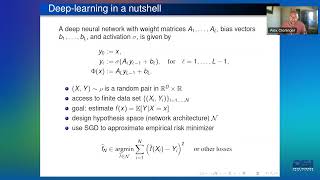
Networks that Adapt to Intrinsic Dimensionality Beyond the Domain
Explore neural networks' ability to adapt to intrinsic dimensionality, focusing on ReLU networks approximating functions with dimensionality-reducing feature maps. Gain insights into manifold learning and data analysis.
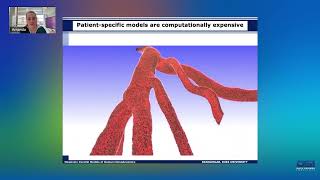
Using Data Science to Advance the Impact of Vascular Digital Twins in Medicine
Explore high-resolution digital twins of vascular anatomy to inform disease treatment. Learn how data science and physics-based modeling combine to address personalized medicine challenges.
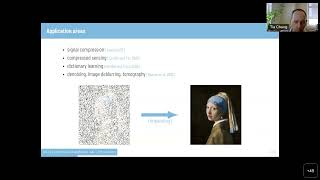
Big Data Inverse Problems - Promoting Sparsity and Learning to Regularize
Explore novel methods for solving big data inverse problems, focusing on sparse representation and L1 regularization. Learn about variable projection and deep neural networks for parameter optimization.
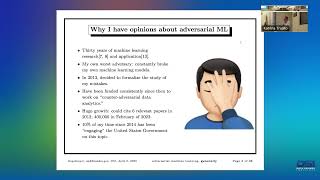
Adversarial Machine Learning: Categories, Concepts, and Current Landscape
Explore adversarial machine learning vulnerabilities, including data subversion, evasion, and model revelation. Learn to identify potential threats and build robust defense strategies.
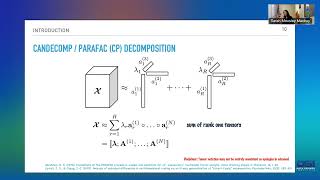
Tensor Factorization for Biomedical Representation Learning
Explore tensor factorization for biomedical representation learning, addressing challenges in healthcare data and improving predictive power for various downstream tasks.
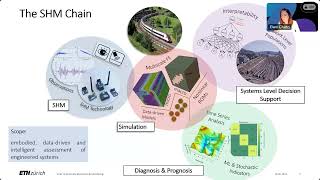
Twinning and Model Discovery for Engineered Systems
Explore hybrid approaches to Structural Health Monitoring, integrating physics-based and data-driven methods for robust monitoring and digital twinning of complex engineering structures.
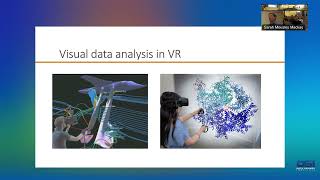
Quantifying the Benefits of Immersion in Virtual Reality
Explore the quantifiable benefits of VR immersion for real-world applications beyond gaming, backed by empirical studies and successful case studies in areas like scientific visual data analysis.
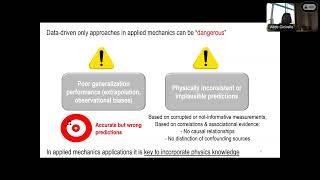
Challenges and Opportunities for Integrating Physics-Knowledge in Machine Learning Strategies
Explore integrating physics knowledge into machine learning algorithms for improved generalization and physics-consistent predictions. Examine biases and strategies through a friction identification case study.
Caliper, Hatchet, and Thicket: Open-Source Tools for HPC Performance Analysis
Explore open-source tools for integrating performance profiling, analyzing hierarchical data, and optimizing application performance on supercomputers. Learn to leverage Caliper, Hatchet, and Thicket for HPC environments.