Our Quest to Understand the Cosmos - Brian Greene in Conversation with Jo Marchant
Explore the cosmos from its beginning to its end with physicist Brian Greene, discussing life, consciousness, free will, and the scientific method in this thought-provoking conversation.
What Is Reality? - With Frank Wilczek
Nobel laureate Frank Wilczek explores fundamental concepts shaping our understanding of the universe, including time, space, matter, energy, complexity, and complementarity, offering insights into the nature of reality.
Diary of an Apprentice Astronaut - With Samantha Cristoforetti
Samantha Cristoforetti shares her extraordinary journey as an astronaut, from selection to life aboard the International Space Station, offering unique insights into the challenges and wonders of space exploration.
The Last Stargazers - With Emily Levesque
Explore the evolving world of professional astronomy, from remote observatories to cutting-edge technology, and the shift from human to robotic stargazers in this captivating journey through space science.
The End of Everything - With Katie Mack
Explore cosmic endings with astrophysicist Katie Mack, delving into quantum mechanics, cosmology, and string theory to uncover potential fates of our universe based on current scientific understanding.
Where Does Matter That Falls into a Black Hole Go? - KITP Public Lecture by Carlo Rovelli
Explore the mysteries of black holes, recent discoveries, and current theories about their interiors in this engaging lecture by renowned physicist Carlo Rovelli.
Low-Energy Interface of Quantum and Gravity - Igor Pikovski
Exploring the interface between quantum mechanics and gravity through novel experiments, focusing on atomic clocks, interferometry, and quantum effects in gravitational fields.
Far Detectors at the LHC - Jamie Boyd
Explores novel experiments for fundamental physics, focusing on far detectors at the LHC. Covers topics like dark matter, axions, and weak short-range forces, discussing opportunities and challenges in experimental physics.
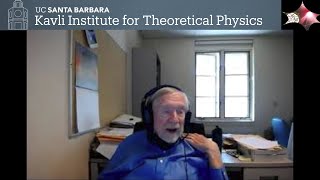
Novel Experiments for Fundamental Physics - General Discussion - KITP Conference Participants
Explore cutting-edge experiments in fundamental physics, including dark matter, axions, and gravitational waves. Discuss theoretical interpretations and potential advancements using cold atoms and interferometric techniques.
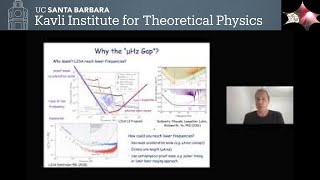
Gravitational Waves and New Physics - Peter Graham
Exploring gravitational waves and new physics through novel experiments, focusing on atomic clocks, pulsar timing, and asteroids to detect weak signals and test fundamental physics theories.
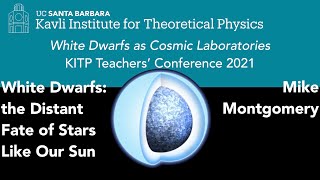
White Dwarfs - The Distant Fate of Stars Like Our Sun - Mike Montgomery
Explore white dwarfs' role in astrophysics, from exoplanets to supernovae. Learn about recent discoveries, cooling processes, and their importance in understanding the Universe's expansion.
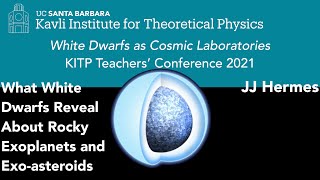
What White Dwarfs Reveal About Rocky Exoplanets and Exo-asteroids - JJ Hermes
Explore white dwarfs as cosmic laboratories, revealing insights into exoplanets, stellar evolution, and the composition of rocky bodies in the universe. Learn about recent discoveries and their implications for astrophysics.
Characterizing the Galactic Double White Dwarf Population - Na'ama Hallakoun, Valeriya Korol
Explore the Galactic double white dwarf population through astrometric, photometric, and spectroscopic data, discussing implications for stellar evolution, gravitational waves, and supernovae.
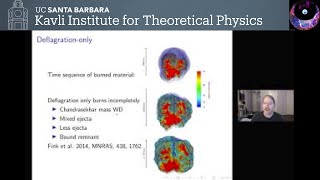
The Makings of Models for White Dwarf Supernovae - Dean Townsley
Explore the physics of white dwarf supernovae models, including detonation, deflagration, and double detonation mechanisms, with insights on their implications for astrophysics and future research directions.
The Detection of Lithium in Cool White Dwarf Atmospheres - Ben Kaiser, Mark Hollands - White Dwarfs
Explore lithium detection in cool white dwarf atmospheres, examining model atmospheres, infrared photometry, and abundances to advance understanding of stellar remnants and galactic evolution.

Why Did the Challenger Space Shuttle Explode - Epic Engineering Failures
Explore the organizational and engineering failures behind the Challenger disaster, examining decision-making processes, technological systems, and critical safety concerns that led to the tragic explosion.

Our Incredible Sun - Wondrium Perspectives
Explore the Sun's incredible features, from its composition and fusion processes to solar phenomena like flares and eclipses, with insights from experts on its role in our solar system and beyond.

The Life and Death of Stars - White Dwarfs, Supernovae, Neutron Stars, and Black Holes
Explore the fascinating journey of stars, from birth to spectacular death, including white dwarfs, supernovae, neutron stars, and black holes. Uncover the mysteries of stellar evolution and remnants.

Cosmology - A Big Bang and the Beginning of the Universe
Explore the origins and development of the universe through cosmology. Learn about the Big Bang theory and current astronomical knowledge on the universe's beginnings and evolution.
Space Science: The Sun and Its Influence on Earth
Explore the Sun's impact on Earth, from seasons to weather, and discover planetary phenomena in our solar system and beyond.

Space Science - Introduction to Stars
Explore stars, constellations, and the zodiac in this engaging series, covering their characteristics, locations, and significance in space science.