
Kepler's Laws and Planetary Motion - Fundamentals of Physics
Explore planetary motion and gravitational interactions through Kepler's laws, deriving orbital mechanics and energy conservation principles in this comprehensive physics lecture.
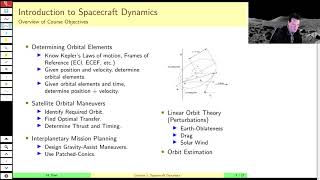
Orbital Mechanics and Spacecraft Dynamics
Comprehensive exploration of orbital mechanics, spacecraft dynamics, and mission planning. Covers historical context, mathematical foundations, orbital maneuvers, and spacecraft design principles.
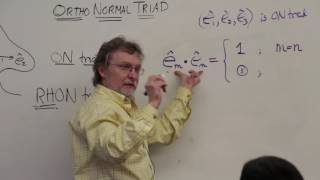
Intermediate Dynamics
Comprehensive exploration of advanced dynamics concepts, covering vector algebra, kinematics, particle dynamics, orbital mechanics, rigid body analysis, and more for in-depth understanding.
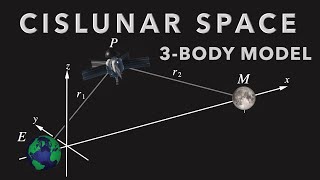
Cislunar Space - 3-Body Model of Orbital Dynamics Beyond the Geosynchronous Belt
Explore orbital dynamics beyond geosynchronous orbit using the 3-body model. Learn about Lagrange points, manifolds, and resonances in cislunar space, with practical MATLAB exercises and real-world applications.
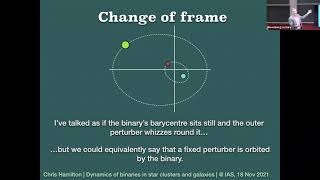
Dynamical Evolution of Binaries in Star Clusters and Galaxies - Chris Hamilton
Explore binary system evolution in star clusters and galaxies, focusing on tidal forces, Lidov-Kozai theory, and compact object mergers. Gain insights into celestial mechanics and astrophysical phenomena.
Celestial Operator Product Expansions and W1+Infinity Symmetry for All Spins - Monica Pate
Explore celestial operator product expansions, w1+infinity symmetry, and their implications for massless particles of all spins in gravitational theories and high-energy physics.
Trajectory Types Near L1, L2, and L3 in the Three Body Problem - Theory and MATLAB Examples
Explore trajectory types near Lagrange points in the three-body problem. Learn analytical solutions, MATLAB simulations, and applications to Earth-Moon and Sun-Jupiter systems. Gain insights into orbital dynamics and space mission design.
Root Finder in Space - Calculating Aphelion - Episode 2
Learn to calculate the aphelion of orbiting bodies using Scilab. This tutorial covers code setup for determining the farthest point in various celestial orbits.
Introduction to KAM Theory - Lecture 1
Delve into the fundamentals of Kolmogorov-Arnold-Moser (KAM) theory, exploring quasi-periodic motions, celestial mechanics stability, and analytical solutions for circle diffeomorphisms and Hamiltonian systems.
Introduction to KAM Theory - Lecture 2
Delve into the fundamentals of KAM theory and its application in celestial mechanics, exploring quasi-periodic motions, small divisors, and analytical circle diffeomorphisms in dynamical systems.
The Time Scale of a Human Life - Elementary Mathematics Explained
Explore the measurement of time through human life stages, astronomical cycles, and life spans. Learn to visualize a century-long timeline and understand key milestones in human development.
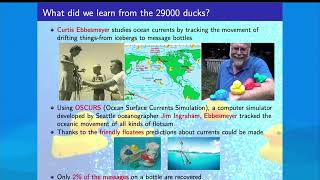
From Alan Turing to Contact Geometry: Towards a Fluid Computer
Explore the intersection of hydrodynamics, computation, and contact geometry. Discover how fluid dynamics can simulate universal Turing machines and its implications for undecidable fluid paths and celestial mechanics.
Separating Actions from Angles in Local Diffeomorphisms
Explore geometric normalization of analytic local diffeomorphisms near weakly attracting elliptic fixed points, focusing on existence and applications.
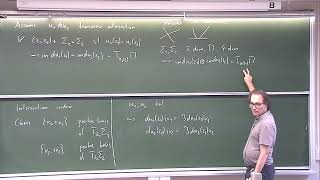
The Restricted Three-Body Problem and Holomorphic Curves - Lecture 3
Delve into advanced celestial mechanics, exploring holomorphic curves and their role in solving the restricted three-body problem through Birkhoff's conjecture and periodic orbits.
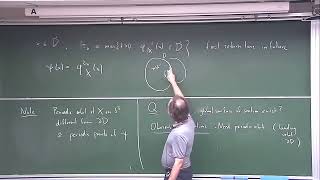
The Restricted Three-Body Problem and Holomorphic Curves - Lecture 1
Explore the dynamics of the restricted three-body problem and its relationship to holomorphic curves, focusing on Birkhoff's conjecture and the mathematical analysis of celestial mechanics.

How Earth Moves
Explore Earth's complex movements, from daily rotation to cosmic travel, and their impact on time, seasons, and our place in the universe. Uncover fascinating celestial phenomena and calendar intricacies.
Orbital Evolution I - Selma De Mink, Sophie Schroder
Explore orbital evolution in binary systems, from stars to black holes. Learn about circumbinary gas, observational signatures, and numerical modeling techniques across astrophysical scales.

The Mystery of Dark Matter
Explore dark matter's effects on galactic star speeds, current theories, and detection experiments in this comprehensive introduction to one of physics' greatest mysteries.
General Astronomy - Making Sense of the Universe
Explore elliptical orbits, Kepler's laws, and Newton's principles of motion in this comprehensive lecture on fundamental astronomical concepts and historical scientific breakthroughs.

Dangerous Worlds
Explore extreme exoplanets with astronomer Elizabeth Tasker, from scorching hot Jupiters to water worlds, and learn about the fascinating diversity of planets beyond our solar system.
Gravity Simulator - Double-Planet System - Episode 3
Explore double-planet and trinary star systems using a gravity simulator. Learn to code physics simulations and visualize complex celestial interactions in VPython.