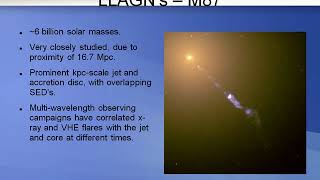
Studying Active Galactic Nuclei through GRMHD and Radiation Transport Models
Explore active galactic nuclei through advanced modeling techniques, including GRMHD and radiation transport, to understand their complex physics and observational characteristics.
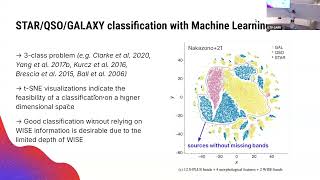
Searching for Quasars in the Era of Large Multi-Wavelength Datasets
Explore cutting-edge techniques for identifying quasars using extensive multi-wavelength datasets, enhancing our understanding of these distant cosmic objects and their role in the universe.

Shaping Galaxies with Supermassive Black Hole Winds
Explore how supermassive black hole winds shape galaxies, influence star formation, and distribute elements across the universe through observations and simulations.
The Realm of Supermassive Black Holes - Lecture 13
Explore the realm of supermassive black holes, from quasars to radio galaxies. Learn about their discovery, properties, and recent observations, including the groundbreaking image from the Event Horizon Telescope.
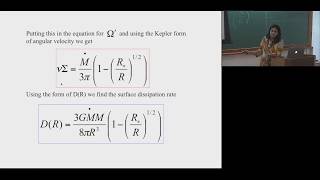
Formation, Fueling, and Feedback from Supermassive Black Holes - Lecture 2
Explore supermassive black hole physics: formation, growth, and environmental impact. Covers accretion discs, AGN structure, jets, and scaling relations. Ideal for graduate students in astrophysics.
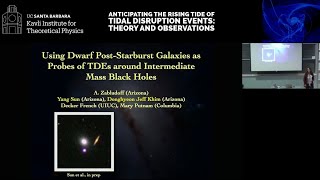
Using Dwarf Post-Starburst Galaxies as Probes of TDEs around Intermediate Mass Black Holes
Explore dwarf post-starburst galaxies as probes for tidal disruption events around intermediate mass black holes, offering insights into galactic nuclei and black hole properties.
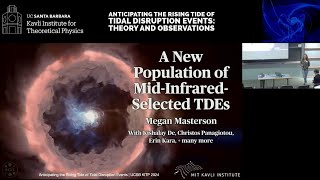
A New Population of Mid-Infrared-Selected Tidal Disruption Events
Explore a newly discovered population of tidal disruption events selected through mid-infrared observations, offering insights into supermassive black holes and galactic nuclei properties.
Exploring the Remains of Stars Disrupted by Stellar Black Holes
Investigación sobre estrellas destruidas por agujeros negros estelares, analizando eventos de disrupción de marea y su impacto en la comprensión de núcleos galácticos y agujeros negros supermasivos.
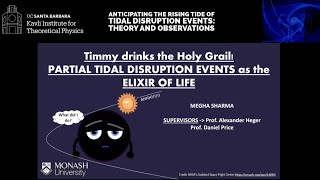
Partial Tidal Disruption Events: Elixir of Life
Explore partial tidal disruption events and their role in galactic nuclei. Learn about stellar destruction by supermassive black holes and the resulting accretion flares that provide insights into cosmic phenomena.
The Search for Tidal Disruption Events
Explore the latest advancements in detecting tidal disruption events, their impact on understanding galactic nuclei, and the challenges in modeling these cosmic phenomena.
Understanding Tidal Disruption Events Through Their Polarized Emission
Explore polarized emission in tidal disruption events, offering unique insights into supermassive black holes and galactic nuclei. Part of a conference on advancing TDE research and observations.
Population Studies of Tidal Disruption Events and their Hosts
Explore tidal disruption events: their host galaxy preferences and UV/optical emission origins. Gain insights into galactic nuclei and supermassive black holes through luminous accretion flares.
Observations of TDEs and Other Nuclear Transients
Explore observations of tidal disruption events and nuclear transients, providing insights into galactic nuclei and supermassive black holes. Learn about recent advances and outstanding questions in the field.

Unraveling the Complexity of Tidal Disruption Events with Multi-wavelength Observations of ASASSN-15oi
Explore multi-wavelength observations of ASASSN-15oi to unravel the complexity of tidal disruption events, providing insights into galactic nuclei and supermassive black holes.
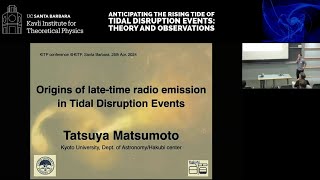
Origins of Late-Time Radio Emission in Tidal Disruption Events
Explore the origins of late-time radio emissions in tidal disruption events, providing insights into galactic nuclei and supermassive black holes through luminous accretion flares.
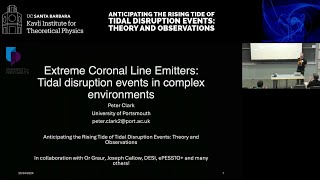
Extreme Coronal Line Emitters: Tidal Disruption Events in Complex Environments
Explore tidal disruption events in complex environments, focusing on extreme coronal line emitters and their impact on understanding galactic nuclei and supermassive black holes.
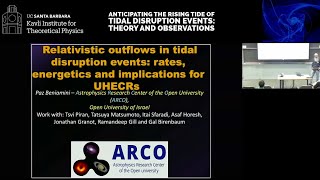
Relativistic Outflows in Tidal Disruption Events: Rates, Energetics and Implications for UHECRs
Explore relativistic outflows in tidal disruption events, examining rates, energetics, and implications for ultra-high-energy cosmic rays with expert Paz Beniamini from Open University Israel.
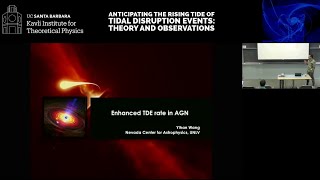
Enhanced Tidal Disruption Event Rate in Active Galactic Nuclei
Explore enhanced tidal disruption event rates in active galactic nuclei, examining the interaction between stars and supermassive black holes in galactic centers.
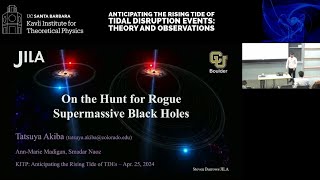
On the Hunt for Rogue Supermassive Black Holes Using Tidal Disruption Events
Explore the detection of rogue supermassive black holes through tidal disruption events, offering insights into galactic nuclei and black hole properties across cosmic time.
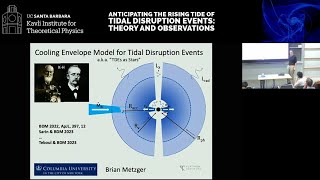
Cooling Envelope Model for Tidal Disruption Events
Explore the cooling envelope model for tidal disruption events with Brian Metzger, examining how stars are destroyed by supermassive black holes and the resulting luminous accretion flares.
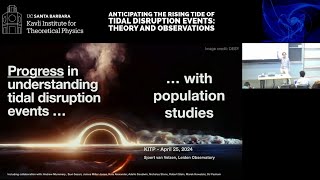
Current Status of TDE Observations: The Promise of Population Studies
Explore the current state of tidal disruption event observations and their potential for population studies, focusing on recent advances and future prospects in understanding galactic nuclei and supermassive black holes.