The Undiscovery of Cosmic Deceleration - Robert P. Kirshner - Radcliffe Institute
Explore the unexpected discovery of cosmic acceleration and its implications for our understanding of the universe, dark energy, and fundamental physics.
The Cosmic Microwave Background and Dark Energy - Lecture 23
Explore the Cosmic Microwave Background, dark energy, and large-scale clustering in this lecture on astrophysics frontiers, featuring evidence from supernovae and computer simulations of universe evolution.
Introduction to Astronomy - Stars
Explore the life cycle of stars, from formation to evolution, including supernovae, pulsars, and black holes. Discover how stars create elements and their impact on the universe.
Olbrzymy, cebule, wybuchy i zombie - opowieść o życiu gwiazd
Fascynująca podróż przez życie gwiazd - od narodzin po śmierć. Odkryj nieoczekiwane powiązania między gwiazdami a naszym życiem w tej wciągającej opowieści pełnej astronomicznych ciekawostek.
BSM Searches and Supernovae - Ivan Jesus Martinez Soler
Explore neutrino physics in supernovae and BSM searches, covering neutrino masses, superposition, bounds, and sensitivity measurements in this interdisciplinary conference talk.
Stellar Mass Binaries in AGN - Hui Li - Barry Mc Kernan
Explore stellar mass binaries in AGN, their formation, evolution, and interactions with circumbinary gas. Gain insights into numerical modeling and observational signatures of these systems.
General Astronomy - The Fates of High-Mass Stars
Explore the life cycles of massive stars, from fusion processes to spectacular supernovae, and their cosmic remnants in this comprehensive astronomical journey.

Chasing Supernovae with Kepler
Explore how the Kepler spacecraft's precise measurements are used to hunt supernovae, offering insights into the early stages of stellar explosions and advancing our understanding of these cosmic events.
Galaxies by G Srinivasan
Explore galaxies with renowned physicist G Srinivasan in this advanced lecture, part of a comprehensive summer course on gravity, astrophysics, and cosmology for physics and astronomy students.
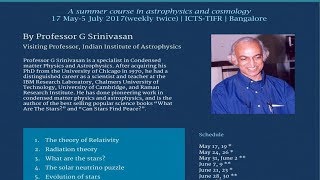
What Are the Stars? - by G Srinivasan
Explore the nature of stars, their composition, energy production, and lifecycle in this comprehensive lecture by astrophysicist G Srinivasan, covering key concepts from Eddington's theories to nuclear fusion.

The Life and Death of Stars - White Dwarfs, Supernovae, Neutron Stars, and Black Holes
Explore the fascinating journey of stars, from birth to spectacular death, including white dwarfs, supernovae, neutron stars, and black holes. Uncover the mysteries of stellar evolution and remnants.
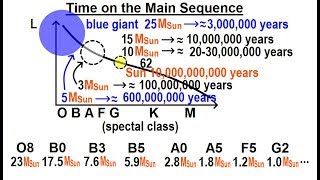
Life & Death of a High Mass Star
Explore the lifecycle of massive stars, from their main sequence to supernova explosions. Learn about red giants, iron cores, and the final moments of high-mass stellar evolution.
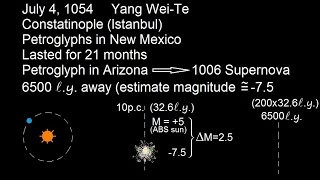
Astronomy - Supernova: The Death of Stars
Explore the fascinating world of supernovas, from historical observations to types and mechanisms. Learn about white dwarfs, electron degeneracy, and how supernovas help measure cosmic distances.
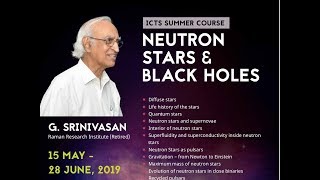
Supernovae and Neutron Stars - Lecture 3
Explore the formation and evolution of neutron stars, supernovae, and their remnants. Delve into stellar physics, cosmic rays, and the violent interstellar medium in this comprehensive lecture.
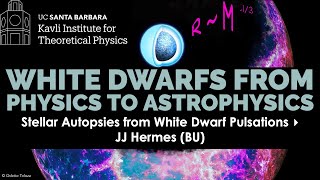
Stellar Autopsies from White Dwarf Pulsations - JJ Hermes
Explore white dwarf pulsations as a tool for stellar autopsies, uncovering insights into stellar evolution, Galactic history, and fundamental physics through cutting-edge observational and theoretical approaches.

Massive Stars and Supernovae – With Thomas Haworth
Explore the formation, life, and explosive death of massive stars, their impact on galaxies, and recent discoveries in planetary science through engaging demonstrations and simulations.
Introduction to Numerical Relativistic Hydrodynamics - Lecture 1
Explore numerical relativistic hydrodynamics, essential for modeling high-energy astrophysical phenomena like black hole mergers and supernovae, crucial for gravitational-wave astronomy advancements.
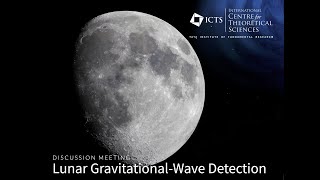
Observing EM Counterparts to Decihertz GW Sources by Varun Bhalerao
Exploring electromagnetic counterparts to decihertz gravitational wave sources, covering infrared to high-energy observations, mission comparisons, and challenges in detecting various astrophysical phenomena.

Catching Gravitational Waves - Understanding Detection and Future Implications
Explore gravitational waves: their nature, sources, detection methods, and future implications in astronomy. Learn about LIGO's groundbreaking discoveries and the new era of cosmic observation.
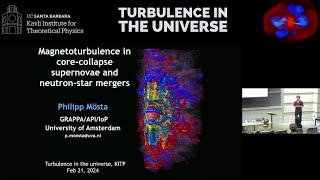
Magnetoturbulence in Supernovae and Neutron-Star Mergers - Philipp Moesta
Explore magnetoturbulence in supernovae and neutron-star mergers with Philipp Moesta. Gain insights into this crucial astrophysical process and its impact on stellar phenomena.
Introduction to Numerical Relativistic Hydrodynamics - Lecture 4
Explore advanced concepts in numerical relativistic hydrodynamics, focusing on computational techniques for modeling high-energy astrophysical phenomena and gravitational wave sources.