
Fundamentals of Physics
This course covers Newtonian mechanics, special relativity, gravitation, thermodynamics, and waves.

Kepler's Laws and Planetary Motion - Fundamentals of Physics
Explore planetary motion and gravitational interactions through Kepler's laws, deriving orbital mechanics and energy conservation principles in this comprehensive physics lecture.
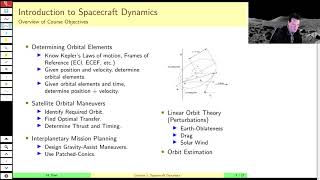
Orbital Mechanics and Spacecraft Dynamics
Comprehensive exploration of orbital mechanics, spacecraft dynamics, and mission planning. Covers historical context, mathematical foundations, orbital maneuvers, and spacecraft design principles.
On the Current State of Fundamental Physics
Explore fundamental physics concepts, from Kepler's laws to cosmic redshift, challenging conventional wisdom and encouraging independent thinking in scientific inquiry.
Earth Science - The Birth of Modern Astronomy
Explore the revolutionary ideas of Kepler, Galileo, and Newton that shaped modern astronomy, from elliptical orbits to gravity and laws of motion.
General Astronomy - Making Sense of the Universe
Explore elliptical orbits, Kepler's laws, and Newton's principles of motion in this comprehensive lecture on fundamental astronomical concepts and historical scientific breakthroughs.

Planetary Orbits - Kepler, Newton, and Gravity
Explore planetary orbits through Newton's law of gravitation and Kepler's patterns. Brian Greene explains the basics, touching on conic sections and space dimensionality in this engaging discussion.
Mechanics and the Solar System - Math History - NJ Wildberger
Explore the historical development of planetary motion theories, from Earth-centered models to Newton's laws, highlighting key figures and their contributions to our understanding of the solar system.
Astrophysics - Binary Systems & Kepler's Laws
Comprehensive exploration of binary star systems, Kepler's laws, and related astrophysical concepts, including orbital mechanics, mass determination, and reduced mass theory.

Astronomy
Explore celestial bodies, Mars, and Kepler's Laws in this comprehensive journey through our Universe, covering neutron stars, black holes, and astronomical measurements.
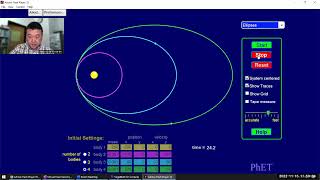
Physics 4A - Kepler's Second Law and Conservation of Angular Momentum
Explore Kepler's Second Law and angular momentum conservation in planetary motion, gaining insights into orbital dynamics and celestial mechanics.
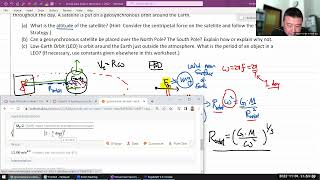
Physics 4A - Geosynchronous Orbit and Other Earth Orbits
Explore geosynchronous and other Earth orbits, understanding their principles and applications in satellite technology and space exploration.
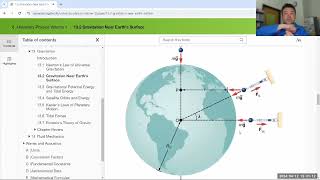
Physics 4A - Chapter 13 Overview
Overview of key concepts in Chapter 13 of Physics 4A, covering fundamental principles and applications in classical mechanics.
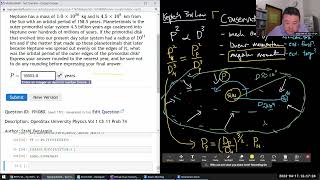
Physics 4A - Kepler's Third Law and Orbital Mechanics - Problem 74
Explore planetary motion and Kepler's 3rd Law through a detailed problem-solving session, enhancing understanding of celestial mechanics and orbital dynamics.
Universal Law of Gravity and Planetary Motion - General Physics Lesson 7.3
Explore gravity's impact on planetary motion, learn escape speed calculations, and understand Kepler's Laws. Master orbital mechanics and gravitational potential energy concepts through practical problem-solving.
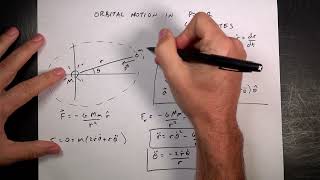
Orbital Motion in Polar Coordinates - Differential Equations and Numerical Solutions
Explore orbital motion using polar coordinates, deriving equations and implementing numerical calculations in Python to visualize and analyze celestial mechanics.
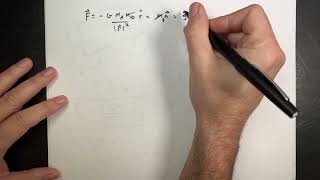
Gravitation: Universal Gravity, Fields, Energy, and Kepler's Laws - Lecture 13
Explore key concepts in gravitation, from universal gravity to Kepler's laws, enhancing understanding of fundamental physics principles.
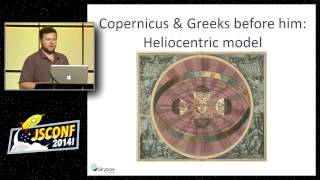
Realtime Satellite Tracking in the Browser
Explore real-time satellite tracking in browsers using JavaScript, learning orbital mechanics concepts and mapping techniques with Leaflet.js and satellite.js.
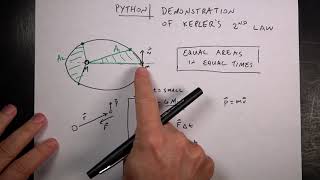
Verifying Kepler's Second Law with Python and Physics
Model planetary orbits and verify Kepler's 2nd Law using Python, demonstrating equal area sectors in equal time periods through orbital motion simulations and sector area calculations.
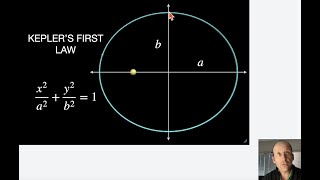
Modeling Kepler's First Law with Python
Model Kepler's first law of planetary motion using Python, demonstrating elliptical orbits through code implementation and visual plotting.
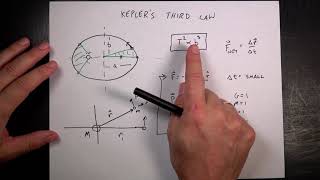
Demonstration of Kepler's Third Law Using Python
Explore Kepler's Third Law through Python modeling, calculating orbital periods and semi-major axes for various orbits to verify the law's validity.