The Search for Life in the Universe
Explore the possibilities of extraterrestrial life and interstellar travel with astrophysics expert Pete Worden. Learn about cutting-edge initiatives, propulsion technologies, and recent discoveries in space exploration.
Extraordinary Physics with Millisecond Pulsars - Scott Ransom
Explore millisecond pulsars' role in detecting gravitational waves, testing general relativity, and understanding dense matter, using advanced timing observations and cutting-edge telescopes.
Radioastronomy and the LLAMA Project
Exploración de la radioastronomía y el proyecto LLAMA, abordando sus aplicaciones, desafíos y contribuciones al estudio del universo desde una perspectiva científica innovadora.
The ABC of Smart Machines - With Danielle George
Explore radio astronomy, cutting-edge telescopes, and data-driven cosmic discoveries with Professor Danielle George. Learn about engineering challenges and innovative technologies shaping our understanding of the universe.
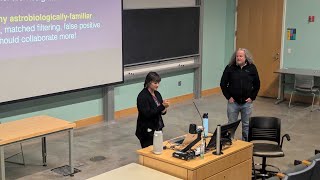
Technosignatures - Exploring a Weird and Wonderful Corner of Astrobiology
Explore the fascinating world of technosignatures in astrobiology with SETI Institute's Dr. Sheikh as she reveals potential signs of extraterrestrial technological activity.
Multi-messenger Astronomy: Progress and Problems in Exploring the Dynamic Sky
Explore the dynamic universe through multi-messenger astronomy, examining cosmic rays, neutrinos, photons, and gravitational waves to understand astrophysical phenomena and recent research developments.
Peering into the Early Universe - Observing Cosmic History Through High-Precision Measurements
Explore high-precision astronomical techniques and custom telescope designs used to study crucial epochs of the early Universe, overcoming observational challenges to reveal our cosmic origins.
Overview of SKA Radio Interferometer Telescope Activities - Design and Implementation
Explore the design challenges and scientific activities of the Square Kilometer Array (SKA) radio telescope project, focusing on the low-frequency aperture array and RRI's contributions to pulsar research.
Atomic Hydrogen in Galaxies Nine Billion Years Ago
Explore the groundbreaking detection of atomic hydrogen in ancient galaxies, tracing 30 years of research that reveals how galaxies evolved through gas-to-star conversion 9 billion years ago.
Telescopes on the Moon: The Next Decades - Exploring Space Through Lunar Observatories
Explore groundbreaking astronomical possibilities as lunar-based telescopes revolutionize our understanding of dark ages cosmology, early universe radiation, and exoplanet discoveries in unprecedented detail.
Why Have We Not Found Any Aliens? - With Keith Cooper
Exploring SETI's six-decade quest for extraterrestrial intelligence, examining challenges, assumptions, and future prospects in the search for alien life beyond Earth.

Star Formation in Orion
Explore star formation in Orion through observations from space telescopes, uncovering the birth of stars and enhancing our understanding of stellar origins and evolution.
Neutron Stars and Black Holes - Lecture 6: Pulsars and Their Properties
Explore pulsars, neutron stars, and their remarkable properties. Delve into the Crab Nebula's history, pulsar discovery, and radiation mechanisms. Gain insights into magnetospheres and electrodynamics of these fascinating cosmic objects.
Pulsars: Properties, Radiation, and Discovery - Lecture 8
Explore pulsars, neutron stars, and their remarkable properties in this comprehensive lecture. Learn about their discovery, radiation mechanisms, and role in astrophysics.
Darkness Visible - Shedding New Light on Black Holes
Explore cutting-edge techniques to observe and understand black holes, including radio telescope arrays and mathematical models. Learn how these methods reveal fundamental truths about the universe and bridge general relativity with quantum mechanics.

Coronal Mass Ejections and Solar Gamma-ray Emission
Explore sustained gamma-ray emission from the Sun, its detection methods, and connection to solar phenomena like coronal mass ejections, solar flares, and energetic particle events.
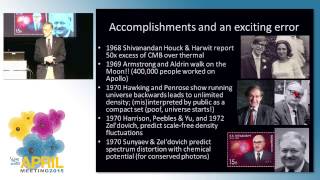
50 Years of the Cosmic Microwave Background - Discoveries and Future Prospects
Explore 50 years of cosmic microwave background research, from early discoveries to modern precision cosmology. Learn about key breakthroughs, current theories, and future prospects in this fascinating field of astrophysics.
The First Billion Years of the Universe
Explore the early Universe's mysteries, from the Big Bang to the first stars. Learn about unusual cosmic phenomena and their impact on our understanding of the Universe today.
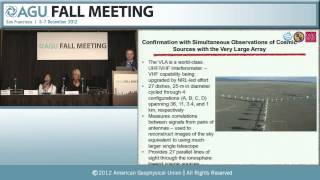
An Unlikely New Tool for Spotting Clandestine Nuclear Tests
Innovative use of GPS technology for detecting clandestine nuclear tests, exploring ionospheric disturbances and acoustic waves as potential indicators of underground explosions.
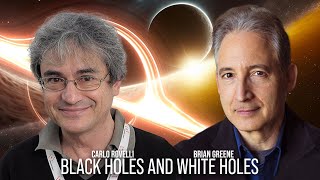
Beyond Einstein - Gravitational Geysers: Exploring White Holes
Explore white holes, time-reversed cousins of black holes, with physicist Carlo Rovelli and Brian Greene. Delve into their speculative nature, potential connection to dark matter, and implications for our understanding of the universe.

The Future of Telescopes - From Giant Ground-Based Arrays to Space-Based Observatories
Explore the future of astronomy with innovative telescope designs, from massive ground-based observatories to space-based instruments, revolutionizing our view of the universe.