Microlensing, Astrometry and Other Methods for Exoplanet Detection - Lecture 6
Explore planetary detection methods like transits and migration, understanding their impact on our view of solar systems and potential exoplanet discoveries.
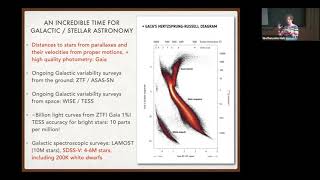
Astrophysics of White Dwarfs in the Era of Modern Surveys - Nadia Zakamska
Explore white dwarf astrophysics through modern surveys, examining ultra-compact binaries, supernova progenitors, and stellar evolution. Gain insights into equation of state, short-period binaries, and mass loss processes.
Introduction to SIRIL - Astrophotography Software
Learn to process astrophotography images using SIRIL software, enhancing celestial captures with advanced techniques and tools for stunning results.

How to Hunt for Distant Worlds
Explore exoplanet detection methods, from radial velocity to direct imaging, and learn about the history and significance of these distant worlds in our galaxy.
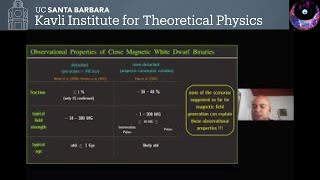
Formation and Evolution of Close Magnetic White Dwarf Binaries - Diogo Belloni
Explore the formation and evolution of close magnetic white dwarf binaries, their impact on astrophysics, and implications for stellar remnants and galactic populations.
Observations of Polluted White Dwarfs - Siyi Xu
Explore observations of polluted white dwarfs, their significance in astrophysics, and insights into stellar and planetary evolution. Gain expert knowledge on this fascinating topic in astronomy.
Observations of Thermonuclear Supernovae - Kate Maguire
Explore thermonuclear supernovae observations with Kate Maguire, covering astrometric, photometric, and spectroscopic data from all-sky surveys to gain insights into white dwarf populations and their astrophysical implications.
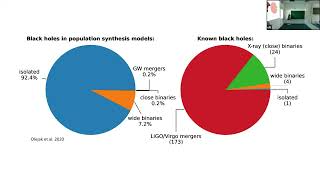
Toward the Mass Function of Black Holes with Modern Observations of Microlensing Events
Explore gravitational microlensing techniques for detecting isolated stellar remnants, focusing on recent advancements leading to the discovery of the first isolated stellar-mass black hole in the Milky Way.

Challenges and Advantages of Interferometry from Space
Explore space interferometry's challenges and benefits with NASA expert Chas Beichman, covering astrometry, JWST, and future prospects.
Малый Пулковский базис и его связь с градусными измерениями
Изучите связь Малого Пулковского базиса с градусными измерениями и его значение в военной топографии. Повысьте свои навыки в геодезии и картографии.
Large Baseline Optical Imaging Assisted by Single Photons and Linear Quantum Optics
Explore quantum metrology and networking tools to enhance optical telescope interferometry, improving diffraction-limited imaging of point source positions using single-photon technology.
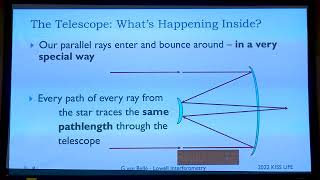
Introduction to Interferometry
Explore the principles and applications of interferometry in astronomy, from basic concepts to advanced techniques and array configurations.
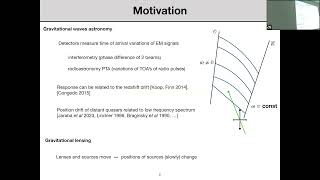
Redshift Drift, Position Drift and Caustics in General Relativity
Explore redshift and position drifts in general relativity, examining their formulas, physical consequences, and applications in gravitational lensing, astrometry, and cosmology.