
Kepler's Laws and Planetary Motion - Fundamentals of Physics
Explore planetary motion and gravitational interactions through Kepler's laws, deriving orbital mechanics and energy conservation principles in this comprehensive physics lecture.

Recognizing the Alien in Us
Explore the intersection of physics and biology in the quest to define life, its origins, and potential existence beyond Earth, guided by astrobiologist Sara Walker's innovative perspectives.

Planetary Orbits - Kepler, Newton, and Gravity
Explore planetary orbits through Newton's law of gravitation and Kepler's patterns. Brian Greene explains the basics, touching on conic sections and space dimensionality in this engaging discussion.

Feynman's Lost Lecture on Planetary Orbits
Explore Feynman's elegant proof of planetary elliptical orbits, featuring 3Blue1Brown's visualizations. Uncover the beauty of physics through this captivating demonstration of celestial mechanics.
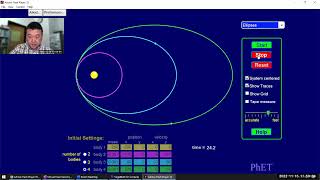
Physics 4A - Kepler's Second Law and Conservation of Angular Momentum
Explore Kepler's Second Law and angular momentum conservation in planetary motion, gaining insights into orbital dynamics and celestial mechanics.
Universal Law of Gravity and Planetary Motion - General Physics Lesson 7.3
Explore gravity's impact on planetary motion, learn escape speed calculations, and understand Kepler's Laws. Master orbital mechanics and gravitational potential energy concepts through practical problem-solving.
Science and Technology Q&A for Kids and Others - Part 143
Explore diverse science and technology topics with Stephen Wolfram in an unscripted Q&A session, covering eclipses, lunar dynamics, space colonization, and the capabilities of AI and large language models.
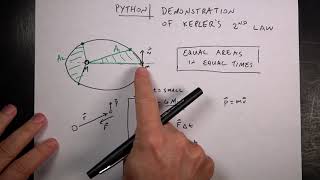
Verifying Kepler's Second Law with Python and Physics
Model planetary orbits and verify Kepler's 2nd Law using Python, demonstrating equal area sectors in equal time periods through orbital motion simulations and sector area calculations.

Circular Motion - Physics 101 / AP Physics 1 Review with Dianna Cowern
Explore circular motion concepts and solve real-world problems in this engaging physics lesson. Learn about centripetal force, tension, and banked curves with clear explanations and practical examples.
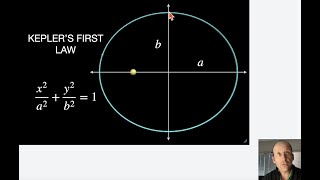
Modeling Kepler's First Law with Python
Model Kepler's first law of planetary motion using Python, demonstrating elliptical orbits through code implementation and visual plotting.
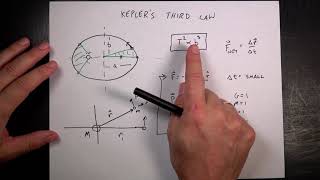
Demonstration of Kepler's Third Law Using Python
Explore Kepler's Third Law through Python modeling, calculating orbital periods and semi-major axes for various orbits to verify the law's validity.