Earth Science - The Ancient Roots of Astronomy
Explore ancient astronomy's roots, from Greek geocentric models to Copernicus' revolutionary ideas, and how they shaped our understanding of the cosmos.

Earth Science - Introduction to Earth Science
Comprehensive introduction to Earth Science, covering geology, oceanography, meteorology, and astronomy. Explores Earth's formation, systems, scientific methods, and the universe's scale and history.
General Astronomy - Neutron Stars and Black Holes
Explore neutron stars and black holes, delving into special and general relativity, gravitational waves, and the fascinating properties of these cosmic phenomena.
General Astronomy - The Fates of High-Mass Stars
Explore the life cycles of massive stars, from fusion processes to spectacular supernovae, and their cosmic remnants in this comprehensive astronomical journey.
General Astronomy - The Fates of Low and Intermediate-Mass Stars
Explore the life cycles of low and intermediate-mass stars, from core helium fusion to planetary nebulae and white dwarfs, including key processes and structures.
General Astronomy - The Lives of Stars
Explore stellar evolution, from main sequence stars to red giants, understanding fusion processes, mass loss, and the diverse fates of stars based on their initial mass.
General Astronomy - The Formation of a Protostar
Explore the fascinating process of protostar formation, from nebulae to protostellar disks and jets, in this comprehensive astronomy lecture.
General Astronomy - The Structure of the Sun
Explore the Sun's structure, from its core to its atmosphere, including phenomena like sunspots and solar wind. Gain insights into solar physics and helioseismology.
General Astronomy - Why the Sun Shines
Explore the Sun's energy production, from ancient theories to modern understanding, covering nuclear fusion, equilibrium, and energy transport in stellar interiors.
General Astronomy - The Nature of Light
Explore light's properties, from colors and reflection to waves and particles. Understand electromagnetic spectrum, visible light, and its everyday applications.
General Astronomy - Atmospheres of the Terrestrial Planets
Explore terrestrial planet atmospheres, from lunar and Mercurian traces to Mars' winds and Venus' greenhouse effect. Understand atmospheric evolution and planetary climate dynamics.
General Astronomy - Earth's Atmospheric Structure and Magnetic Field
Explore Earth's atmospheric layers, global wind patterns, and magnetic field, including the magnetosphere, auroras, and field reversals.
General Astronomy - An Introduction to Planetary Atmospheres
Explore planetary atmospheres, their composition, and effects like atmospheric pressure and the greenhouse effect. Compare Earth's atmosphere with other planets.
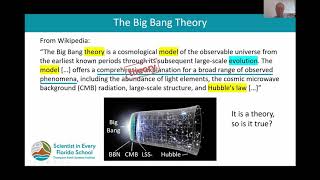
The Role of Theories, Laws, Hypotheses & Models - Dr. Bingkan Xue
Explore scientific concepts like Hubble's Law, the Big Bang Theory, and evolution, examining their roles as laws, models, and theories in our understanding of the universe.
General Astronomy - Geology of the Terrestrial Planets
Explore the geological features and processes of terrestrial planets, including plate tectonics, volcanism, and erosion, with a focus on Earth, Moon, Mercury, Mars, and Venus.
General Astronomy - An Introduction to Planetary Geology
Explore planetary geology: layering, internal processes, surface shaping, and geological activity. Understand how size affects a planet's geology and the formation of magnetic fields.
General Astronomy - The Formation of the Planets
Explore planetary formation, from condensation temperatures to migration, covering inner and outer regions, frost lines, and the origins of asteroid and Kuiper belts.
General Astronomy - The Origin of the Solar System
Explore cosmic abundances, element origins, and the solar system's formation through the nebular hypothesis, including protoplanetary disk development and radioactive dating techniques.
General Astronomy - A Tour of the Solar System
Explore our solar system's diverse planets and celestial bodies, from the scorching Mercury to the icy Kuiper Belt, in this comprehensive astronomical tour.
General Astronomy - Eclipses and the Motion of the Moon
Explore lunar phenomena, including eclipses, moon phases, and synchronous rotation. Understand the mechanics behind solar and lunar eclipses and their visual effects.
General Astronomy - The Reason for Seasons
Explore Earth's tilt, orbital distance, and celestial mechanics to understand the scientific basis for seasonal changes and their global impact.