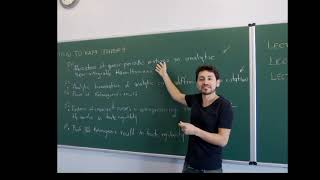
Introduction to KAM Theory - Lecture 1
Delve into the fundamentals of Kolmogorov-Arnold-Moser (KAM) theory, exploring quasi-periodic motions, celestial mechanics stability, and analytical solutions for circle diffeomorphisms and Hamiltonian systems.
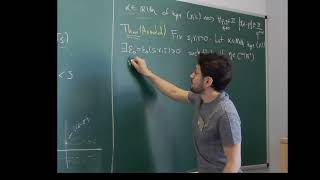
Introduction to KAM Theory - Lecture 2
Delve into the fundamentals of KAM theory and its application in celestial mechanics, exploring quasi-periodic motions, small divisors, and analytical circle diffeomorphisms in dynamical systems.
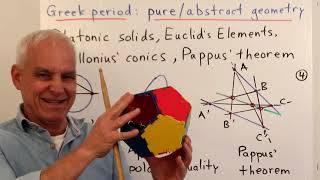
A Brief History of Geometry - Sociology and Pure Mathematics
Explore geometry's evolution from ancient times to 1400 AD, covering key theorems, Platonic solids, and applications in astronomy, surveying, and construction. Highlights include Islamic contributions to spherical geometry.
Astronomy and Trigonometry in India - Math History
Explore ancient Indian contributions to astronomy and trigonometry, including Brahma Gupta's work and the development of sign tables, in this insightful mathematical history lecture.
The Time Scale of a Human Life - Elementary Mathematics Explained
Explore the measurement of time through human life stages, astronomical cycles, and life spans. Learn to visualize a century-long timeline and understand key milestones in human development.
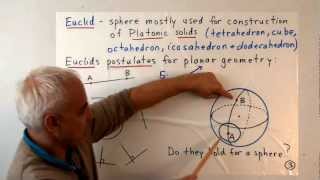
Spherical and Elliptic Geometries - Universal Hyperbolic Geometry
Explore spherical and elliptic geometries, from ancient Greek astronomy to modern concepts. Learn about longitude, latitude, measurement techniques, and key theorems in non-Euclidean spaces.
A Brief Introduction to Nested Sampling - IPAM at UCLA
Explore Nested Sampling for Bayesian model uncertainty and selection. Learn its principles, advantages, and recent extensions like Dynamic Nested Sampling for estimating marginal likelihoods and posterior distributions.
Persistence and First-Passage Properties of Stochastic Processes by Satya N Majumdar
Explore stochastic processes, focusing on persistence and first-passage properties. Covers applications in chemistry, finance, astrophysics, and more. Examines Markov processes and run-and-tumble particle models.
The Dynamical Systems Approach to Spatially Homogenous Einstein-Vlasov Cosmology
Explore spatially homogenous Einstein-Vlasov cosmology using dynamical systems analysis. Investigate asymptotic solutions near singularities and expanding futures, focusing on Kantowski-Sachs models with Vlasov matter.
Truth and the Scientific Method by David Gross
Explore the nature of scientific truth, the scientific method's strengths and limitations, and its role in society. Gain insights into reductionism and the challenges facing modern science.

The Science of the Man from the 9 Dimensions
Explore the universe's origins, from the Big Bang to cosmic inflation, and delve into superstring theory's quest for a unified understanding of physics across nine dimensions.
Spacetime, Quantum Mechanics and Positive Geometry by Nima Arkani Hamed
Explore the intersection of spacetime, quantum mechanics, and positive geometry, delving into scattering amplitudes, the mystery of time, and emergent phenomena in theoretical physics.
Quantum Field Theory as the Language of Physics by Nathan Seiberg
Explore quantum field theory's role as the universal language of physics, its applications, limitations, and potential reformulation in this insightful talk by Nathan Seiberg.
Cosmological Simulations by R. Angulo
Explore cosmological simulations in this lecture, covering key concepts, techniques, and applications in modern cosmology research for understanding the universe's structure and evolution.
Does Math Reveal Reality?
Explore the profound connection between mathematics and physical reality with leading thinkers. Delve into whether math is a human invention or an intrinsic part of the universe's fabric.
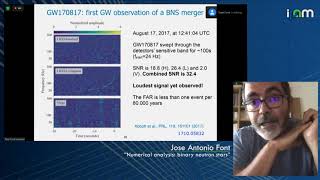
Numerical Analysis - Binary Neutron Stars - IPAM at UCLA
Explore numerical modeling of binary neutron star mergers, covering hydrodynamics, MHD equations, and simulation methods. Learn about gravitational waves, gamma-ray bursts, and r-process elements.
Introduction to Theory and Numerics of Partial Differential Equations - Lecture 1
Explore fundamental concepts and numerical techniques for solving partial differential equations, essential for modeling complex physical phenomena in gravitational-wave astronomy and astrophysics.
The Role of Mathematics in Solving the World's Main Challenges
Explore how mathematics and computation contribute to understanding climate, energy, the cosmos, and life itself through TED-style talks by renowned computational scientists.
Building the Universe with Mathematics
Explore how mathematics can design our universe, from numbers to multidimensional concepts. Discover the progression of ideas that shape existence, including geometry, algebra, infinity, and relativity.
Mysterious Numbers - Unlocking the Secrets of the Universe
Explore extraordinary numbers in physics with Tony Padilla, uncovering fundamental truths about black holes, holographic reality, and the cosmological constant through unusually big, small, and infinite numbers.
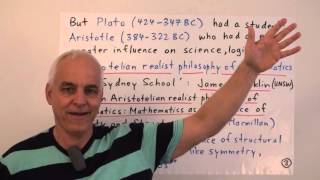
Numbers, the Universe and Complexity Beyond Us - Data Structures Math Foundations 177
Explore the limits of mathematical notation, the philosophy of numbers, and the physical constraints of our universe in representing extremely large quantities and complex mathematical concepts.