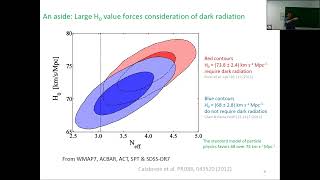
Spatial Curvature, Dark Energy Dynamics, Neither, or Both
Explore dark energy models, their predictions, and observational data constraints. Gain insights into open cosmological questions and the current understanding of the universe's energy composition.
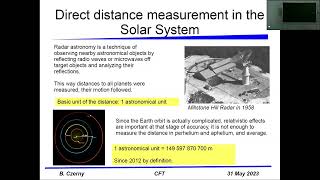
Distance Measurement in Astronomy
Explore astronomical distance measurement techniques, from direct probing to advanced methods using quasars, and understand their role in building a consistent picture of the Universe.
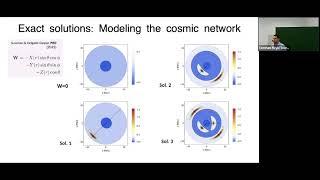
General Relativistic Approaches to Modeling Large-Scale Structure Formation
Explore relativistic approaches to model large-scale structure formation, focusing on exact solutions and the relativistic Zeldovich approximation. Enhance understanding of curvature and relativistic corrections in cosmic structures.
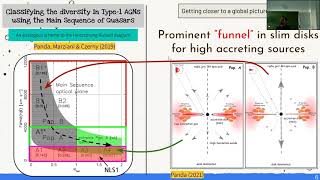
Emission Line Regions in Active Galaxies in the Era of JWST and LSST
Explore recent advancements in AGN variability studies, focusing on emission line regions and their implications for cosmology. Gain insights into quasar research and future prospects with JWST and LSST.
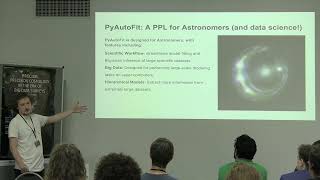
Introduction to Model Fitting - Gravitational Lensing and Graphical Modeling
Explore gravitational lensing model fitting techniques, from traditional methods to innovative graphical modeling, and learn about PyAutoFit for streamlined probabilistic programming.
Introduction to Cosmological N-Body Simulations
Explore precision cosmology through N-body simulations, understanding their history, development, and key applications in unraveling the universe's mysteries.
Statistical Analysis in Cosmology - Part 1
Explore Bayesian statistics, likelihood sampling, chi-square, and covariance matrix in cosmology. Learn parameter estimations in 2-point statistics and Markov Chain Monte Carlo.
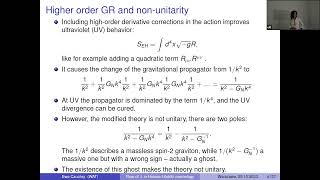
Energy Flow of λ in Hořava-Lifshitz Cosmology
Explore Hořava-Lifshitz cosmology, focusing on λ parameter's energy flow. Analyze two formulations using diverse datasets to bound cosmological parameters and compare with Einstein gravity.
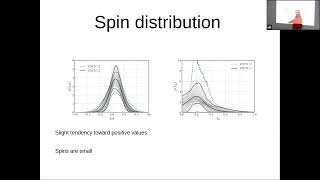
Where Do Merging Binary Black Holes Come From?
Explore the origins of merging binary black holes, examining LVK detections, formation models, and their comparison to observational data.
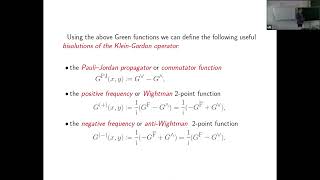
Feynman Propagator on Curved Spacetimes - Definitions and Examples
Explore the Feynman propagator in Quantum Field Theory, examining its definitions and applications across various spacetime models, including stationary, FLRW, and de Sitter.
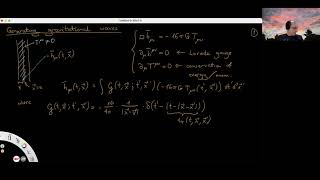
Gravitational Wave Sources, Detectors, and Schwarzschild Metric - Lecture 14
Explore gravitational wave sources, detectors, and the Schwarzschild metric in this advanced physics lecture, covering quadrupole formula and total power calculations.
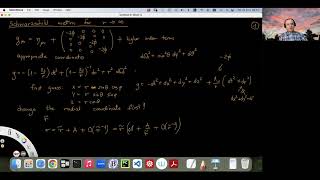
Schwarzschild Metric in General Relativity - Lecture 15
Explore the Schwarzschild metric's properties, including gravitational effects, geodesics, and orbits in this advanced graduate-level physics lecture on general relativity.
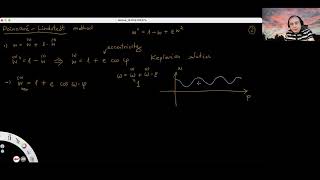
Schwarzschild Metric and Event Horizon - Lecture 16
Explore Schwarzschild metric, event horizons, and black hole physics in this graduate-level lecture. Delve into perihelion precession, coordinate systems, and global structure of Schwarzschild solutions.
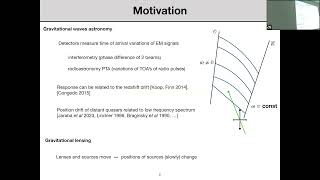
Redshift Drift, Position Drift and Caustics in General Relativity
Explore redshift and position drifts in general relativity, examining their formulas, physical consequences, and applications in gravitational lensing, astrometry, and cosmology.
What We Think We Know About Lyman Alpha Emitting Galaxies - Lecture
Explore high-redshift Lyman Alpha Emitting galaxies, examining common assumptions and their validity. Discover ongoing research methods to test these hypotheses about LAEs.
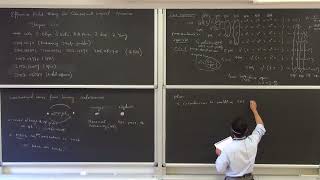
Effective Field Theory for Gravitational Inspiral Dynamics
Explore advanced concepts in gravitational wave physics, focusing on effective field theory applications to binary inspiral dynamics and post-Newtonian expansions.
How to Survive on Mars
Explore Mars survival challenges and solutions with expert insights on microbial adaptation, methane detection, and sustainable habitation in extreme Martian conditions.
Soaring Through the Clouds of Titan with Dragonfly - NASA's Mission to Saturn's Moon
Explore Saturn's moon Titan with Dr. Elizabeth Turtle, lead scientist of NASA's Dragonfly mission. Learn about the unique methane-based environment and the rotorcraft lander designed to study this intriguing world.
Slow, Energy-Efficient, and Mysterious Life Deep Within Earth's Crust
Explore cutting-edge astrobiology research at AbGradCon 2023, featuring keynotes on deep Earth life and early universal biology, plus diverse sessions on exoplanets, biosignatures, and origins of life.
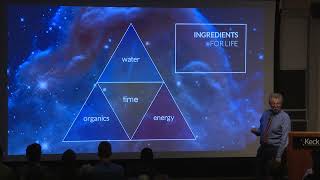
Origins and Evolution of Life in Space and Time
Explore the origins and evolution of life across space and time, from Earth's early days to potential habitable environments on other planets and moons in our solar system and beyond.
Journeys at Mars: Discoveries and Future Exploration
Explore Mars' 30-year journey through expert insights on key discoveries and future missions. Gain perspectives from international scientists and astronauts on Red Planet exploration.