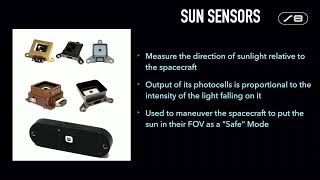
Behind the Scenes of Mission Control: Navigating Spacecraft Operations and Space Exploration
Dive into spacecraft operations and mission control through a Flight Director's eyes, exploring navigation, space challenges, and the impact of space exploration on humanity.
Infinite Beginnings - Time and Origins in Modern Cosmology
Explore cutting-edge cosmological theories with Brian Greene and Will Kinney as they investigate eternal inflation and challenge conventional ideas about the universe's beginning.
Efforts at RRI Towards Hunting Elusive Signatures from the First Stars
Explore groundbreaking research on detecting signals from the universe's first stars, examining innovative detection methods and scientific discoveries at the Raman Research Institute.
X-ray Polarimetry in Astrophysics
Discover the fascinating world of X-ray polarimetry and its role in understanding celestial objects through advanced astrophysical observations and measurement techniques.
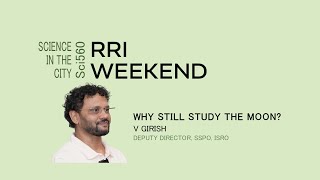
Why Still Study the Moon? - Exploring Lunar Science in Modern Times
Discover fascinating insights about lunar exploration, ongoing research, and the Moon's scientific significance in modern space studies through an engaging discussion by V Girish.

The History of Black Holes - From Theory to Discovery
Explore the profound mysteries of black holes with Marcus Chown, uncovering their crucial role in understanding physics, the universe's origins, and humanity's existence in space and time.
Space Flight in 2024: The Future of Civilian Space Travel
Explore the future of civilian space travel, from potential orbital hotels to lunar resorts, examining costs, developments, and the transformative impact on humanity's journey beyond Earth.
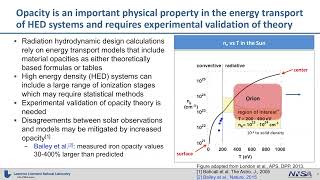
Stellar-Relevant Emission-Based Opacity Experiments at the Orion Laser Facility
Explore stellar-relevant emission-based opacity experiments conducted at the Orion Laser Facility, advancing our understanding of high energy density physics.
Topological Evolution of Time in Unimodular Gravity
Explore the concept of topological evolution of time within the framework of Unimodular Gravity, as presented by Sayyed Rassouli from the University of Nottingham.
Probably Approximately Correct Mathematical Physics
Explore applications of machine learning in string theory and mathematical physics, focusing on black holes and higher-spin holography.
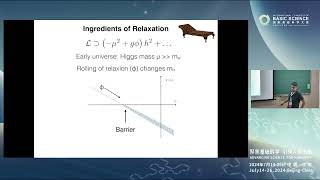
Cosmological Relaxation of the Electroweak Scale
Explore a novel approach to the electroweak hierarchy problem through cosmological evolution, challenging traditional solutions and expanding our understanding of early Universe dynamics.
The Next Big Gravitational Wave Discovery - Continuous Sources
Explore the future of gravitational wave astronomy, focusing on continuous sources and their potential for groundbreaking discoveries in the field.
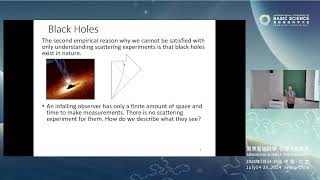
Bulk Locality and Quantum Error Correction in Holography
Explore quantum gravity through AdS/CFT correspondence, unraveling the emergence of local physics and its connection to quantum error correction.
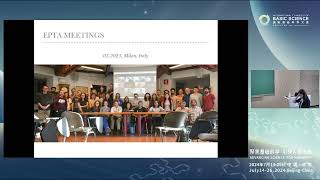
The Second Data Release from the European Pulsar Timing Array - Search for Gravitational Wave Signals
Explore the latest findings from the European Pulsar Timing Array's second data release and its implications for gravitational wave detection.
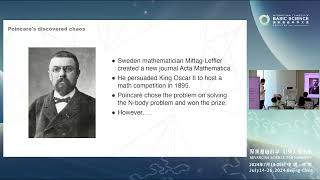
On the Painleve Conjecture in Celestial Mechanics - ICBS 2024
Explore the solution to the Painleve conjecture in celestial mechanics, focusing on noncollision singularities in the four-body problem of Newtonian mechanics.
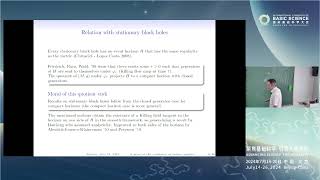
Constancy of Surface Gravity for Non-Degenerate Compact Horizons
Explore non-degenerate compact horizons, surface gravity constancy, and connections to cosmic censorship in general relativity.
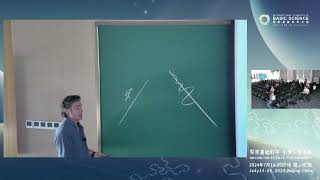
Non-linearities and Gravitational Signals from Black Hole Spacetimes
Explore non-linear behavior of perturbed black holes and its implications for gravitational wave detection and new physics in mergers.
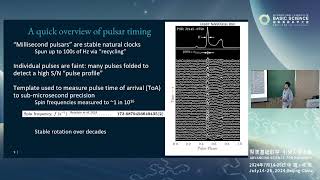
The Parkes Pulsar Timing Array Third Data Release: Overview and Search for an Isotropic Gravitational-wave Background
Explore the Parkes Pulsar Timing Array's latest data release, focusing on gravitational wave detection techniques and results from isotropic stochastic background searches.
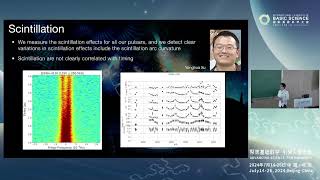
Searching for Gravitational Wave Background with Chinese Pulsar Timing Array Data Release I
Explore gravitational wave detection using Chinese Pulsar Timing Array data. Learn about millisecond pulsar observations, data analysis techniques, and key findings in the search for nanohertz gravitational wave backgrounds.
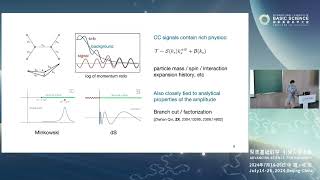
Family Tree Decomposition of Cosmological Correlators
Explore analytical methods for computing cosmological correlators, including family tree decomposition for nested time integrals in dS and FRW universes.
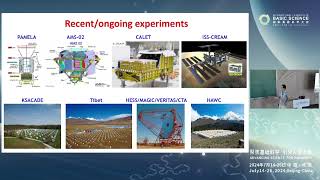
Measurement and Implication of Diffuse Gamma-Ray Emission from the Galactic Plane at Ultra-High Energies
Explore ultra-high energy gamma-ray emissions from the Galactic plane using LHAASO data, examining spectral characteristics and implications for cosmic ray propagation models.