The Statistical Structure of Identifiable Generative Models
Explore the statistical structure of identifiable generative models, focusing on causal representation learning, model identifiability, and unique inferences from observations under suitable assumptions.

Stochastic Interpolants: A Unifying Framework for Flows and Diffusions - Lecture
Explore a unified framework for generative models, bridging flow-based and diffusion-based methods using stochastic interpolants. Learn about probability flow equations, likelihood estimation, and applications in AI for drug discovery.
Lilac: A Modal Separation Logic for Conditional Probability
Explore Lilac, a novel separation logic for probabilistic programs, introducing a modality for conditional probability reasoning and validating its effectiveness through formal verification examples.

Maximum Entropy and Species Distribution Modeling - 2007 - Lecture
Explore maximum entropy methods for species distribution modeling, covering theoretical guarantees, experimental tests, and applications in conservation biology.
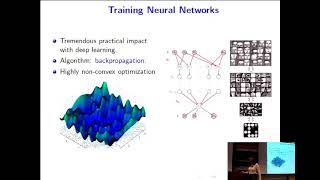
Guaranteed Training of Neural Networks Using Tensor Methods - 2015
Explore guaranteed neural network training using tensor methods. Learn about overcoming non-convexity, risk bounds, and combining unsupervised learning with supervised tasks.

Probabilistic Methods for Classification - 2009
Explore probabilistic methods for classification, covering supervised learning, estimation, and advanced models like Naive Bayes, Maximum Entropy, and Conditional Random Fields.
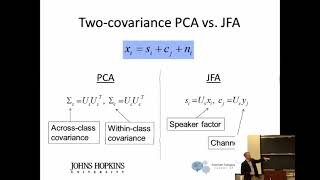
Recent Progress in Acoustic Speaker and Language Recognition - October 2013
Explore recent advancements in speaker and language recognition, focusing on GMM subspace methods, pattern classification, and Bayesian approaches for improved performance and domain adaptation.
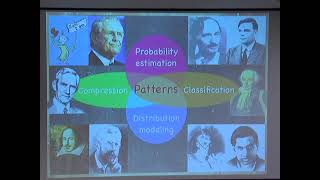
Values and Patterns in Data Learning - 2009
Explore discrete value analysis in data learning through distribution modeling, probability estimation, data compression, and classification. Discover insights from renowned mathematicians and information theorists.

Learning Energy-Based Models of High-Dimensional Data - 2002
Explore energy-based models for high-dimensional data analysis. Learn about deterministic networks, perceptual inference, and efficient learning techniques for large-scale models.

Supervised Learning Algorithms - Lecture 3
Explore supervised learning algorithms, model evaluation, and Python implementation for classification and regression tasks in petroleum engineering and energy transition.

Probabilistic Programming in Python - Conf42 Python 2024
Explore Bayesian statistics, probabilistic modeling, and MCMC in Python. Learn key concepts and practical applications through demonstrations and workflow explanations.
Reducing Costs in Distributed Tracing: Strategies for Efficient Observability
Optimize distributed tracing costs while maintaining effectiveness. Learn span tweaking, custom sampling, and OpenTelemetry techniques to balance observability and expenses in cloud environments.
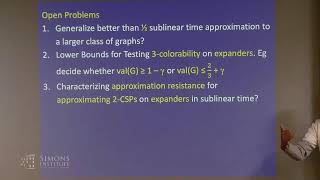
Sublinear Time Algorithms for Max-Cut Approximation on Expander Graphs
Explore random walks on graphs to achieve better-than-1/2 approximation for max-cut on expanding and clusterable graphs, using sublinear time algorithms.

Shaving Logs by Weighing Coins - Extroverted Sublinear Algorithms
Explore innovative sublinear algorithms for efficient data analysis, focusing on log-shaving techniques and coin-weighing problems in computational complexity.

Machine Learning for Petrophysics
Explore machine learning applications in petrophysics with expert Osama Osman, covering key concepts and practical implementations for oil and gas industry professionals.

Quantifying Fractal and Multifractal Scaling Exponents of Geophysics Data
Explore fractal and multifractal analysis methods for geophysical data, including self-similar and self-affine fractals, with demonstrations of software and applications to atmospheric and climate data.

Back to Basics - Using Descriptive Statistics to Study the Shape of the Internet
Explore descriptive statistics to analyze Internet structure, uncovering insights into its shape and characteristics through fundamental data analysis techniques.
Tea - A High-level Language and Runtime System for Automating Statistical Analysis
Introduces Tea, a declarative language for automating statistical analysis. Simplifies hypothesis testing by determining valid tests based on study design and assumptions, lowering barriers to accurate statistical research.

Detecting Discriminatory Risk through Data Annotation Based on Bayesian Inferences
Explore Bayesian inference techniques for detecting discriminatory risk in data annotation, enhancing fairness and accountability in machine learning systems.

A Bayesian Model of Cash Bail Decisions
Explore a Bayesian approach to modeling cash bail decisions, examining the factors influencing judicial determinations and their implications for fairness in the criminal justice system.
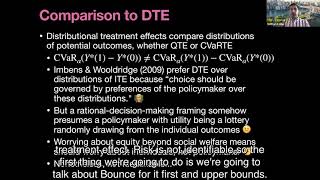
Treatment Effect Risk - Bounds and Inference
Explore bounds and inference in treatment effect risk analysis, focusing on statistical methods for causal inference and risk assessment in experimental studies.