
Distributed Systems
These videos form an 8-lecture series on distributed systems, given as part of the undergraduate computer science course at the University of Cambridge.
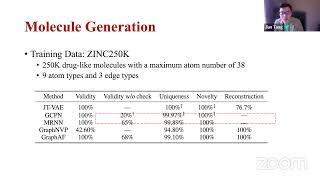
Geometric Deep Learning for Drug Discovery
Explore geometric deep learning techniques for drug discovery, covering graph neural networks, molecule generation, and retrosynthetic prediction. Gain insights into cutting-edge research and applications in pharmaceutical development.
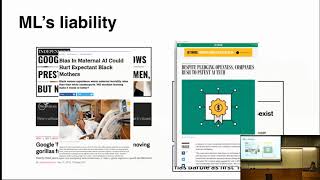
Extending the Theory of ML for Human-Centric Applications
Exploring ML challenges in real-world applications, focusing on data manipulation, multi-objective optimization, and robustness in dynamic environments with human-centric considerations.

Durkheim and Social Facts - Foundations of Modern Social Thought
Explore Durkheim's sociological methodology, examining social facts, collective representations, and the challenges of objectively studying society's values and sentiments.
Introduction to the Four-Vector in Special Relativity - Lecture 14
Explore the four-vector concept in physics, unifying space-time coordinates and energy-momentum, with emphasis on Lorentz transformations and the invariant space-time interval.
David Krakauer on Emergent Political Economies and A Science of Possibility
Exploring emergent political economies through complexity science, examining historical tensions, mathematical approaches, and collective computation to understand societal dynamics and possibilities.
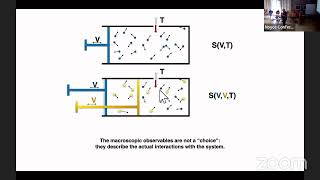
What Makes the Past Different from the Future?
Explore the fundamental differences between past and future, examining scientific concepts and philosophical implications in this thought-provoking lecture on time's arrow.
Causal Representation Learning Through Multi-Modal Data Integration
Explore causal representation learning techniques for integrating multi-modal data in this workshop by Caroline Uhler from MIT and Broad Institute.
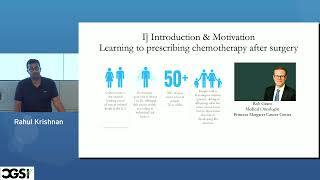
Bridging the Gap: Deep Learning and Causality
Explore the intersection of deep learning and causality, focusing on bridging the gap between these fields. Gain insights into recent advancements and their applications in computational genomics.
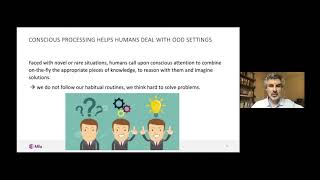
Priors for Semantic Variables - Yoshua Bengio
Explore semantic variables, learning theory, and cognitive processes with Yoshua Bengio. Delve into attention mechanisms, causality, and modular recurrent networks for advanced machine learning insights.

The Primacy of Experiment - Kyle Cranmer
Explore the interplay between physics and mathematics, focusing on experimental validation and the potential for unifying theories in understanding the universe's fundamental laws.

Causality in Machine Learning - Panel Discussion
Experts discuss interpretable machine learning in natural and social sciences, exploring causal inference and its applications across various fields.
Introduction to Performative Prediction - Tutorial 1
Explore performative prediction in machine learning, examining its impact on data distribution, equilibrium challenges, and connections to statistics, game theory, and causality. Gain insights into steering and power dynamics in digital markets.
Distributed Computing Meets Game Theory
Explore the intersection of distributed computing and game theory, examining their synergies and applications in multi-agent systems and decision-making processes.

Time Travel Paradoxes in Doctor Who and Futurama - Sci-Phi: Science Fiction as Philosophy
Explore time travel paradoxes through popular sci-fi, examining philosophical implications, Einstein's relativity, and potential solutions like branching timelines and predestination, challenging our understanding of causality and reality.

Networks from Real Data - Algorithmic Information Dynamics
Explore algorithmic information dynamics and its applications in causality and living systems, from networks to cells, using computational approaches.

Correlation vs. Causality - Unraveling the Relationship
Explore the crucial distinction between correlation and causation through real-world examples and philosophical insights, enhancing critical thinking skills for data interpretation and decision-making.
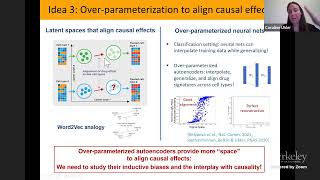
Causality and Autoencoders in Light of Drug Repurposing for COVID-19
Explore causal inference and autoencoders in drug repurposing for COVID-19, covering observational data, causality hierarchy, and predicting interventions with Caroline Uhler from MIT.
Invariance, Causality and Novel Robustness
Explore invariance, causality, and robustness in high-dimensional statistics. Learn about modern applications, heterogeneous data, and novel approaches to prediction problems using causal inference techniques.
Morning Session- Causality
Explore racial bias in data, examining tensions between quantitative and qualitative approaches. Experts discuss implications for fairness and accuracy in research and decision-making.
Causality in a Post-Cookie World
Explore causal learning for data-driven marketing decisions in an era of privacy protection and unpredictable market conditions.