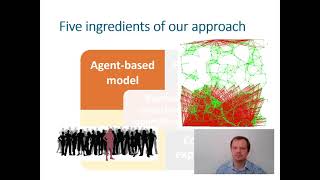
Agent Based Modeling
Explore agent-based modeling for social research, covering model creation, analysis, and documentation, with insights on time dynamics and data quality assessment.

The Carbonate Forum - The Importance of Quantification in Carbonate Sedimentology
Explore quantitative approaches in carbonate sedimentology, discussing uncertainty, numerical models, and interdisciplinary collaboration for improved geological understanding and interpretation.
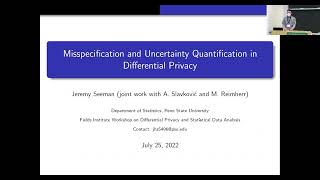
Misspecification, and Uncertainty Quantification in Differential Privacy
Explore differential privacy's theoretical guarantees, misspecification issues, and uncertainty quantification methods. Gain insights into designing mechanisms and addressing implementation challenges.

Trying to Make Sense of Control from Pixels
Explores challenges in merging machine learning with control systems, focusing on autonomous vehicles using vision. Discusses uncertainty quantification, robust controller design, and performance guarantees.
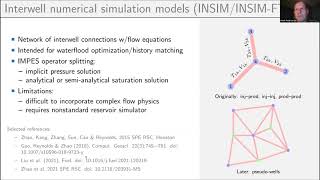
Graph-Based Methods for Reduced-Order Reservoir Simulation
Explore graph-based approaches for reduced-order reservoir simulation, comparing interwell methods like GPSNet with CGNet, which mimics 3D grid connections. Learn about their setup, training, and generalization capabilities.

The Role of Computational Social Science in Policymaking - Session 6
Expert panel explores computational social science's role in policymaking, discussing micro data, agent-based models, empirical validation, and applications in fisheries, energy, and digital twins to enhance decision-making processes.
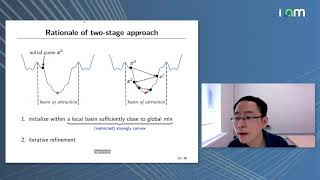
The Effectiveness of Nonconvex Tensor Completion - Fast Convergence and Uncertainty Quantification
Explores nonconvex optimization for tensor completion, proposing a two-stage algorithm with guaranteed success, linear convergence, and statistical accuracy. Discusses distribution characterization and confidence interval construction.
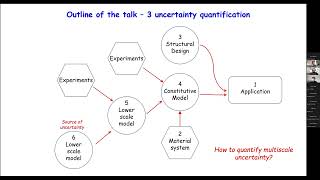
Learning-Based Multiscale Modelling: Computing, Data Science, and Uncertainty Quantification
Explore machine learning frameworks for multiscale modeling in materials science, including Fourier and recurrent neural operators, to accelerate computations and bridge scales across multiple physics levels.

Federated and Collaborative Learning - Session 1
Explore cutting-edge topics in federated learning, including data valuation, privacy, uncertainty quantification, and scaling to foundation models, presented by leading experts in the field.
Distributionally Robust Hypothesis Tests - IFDS 2022
Explore distributionally robust hypothesis tests with Yao Xie, delving into advanced statistical methods for robust decision-making under uncertainty.
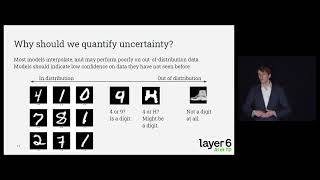
Quantifying the Uncertainty in Model Predictions Using Conformal Prediction
Learn techniques for quantifying uncertainty in neural network predictions, focusing on conformal prediction as a versatile, statistically rigorous method applicable to classification and regression tasks.
Sequential Design Based on Mutual Information for Computer Experiments - Joakim Beck, KAUST
Explore uncertainty quantification using Gaussian Process emulators for complex systems. Learn about sequential design methods, mutual information criteria, and applications in climate, tsunami, and earthquake modeling.

Known Boundary Emulation of Complex Computer Models - Ian Vernon, Cambridge
Explore efficient methods for emulating complex computer models using Known Boundary Emulation, focusing on uncertainty quantification and applications in climate, tsunami, and earthquake problems.
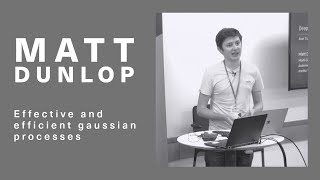
Deep Gaussian Processes for Bayesian Inversion - Matt Dunlop, Courant
Explore deep Gaussian processes for Bayesian inversion, covering theoretical foundations, numerical methods, and applications in uncertainty quantification for complex physical systems.

Pragmatically Ambitious Multiscale Global Temperature Reconstruction - Finn Lindgren, Edinburgh
Explore pragmatic approaches to global temperature reconstruction using multiscale models, data sources, and statistical techniques for uncertainty quantification and bias correction.

Workshop on Probabilistic Numerical Methods - Panel Discussion
Panel discussion exploring probabilistic numerical methods, covering topics like reference priors, robust uncertainty quantification, and Bayesian inversion methods for improved statistical inference and error quantification.

Uncertainty Quantification of Quantum Chemical Methods - IPAM at UCLA
Explore uncertainty quantification in quantum chemistry, covering error estimation, benchmarking, and machine learning approaches for improved accuracy in computational methods.
Deep Learning and Computations of PDEs by Siddhartha Mishra
Explore deep learning applications in PDEs, uncertainty quantification, and optimization. Learn about operator learning, DeepOnet decomposition, and high-dimensional PDEs in this advanced lecture.

Uncertainty Quantification for Kinetic Equations I
Overview of uncertainty quantification for kinetic equations, covering Monte Carlo methods, multi-fidelity techniques, and stochastic Galerkin particle methods. Explores computational challenges and recent advancements in the field.
Learning Uncertainty-Aware Models of Defect Kinetics at Scale - IPAM at UCLA
Explore advanced techniques for modeling metal properties, including energy landscape exploration, coarse-graining with uncertainty quantification, and descriptor-based approaches for capturing diverse material characteristics.
Adaptive Computing and Multi-Fidelity Learning - IPAM at UCLA
Explore adaptive computing and multi-fidelity learning for efficient optimization and uncertainty quantification in complex scientific workflows, with applications and scaling challenges discussed.