Business Analytics for Management Decision
This course will be exclusively quantitative and an application to business/management-related problems. It is connected with problem sets and real life cases to know the relevance of a particular problem and the decision-making thereof.
Deep Generative Models - Discrete Latent Variable Models - Lecture 17
Explore discrete latent variable models in deep generative modeling, covering key concepts and applications in AI and machine learning.
Deep Generative Models - Maximum Likelihood Learning - Lecture 4
Explore maximum likelihood learning in deep generative models with Stanford's Stefano Ermon. Gain insights into advanced AI techniques and their applications in this comprehensive lecture.
Causal Inference Bootcamp - Your Guide to Experiments
Comprehensive guide to causal inference, covering experimental design, analysis, and real-world applications. Explores controlled experiments, natural experiments, and key issues in research methodology.
Physics-Inspired Algorithms and Phase Transitions in Community Detection - 2014 Symposium
Explore physics-inspired algorithms for community detection, including phase transitions, statistical inference, and belief propagation. Learn about innovative approaches to clustering and network analysis.
On the Foundations of Info-Metrics
Explore the science of info-metrics for modeling and inferring from limited data, with insights on reasoning under uncertainty and insufficient information.
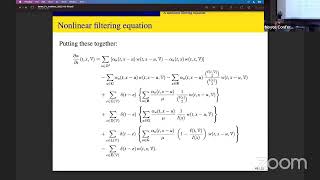
Phylodynamics and Markov Genealogy Processes
Explore phylodynamics and Markov genealogy processes to infer disease transmission from genomic data. Learn about a unified approach using exact likelihood expressions and dynamic genealogy evolution.

Advanced Probability Theory
The course introduces the concept of probability through Kolmogorov’s Axioms. It develops the concept of probability density function, cumulative distribution function, and introduces the concept of a random variable.
Data Thinning to Avoid Double Dipping in Statistical Analysis - Lecture 1
Explore data thinning techniques to prevent double dipping in statistical analysis, with applications in single-cell RNA sequencing and unsupervised learning problems.
Causal Representation Learning Through Multi-Modal Data Integration
Explore causal representation learning techniques for integrating multi-modal data in this workshop by Caroline Uhler from MIT and Broad Institute.
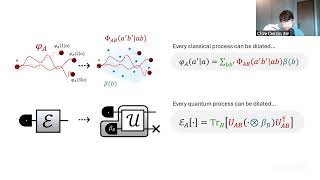
Irreversibility and Inference: Classical and Quantum Reverse Processes via Bayesian Inversion
Explore classical and quantum reverse processes through Bayesian inversion, delving into irreversibility and inference concepts with Clive Cenxin Aw.

The Statistical Process
Explore key statistical concepts including data types, sampling methods, survey design, inference, significance, and measures of central tendency and spread.
Hypothesis Testing and P-Values
Learn key concepts in statistical inference, including p-values, hypothesis testing, t-tests, and ANOVA. Develop skills to choose appropriate tests and interpret results for data-driven decision making.
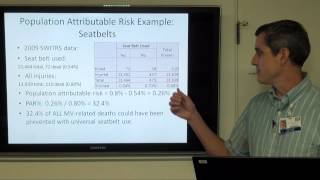
Biostatistics and Epidemiology Lecture Series
Comprehensive lecture series covering essential biostatistics and epidemiology concepts, from basics to advanced topics like probability, statistical inference, and survival analysis.

Fundamentals of Biostatistics
Learn key biostatistics concepts, research methods, data types, and the scientific process for effective study design and analysis in health sciences.
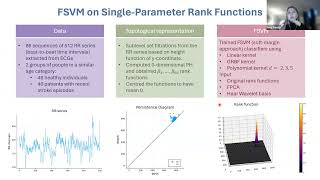
Computable Stability for Persistence Rank Function Machine Learning
Exploring persistent rank functions and rank invariants as alternatives to persistent homology barcodes, with applications in machine learning and topological data analysis.
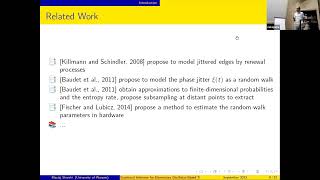
Statistical Inference for Elementary Oscillator-Based True Random Number Generators
Poznaj metody statystycznego wnioskowania dla generatorów liczb losowych opartych na oscylatorach elementarnych.
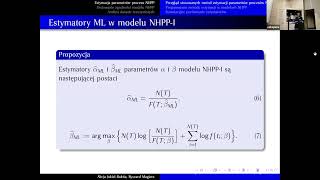
Wnioskowanie Statystyczne dla Modeli Niezawodności Oprogramowania
Poznaj metody wnioskowania statystycznego w modelach niezawodności oprogramowania. Zgłęb techniki analizy i oceny niezawodności systemów informatycznych.

Norwegian Regional Stochastic Model of COVID-19 Epidemics
Explore Norway's stochastic SEIR model for COVID-19, including data collection, mobility tracking, and decision-making processes in public health management.
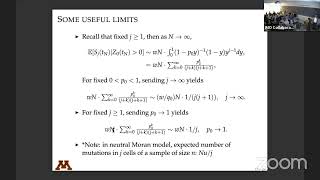
Computational Methods for Inferring Tumor Evolution and Heterogeneity
Explore computational techniques for analyzing tumor evolution and heterogeneity, enhancing understanding of cancer progression and treatment strategies.
Tree-Free Phylodynamic Inference for Emerging Viral Pathogens and Lineages
Explore tree-free phylodynamic methods for analyzing emerging viral pathogens and lineages, focusing on innovative approaches to study viral evolution and spread.