
Implicit Regularization for General Norms and Errors - Lorenzo Rosasco, MIT
Explores implicit regularization in optimization methods, focusing on stability in estimation processes for non-Euclidean norms and non-quadratic errors, with emphasis on accelerated techniques.
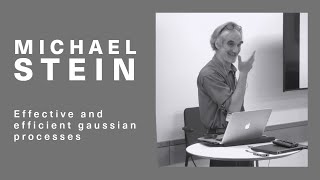
Some Thoughts on Gaussian Processes for Emulation of Deterministic Computer Models
Explore Gaussian Process emulators for complex computer models in uncertainty quantification, focusing on theoretical aspects and applications to climate, tsunami, and earthquake problems.

Adaptive Sampling via Sequential Decision Making - András György
Explore adaptive sampling methods using multi-armed bandit algorithms and MCMC samplers to optimize resource allocation and improve sample quality in machine learning applications.
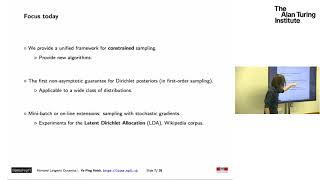
Mirrored Langevin Dynamics - Ya-Ping Hsieh
Explore posterior sampling in constrained distributions, focusing on Latent Dirichlet Allocation. Learn about a unified framework for deriving novel sampling schemes with improved convergence rates.

Building Efficient Learning Algorithms: A Computational Regularization Perspective - Lorenzo Rosasco
Explore efficient learning algorithms through a computational regularization lens. Unify algorithmic tricks in least squares learning for accuracy and resource efficiency.
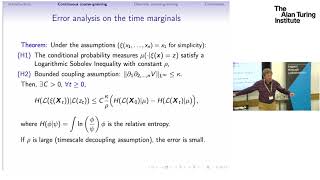
Coarse-Graining Stochastic Dynamics
Explore techniques for simplifying complex stochastic systems through coarse-graining, enabling practical computation and accurate prediction in various scientific fields.
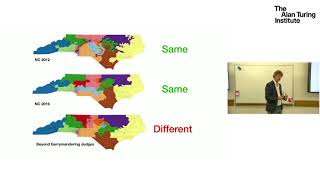
Understanding the Geopolitical Structure of the USA
Explore statistical approaches for analyzing geopolitical structures in the USA, combining data analysis with complex systems modeling to uncover crucial features and patterns.
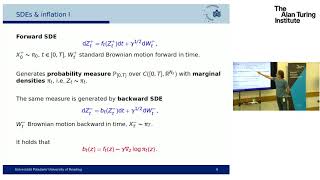
Learning Models by Making Them Interact
Explore new approaches to data-driven modeling of complex systems, combining statistical inference, high-throughput computation, and physical laws for more accurate predictions in various scientific fields.

Generative Techniques for Music AI
Explore diverse techniques for AI music generation, from symbolic AI to deep learning, covering optimization algorithms, complex systems, and statistical methods. Gain insights into key approaches and their applications.
Machine Learning for LHC Theory - Lecture 1
Explore machine learning applications in high-energy physics, focusing on LHC theory. Learn key concepts and techniques for analyzing complex particle collision data and uncovering new physics insights.

The Startling Reason Entropy and Time Only Go One Way
Explore the fascinating connection between entropy, probability, and the unidirectional flow of time. Discover why natural phenomena tend towards lower energy states and how this relates to the universe's increasing disorder.
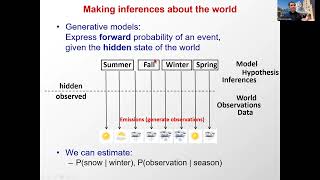
Expression Analysis, Clustering, and Classification in Machine Learning - Lecture 2
Comprehensive exploration of machine learning concepts, from basic principles to advanced techniques, with applications in gene expression analysis and text clustering.
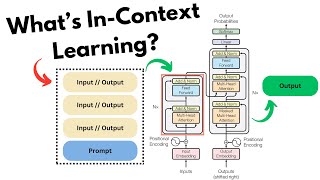
In-Context Learning in Deep Learning - How It Works in Large and Small Language Models
Explore in-context learning in LLMs: definition, significance, Bayesian framework, and implementation. Gain insights into this surprising capability of language models and its implications for AI.
Probabilistic Inference in Language Models via Twisted Sequential Monte Carlo
Explore advanced probabilistic inference techniques for language models using Twisted Sequential Monte Carlo, enhancing LLM capabilities and safety measures.
Reliable Machine Learning in Healthcare
Explore reliable machine learning techniques for healthcare applications, focusing on survival models, dependent censoring, and covariate shift detection to enhance medical decision-making.
What Is ChatGPT Doing? Understanding Large Language Models - Episode 2
Explore the inner workings of ChatGPT and large language models, understanding their token-by-token generation process and the complexities behind their seemingly intelligent outputs.
Machine Learning Models for Single Cell and Regulatory Genomics - CGSI 2023
Explore machine learning models for single-cell and regulatory genomics, focusing on recent research and applications in computational biology.
Efficiently Exploring Combinatorial Perturbations From High Dimensional Observation
Explore efficient methods for analyzing combinatorial perturbations in high-dimensional data, focusing on innovative approaches and practical applications.
GFlowNet Foundations and Applications in Biological Sequence Design
Explore GFlowNet foundations and applications in biological sequence design. Learn about flow conservation, transition probabilities, and practical implementations for molecule generation and peptide design.
DiGress: Discrete Denoising Diffusion for Graph Generation
Explore DiGress, a discrete denoising diffusion model for graph generation with categorical attributes. Learn about its innovative approach, challenges, and state-of-the-art performance in molecular and non-molecular datasets.
Linear Structure of High-Level Concepts in Text-Controlled Generative Models
Explore the linear structure of high-level concepts in text-controlled generative models, focusing on embedding, representation, and semantic encoding for precise model control.