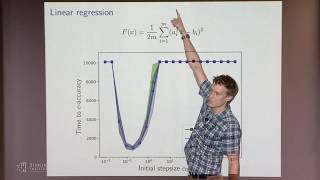
The Importance of Better Models in Stochastic Optimization
Explore stochastic optimization models, focusing on robustness, stability, and asymptotic minimax theory. Learn about weak convexity, sharp growth problems, and practical experiments.
Computation in Very Wide Neural Networks
Explore infinite-width neural networks, their correspondence to Gaussian processes, and implications for deep learning performance and dynamics in parameter space.
Understanding Unstructured Data with Language Models - Alex Peattie
Explore language models for unstructured data analysis, covering classification, predictive modeling, and information retrieval. Learn key concepts and practical applications in various fields.
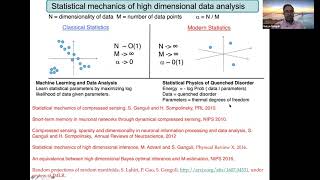
Weaving Together Machine Learning, Theoretical Physics, and Neuroscience
Exploring the intersection of machine learning, physics, and neuroscience through complex systems analysis to develop better algorithms and understand neural systems.
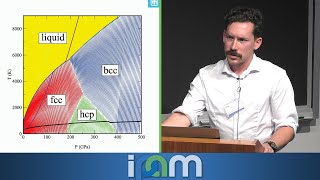
Machine Learning in Equation of State and Transport Modeling at Extreme Conditions
Explore machine learning applications in equation of state and transport modeling for extreme conditions, enhancing accuracy and efficiency in material science and astrophysics research.
Introduction to Quantum Algorithms - IPAM at UCLA
Explore quantum algorithms, focusing on Grover's algorithm, with mathematical foundations, quantum circuits, and practical applications in this comprehensive introduction.

End-to-End Learning and Auto-Differentiation - Forces, Uncertainties, Etc.
Explore deep learning and auto-differentiation in molecular simulations, covering surrogate functions, sampling distributions, and time-propagation of differential equations for scientific problem-solving.
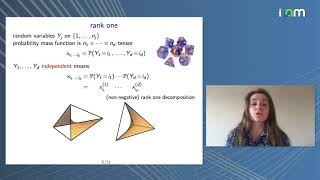
Tensors in Statistics and Data Analysis
Explore tensors in statistics and data analysis, covering probability tensors, biological measurements, and signature tensors for time-series data. Learn about decompositions and algebraic properties in this comprehensive overview.
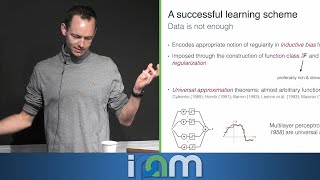
Machine Learning Basics: A Speedrun - IPAM at UCLA
Speedrun through machine learning fundamentals, covering key concepts like inductive bias, regularization, and kernel methods for both linear and nonlinear regression.
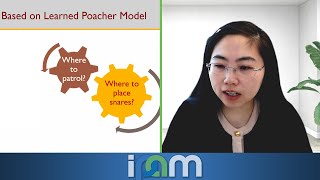
Machine Learning and Game Theory for Social Impact
Explore machine learning and game theory applications in security, sustainability, and food rescue, featuring real-world deployments and innovative solutions for societal challenges.
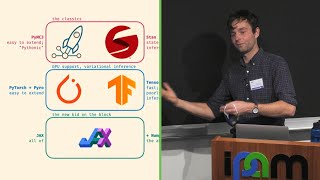
Methods for Scalable Probabilistic Inference - IPAM at UCLA
Explore scalable probabilistic inference methods for astrophysics, focusing on Gaussian Processes for time series analysis and open-source tools to accelerate Bayesian inference with large datasets.
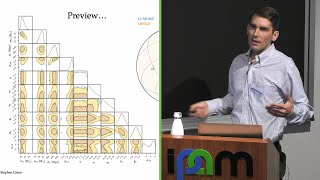
Real-Time Gravitational-Wave Parameter Estimation Using Machine Learning
Explore machine learning for real-time gravitational-wave parameter estimation, covering Bayesian inference, neural networks, and simulation-based techniques to enhance speed and accuracy in astrophysical data analysis.
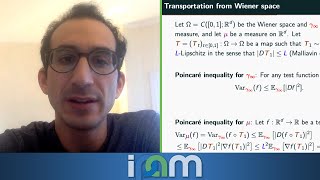
The Brownian Transport Map - IPAM at UCLA
Explore Lipschitz transport maps between probability measures, focusing on the Brownian transport map's construction, properties, and applications to Euclidean functional inequalities.
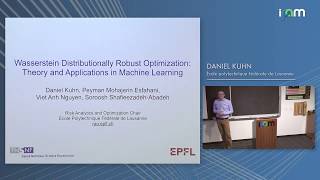
Wasserstein Distributionally Robust Optimization - Theory and Applications in Machine Learning
Explore Wasserstein distributionally robust optimization theory and its applications in machine learning, focusing on data-driven decision-making under uncertainty and statistical learning.
Machine Learning and Neural Networks: Simple and Multiple Linear Regression - Day 5
Learn simple and multiple linear regression techniques for machine learning and neural networks, covering key concepts and practical applications.
Deep Learning Applications by Rina Panigrahy
Explore deep learning applications, from basic concepts to advanced techniques. Learn about neural networks, optimization methods, and real-world uses in image and speech recognition.
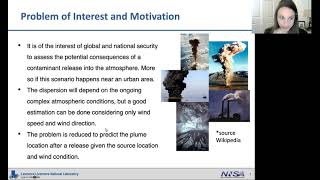
Machine Learning Approaches for Predicting Seismic, Acoustic and Atmospheric Data
Explore machine learning techniques for predicting seismic, acoustic, and atmospheric data, focusing on KNN and neural networks with uncertainty quantification for improved accuracy.

Deep Generative Modeling
Explore deep generative modeling, including autoencoders, VAEs, GANs, and diffusion models. Learn about latent variables, training techniques, and recent advances in generative AI.
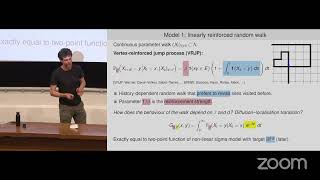
Spin Systems with Hyperbolic Symmetry
Explore spin systems with hyperbolic symmetry, their origins, applications in probabilistic models, recent findings, and open questions in this advanced mathematical discussion.
Generalization and Robustness in Offline Reinforcement Learning
Explore offline reinforcement learning for safety-critical applications, covering generalization, robustness, and imitation learning in large-scale settings with rich function approximation.
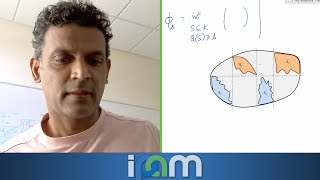
Gibbs Sampling for Convex Bodies and an L_0 Isoperimetric Inequality
Explore Gibbs sampling for high-dimensional distributions, focusing on convergence guarantees and conductance bounds for sampling from convex bodies. Gain insights into this widely-used algorithm's efficiency and limitations.