Designing Robust Learners
Explore robust machine learning techniques to handle data perturbations and improve model resilience, focusing on TV estimation, modulus examples, and arbitrary loss scenarios.
Better Learning from the Past - Counterfactual - Batch RL
Explore counterfactual and batch reinforcement learning for improved decision-making under uncertainty, with focus on generalization bounds and policy optimization techniques.

The Hamiltonian Monte Carlo Revolution Is Open Source - Probabilistic Programming with PyMC3
Explore Bayesian statistical computation and Hamiltonian Monte Carlo algorithms using PyMC3, an open-source probabilistic programming package. Learn to apply these advanced techniques to complex models in Python.
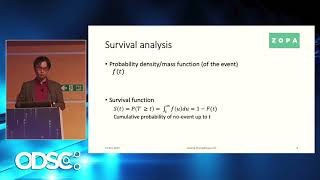
Deep Learning Survival Analysis for Consumer Credit Risk Modelling
Explore deep learning survival analysis for precise credit risk prediction in consumer lending, combining traditional methods with advanced techniques for improved time-to-event forecasting.
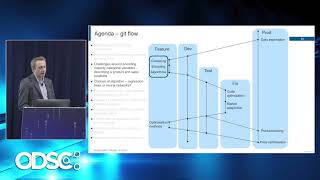
Price Optimisation - From Exploration to Productionising - David Adey, PhD & Alexey Drozdetskiy, PhD
Explore dynamic price optimization using machine learning, from data analysis to cloud deployment. Learn about feature encoding, model selection, efficiency improvements, and practical implementation strategies for revenue growth.
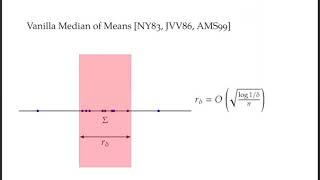
Algorithms for Heavy-Tailed Statistics - Regression, Covariance Estimation, and Beyond
Explore advanced statistical techniques for handling heavy-tailed data, including regression and covariance estimation, with a focus on SOS assumptions and median of means framework.
Quadratic Speedup for Finding Marked Vertices by Quantum Walks
Explore quantum walks for efficient vertex search, offering quadratic speedup over classical methods. Learn about structured search, constraints, and applications in quantum computing.
Machine Learning for Beginners - Data Scientists and Analysts
Comprehensive introduction to machine learning for data professionals, covering key concepts, techniques, and practical applications in business contexts, with hands-on coding examples.
Optimal Gradient-Based Algorithms for Non-Concave Bandit Optimization
Explore optimal gradient-based algorithms for non-concave bandit optimization, covering stochastic problems, low-rank linear rewards, and high-order polynomials with applications to reinforcement learning.

Dreamcoder- Bootstrapping Inductive Program Synthesis With Wake-Sleep Library Learning
Explore program induction and library learning in AI, focusing on DreamCoder's approach to synthesizing models and systems through neural-guided Bayesian inference and abstraction refinement.

Hybrid Classical-Quantum Algorithms
Explore hybrid algorithms combining quantum and classical computing for optimization and inference, leveraging strengths of both platforms to solve complex problems efficiently.

What Are the Statistical Limits of Offline Reinforcement Learning With Function Approximation?
Explore statistical limitations in offline reinforcement learning with function approximation, covering realizability, coverage, policy evaluation, and practical considerations.
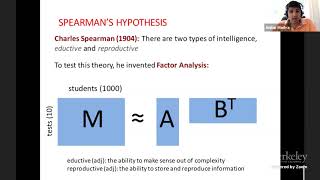
Recent Progress in High-Dimensional Learning
Explore recent advancements in high-dimensional learning, covering factor analysis, phylogenetic reconstruction, and hidden Markov models, with applications in genetics and machine learning.
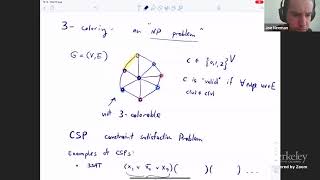
Crash Course on Probabilistically Checkable Proofs - Introduction
Explore probabilistically checkable proofs, including recoloring, constraint satisfaction, and the PCP theorem. Learn about verifier parameters and hardness of approximation in this comprehensive introduction.
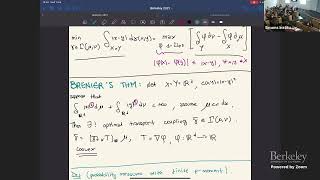
Crash Course on Optimal Transport
Explore optimal transport theory, its applications, and key concepts like cost formulation, optimal coupling, and transport maps in this comprehensive lecture.
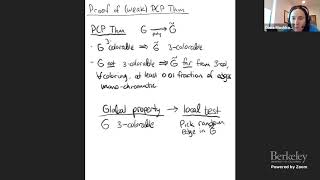
Crash Course on Probabilistically Checkable Proofs - PCP
Explore probabilistically checkable proofs, their formulation, global vs local tests, and computational implications in this comprehensive lecture on advanced theoretical computer science concepts.
Mind Over Data - The One Thing You Know and Machines Don't
Explore the intersection of human intuition and machine learning in causal reasoning, examining Bayesian networks, confounding factors, and real-world applications in AI and data analysis.
From Classical Statistics to Modern Machine Learning
Explore the evolution from classical statistics to modern machine learning, examining key concepts like generalization, interpolation, and the "double descent" phenomenon in supervised learning.
Can Non-Convex Optimization Be Robust?
Explore non-convex optimization's robustness, examining locally optimizable functions, perturbed objectives, and matrix completion. Insights on empirical vs. population risk and semi-random adversaries.
Nearest Neighbors I
Explore nearest neighbor algorithms in machine learning, covering regression, classification, consistency, and convergence rates in metric spaces. Gain insights into statistical learning frameworks and smoothness conditions.
K-Means and K-Medians Under Dimension Reduction
Explore k-means and k-medians clustering algorithms under dimension reduction, examining distortion graphs, cost analysis, and combinatorial lemmas for robust high-dimensional statistics.