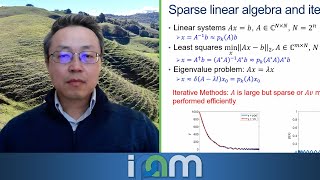
Practical Quantum Circuits for Block Encodings of Sparse Matrices
Explore efficient quantum circuits for block encodings of sparse matrices, focusing on strategies for well-structured matrices and quantum walks on graphs. Gain insights into quantum linear algebra algorithms.

Embedding as a Tool for Algorithm Design
Explore embedding algorithms for structured data prediction, combinatorial optimization, and dynamic network processes. Learn innovative approaches to algorithm design using latent variable models and mean field techniques.
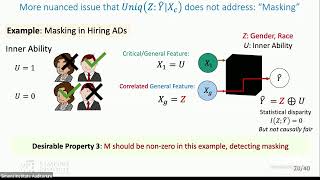
Algorithmic Fairness From The Lens Of Causality And Information Theory
Explore algorithmic fairness through causality and information theory, focusing on identifying and explaining sources of disparity in ML models and quantifying accuracy-fairness trade-offs.
Wasserstein GANs Work Because They Fail - to Approximate the Wasserstein Distance
Explore the counterintuitive success of Wasserstein GANs despite their failure to accurately approximate the Wasserstein distance, offering insights into their effectiveness in generative modeling.

Hidden Symmetries of Computational Problems
Explore hidden symmetries in computational problems, uncovering geometric methods for optimization and sampling with insights from experts in mathematics and quantum computing.

Optimal Iterative Algorithms for Problems With Random Data
Explore advanced iterative algorithms for solving problems with random data, focusing on computational complexity in statistical inference.
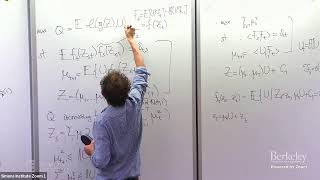
Optimal Iterative Algorithms for Problems With Random Data
Explore optimal iterative algorithms for statistical problems with random data, focusing on computational complexity and efficient solutions in statistical inference.
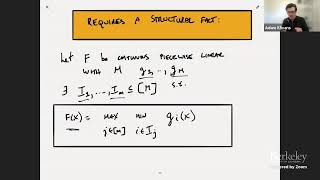
In Search of New Algorithms Part I - Neural Networks
Explore neural networks and their role in developing new algorithms, focusing on computational complexity and statistical inference challenges.

The Power and Limitations of Kernel Learning
Explore kernel learning's potential and limitations in modern machine learning, including practical implementations, comparisons with state-of-the-art methods, and insights into overfitting and acceleration.

Learning One-Hidden-Layer Neural Networks with Landscape Design
Explore optimization techniques for one-hidden-layer neural networks, focusing on landscape design and new objective functions to overcome traditional training challenges.

Latency SLOs Done Right - Calculating and Setting Accurate Service Level Objectives
Explore accurate latency SLO calculation methods, including histogram-based approaches, to set mathematically correct quantiles and improve service level objectives for better monitoring and performance management.

Deep Learning for Survival Analysis
Explore deep learning models for survival analysis, applying them to predict time-to-event outcomes in various fields like credit, machinery, and healthcare with Louise Ferbach.
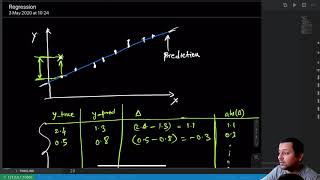
Simple and Basic Evaluation Metrics for Regression
Learn essential evaluation metrics for regression problems, including MAE, MSE, RMSE, RMSLE, and R2 score, with practical implementation in Python.

Model Explanation and Prediction Exploration Using Spark ML
Explore techniques for explaining non-linear models, showing feature contributions, and performing what-if analysis using Spark ML. Implement these methods to enhance model interpretability and enable interactive prediction exploration.
Learning What We Know and Knowing What We Learn - Gaussian Process Priors for Neural Data Analysis
Explore Gaussian process priors for neural data analysis, covering latent variable models, Bayesian inference, covariance kernels, and factor analysis. Gain insights into advanced techniques for understanding complex neural datasets.
Detecting Cancer with RBF Networks Trained by Genetic Algorithms
Explore machine learning techniques for cancer detection using RBF networks and genetic algorithms, with practical insights on implementation and advanced concepts.
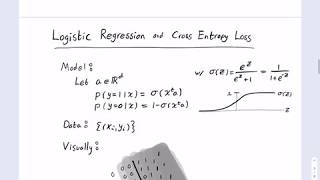
Supervised Machine Learning Review
Comprehensive review of supervised machine learning concepts, focusing on statistical frameworks, loss functions, and the intriguing double-descent phenomenon in neural networks.
Statistical Learning Theory and Applications - Class 7
Explore statistical learning theory, covering least squares, gradient descent, regularization, and induction, with insights into historical context and practical applications.
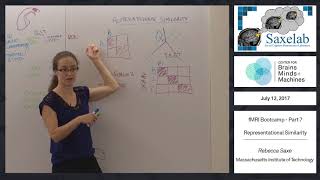
FMRI Bootcamp - Representational Similarity
Explore advanced fMRI analysis techniques, focusing on representational similarity and its applications in neuroimaging research.
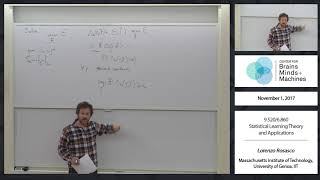
Generalization Error and Stability
Explore statistical learning theory, focusing on generalization error, stability, and empirical risk minimization. Gain insights into universal consistency and the law of large numbers.

Replacing Probability Distributions in Security Games via Hellinger Distance
Explore statistical distance in security games, focusing on Hellinger distance as an alternative to max-log for bit security frameworks and leftover hash lemma applications.