
IMU Preintegrated Features for Efficient Deep Inertial Odometry
Explore efficient deep inertial odometry using IMU preintegrated features. Learn about measurement errors, problem statement, evaluation, training, and results in human walking applications.
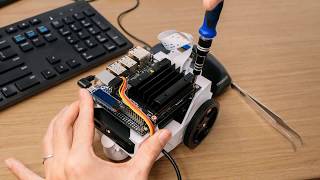
AI for Makers - Learn with JetBot
Learn to build AI projects with JetBot, an open-source DIY robotics kit for Jetson Nano. Explore real-time deep learning, object recognition, and various applications in this hands-on introduction.

Breaking New Frontiers in Robotics and Edge Computing with AI
Explore cutting-edge AI deployment for robotics and edge computing, covering tools, techniques, and recent developments in deep learning and NVIDIA's Jetson platform.
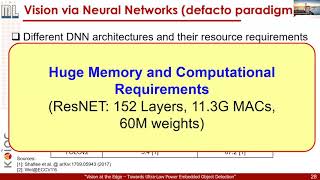
Towards Ultra-Low Power Embedded Object Detection
Explores ultra-low power embedded object detection for edge intelligence, presenting a hierarchical framework to reduce processing demands while maintaining accuracy in high-resolution video frames.
Min-Max Optimization - Part I
Explore min-max optimization, equilibrium computation, and adversarial gradient descent in zero-sum games, connecting classical techniques to deep learning applications.
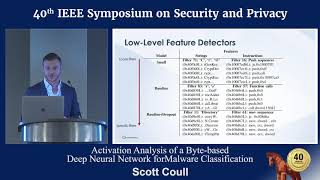
Activation Analysis of a Byte-Based Deep Neural Network for Malware Classification
Explores deep learning models for malware classification, analyzing learned features from byte-level to end-to-end, connecting activations to binary semantics, and examining impacts of training data and regularization.
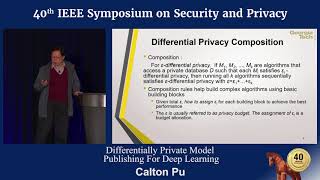
Differentially Private Model Publishing for Deep Learning
Explore techniques for publishing deep learning models with differential privacy, optimizing privacy loss and model accuracy through concentrated differential privacy and dynamic budget allocation.
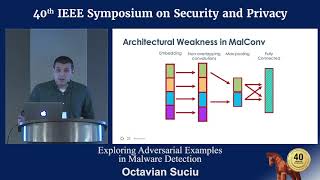
Exploring Adversarial Examples in Malware Detection
Explore adversarial examples in malware detection using CNNs, examining attack strategies, their effectiveness, and implications for model robustness in cybersecurity applications.
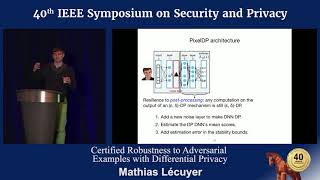
Certified Robustness to Adversarial Examples with Differential Privacy
Explore certified defense against adversarial examples using differential privacy. Scalable solution for large networks and datasets, providing robustness guarantees for various model types.
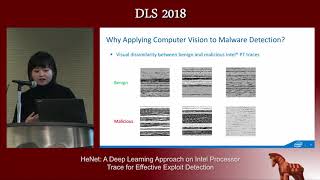
HeNet- A Deep Learning Approach on Intel Processor Trace for Effective Exploit Detection
Explore a deep learning approach using Intel Processor Trace for effective exploit detection. Learn about HeNet's hierarchical ensemble neural network for classifying hardware-generated control flow traces in malware detection.
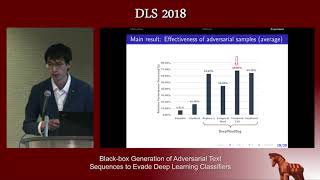
Black-Box Generation of Adversarial Text Sequences to Evade Deep Learning Classifiers
Explores techniques for generating adversarial text sequences to deceive deep learning classifiers, focusing on black-box attacks and their effectiveness in real-world scenarios.
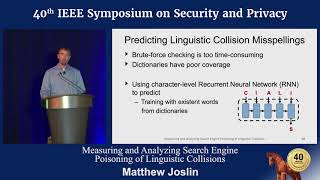
Measuring and Analyzing Search Engine Poisoning of Linguistic Collisions
Analyzing linguistic-collision search poisoning attacks, revealing prevalence and impact on Google and Baidu. Explores misspellings, auto-correction evasion, and targeted categories, offering insights for threat mitigation.
Deep Learning Workshop for Satellite Imagery - Training & Prediction
Hands-on deep learning workshop for satellite imagery, covering model training, debugging, prediction, and advanced techniques like custom metrics, heatmaps, and model deployment.
Deep Learning Workshop for Satellite Imagery - Data Processing
Hands-on workshop on data processing for satellite imagery, covering fundamentals, Python processing, image manipulation, and preparation of training data for deep learning applications.
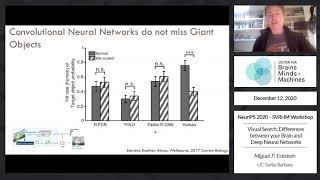
Visual Search - Differences Between Your Brain and Deep Neural Networks
Explore how human visual perception differs from deep neural networks, examining experiments, results, and implications for fields like medical imaging.
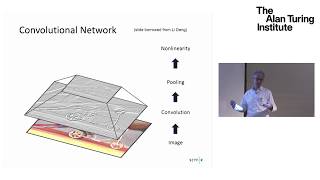
Artificial Intelligence per Kilowatt-Hour - Max Welling, University of Amsterdam
Explore cutting-edge AI efficiency: compressing neural nets, low-precision computing, and spiking networks to maximize intelligence per kilowatt-hour as AI moves to edge devices.

Planning and Control
Explore state transition equations, numerical examples, and PyTorch implementations for optimal control in planning and control systems, with a focus on the Kelley-Bryson algorithm and cost considerations.

When Biology Moves to Engineering
Exploring AI's role in transforming biology from empirical science to engineering, enabling better diagnostics and biological circuit design for improved healthcare and drug discovery.
Extracting Mel Spectrograms with Pytorch and Torchaudio
Master Mel Spectrogram extraction using PyTorch and torchaudio. Learn key audio transformations, resampling techniques, and practical implementation for audio processing tasks.

Sound Generation with Deep Learning - Approaches and Challenges
Explore deep learning approaches for sound generation, including raw audio and spectrogram methods. Learn about challenges, architectures, and inputs used in creating AI-generated audio.

Safety and Robustness for Deep Learning with Provable Guarantees - Marta Kwiatkowska - Oxford
Explore techniques for ensuring safety and robustness in deep learning systems, focusing on automated certification methods, Bayesian learning, and causality in critical applications.