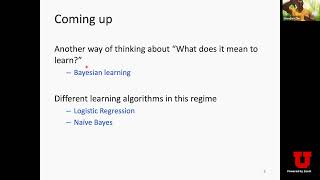
Machine Learning - Lecture 23
Dive into advanced data science concepts through comprehensive coverage of machine learning principles, algorithms, and practical applications in this university-level lecture.
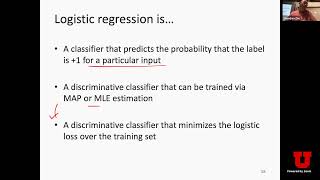
Machine Learning Fundamentals - Lecture 26
Dive into advanced data science concepts through comprehensive coverage of machine learning principles, algorithms, and practical applications in this graduate-level lecture from University of Utah.
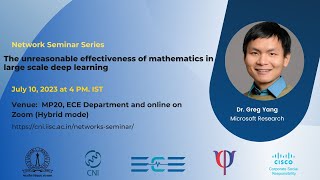
The Unreasonable Effectiveness of Mathematics in Large Scale Deep Learning - From Theory to Practice
Explore the mathematical foundations of large-scale deep learning, focusing on infinite-width neural networks and their practical applications in tuning enormous models like GPT-3.
Floating Point Computations Today and in the Future
Explore floating-point computations, IEEE 754 standard, data compression techniques, POSIT arithmetic, and C++ libraries. Gain insights into deep learning and alternative FP formats.
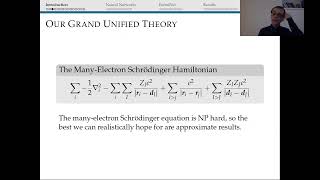
Solving the Many-Electron Schrödinger Equation with Deep Neural Networks
Explore deep neural networks for solving complex quantum mechanical equations in many-electron systems, advancing computational physics and materials science.
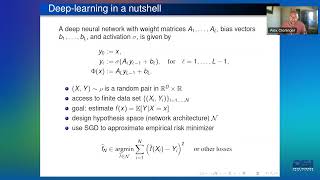
Networks that Adapt to Intrinsic Dimensionality Beyond the Domain
Explore neural networks' ability to adapt to intrinsic dimensionality, focusing on ReLU networks approximating functions with dimensionality-reducing feature maps. Gain insights into manifold learning and data analysis.
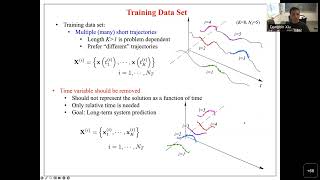
Data-Driven Modeling of Unknown Systems with Deep Neural Networks
Explore data-driven modeling of unknown systems using deep neural networks. Learn to discover and approximate evolution operators for predictive analysis across various problem domains.
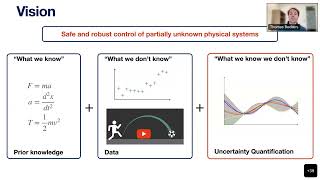
Physics-Enhanced Gaussian Processes for Learning of Electromechanical Systems
Explore physics-enhanced Gaussian processes for modeling electromechanical systems. Learn about GP-PHS and physics-enhanced variational autoencoders to improve data efficiency and ensure physical correctness.
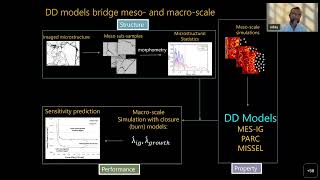
Data-Driven Multi-Scale Simulations for Materials-by-Design of Energetic Materials
Explore multi-scale modeling of energetic materials using machine learning for scale bridging. Learn about structure-property-performance relationships and optimization strategies for materials design.
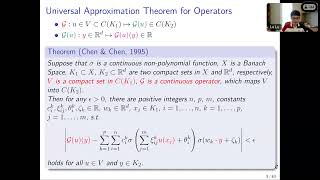
Deep Neural Operators with Reliable Extrapolation for Multiphysics and Multiscale Problems
Explore deep neural operators for complex systems, focusing on DeepONet and its extensions for multiphysics and multiscale problems. Learn about extrapolation challenges and solutions in deep learning models.
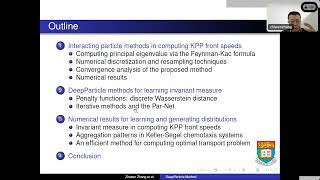
DeepParticle: Learning Invariant Measure by Deep Neural Network Minimizing Wasserstein Distance
Explore DeepParticle: an integrated approach combining deep learning, optimal transport, and interacting particles to solve high-dimensional PDEs, demonstrated through Fisher-Kolmogorov-Petrovsky-Piskunov front speeds in incompressible flows.
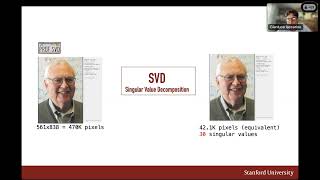
AutoEncoders for Aerodynamic Predictions
Explore autoencoders for aerodynamic predictions, focusing on flow past wing geometries. Learn about non-linear compression, latent representations, and uncertainty quantification in data-driven modeling.
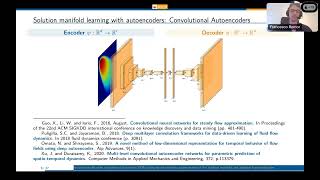
Intrusive Model Order Reduction Using Neural Network Approximants
Explore innovative neural network-based techniques for efficient reduced-order modeling of complex parametric partial differential equations, focusing on intrusive and interpretable methodologies.
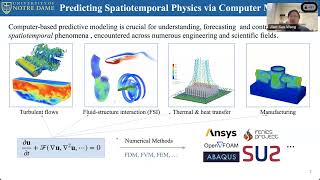
Neural Differentiable Physics: Unifying Numerical PDEs and Deep Learning for Data-Augmented Computational Physics
Explore Neural Differentiable Physics, unifying numerical PDEs and deep learning for enhanced computational modeling of complex physical systems. Learn innovative SciML approaches integrating physics principles with AI.

Deep Dive into ChatGPT: Architecture and Comparison with Bard and LLaMa
Explore ChatGPT's architecture, implementation, and evolution. Compare with Bard and LLaMa. Learn to build tinyGPT. Gain insights into transformers, attention mechanisms, and the GPT family of models.

Multimodal Generative AI: Technology Overview and Business Implications
Explore multimodal generative AI's technology, business applications, and limitations. Gain insights into training, costs, and open-source systems like LLaVA for text, image, and audio processing.

Deploying Deep Learning Models for Inference at Production Scale
Optimize and deploy AI models at scale using NVIDIA TensorRT and Triton Inference Server. Learn production-ready techniques for efficient inference across various platforms and infrastructures.
Introduction to Neural Networks
Explore neural networks, their components, and architectures. Learn about RNNs, LSTMs, and CNNs with practical examples in Python for movie review and image classification tasks.
How to Get Value Out of ChatGPT and Stable Diffusion Models with Proprietary Data
Explore applications of language models and generative AI in corporate settings, boosting productivity and customer experience while preserving proprietary data.
Advanced Python Libraries for Data Science
Explore advanced Python libraries for data science, focusing on scikit-learn, TensorFlow, and PyTorch Geometric. Learn implementation, methodologies, and practical applications through code exercises.
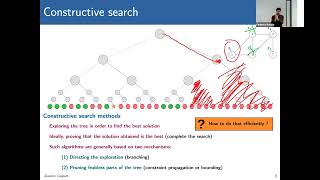
Learning to Bound Using Decision Diagrams and Reinforcement Learning
Explore decision diagrams and reinforcement learning for tighter bounds in discrete optimization, enhancing branch-and-bound algorithms with improved variable ordering techniques.