Human-Machine Collaboration Approach to Deep Learning Development
Explore human-machine collaboration in deep learning development with insights from AI expert Alexander Wong on computational imaging and computer vision.
Distributed Training and Gradient Compression - Lecture 14
Explore distributed training challenges, focusing on bandwidth and latency bottlenecks. Learn gradient compression techniques and delayed gradient averaging to optimize communication in deep learning systems.
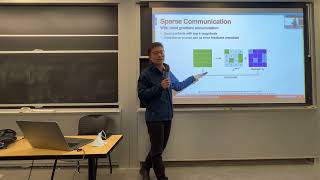
Distributed Training and Gradient Compression - Lecture 14
Explore distributed training challenges, focusing on bandwidth and latency bottlenecks. Learn gradient compression techniques and delayed gradient averaging to optimize communication in deep learning.
EfficientML.ai - Basics of Neural Networks - Lecture 2
Explore neural network fundamentals, including architecture, training, and optimization techniques. Gain insights into efficient machine learning concepts and applications.
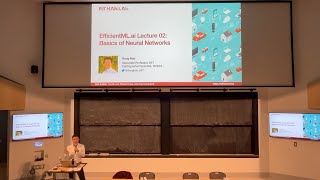
Basics of Neural Networks - EfficientML.ai Lecture 2
Explore neural network fundamentals, including architecture, training, and optimization techniques, in this comprehensive MIT lecture on efficient machine learning.
QLoRA - How to Fine-tune an LLM on a Single GPU with Python Code
Learn to fine-tune large language models on a single GPU using QLoRA. Explore quantization techniques, LoRA, and practical implementation with Python code for custom YouTube comment responses.
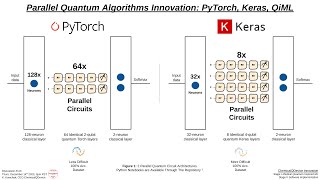
Parallel Quantum Algorithms Innovation: PyTorch, Keras, and QiML
Explore parallel quantum algorithms for machine learning using PyTorch and Keras. Enhance model accuracy and efficiency by incorporating quantum layers in neural networks.
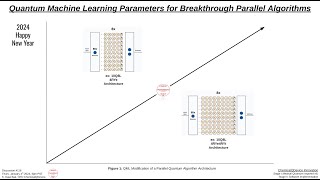
Quantum Machine Learning Parameters for Breakthrough Parallel Algorithms
Explore breakthrough parallel quantum algorithms for machine learning, improving performance and efficiency. Learn key benefits and optimal parameter settings for quantum-classical hybrid models.
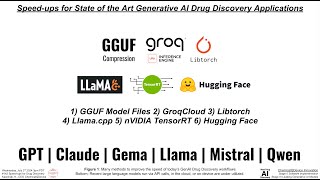
Speed-ups for State-of-the-Art Generative AI Drug Discovery Applications
Explore cutting-edge generative AI techniques for drug discovery, including VAEs, Hugging Face pipelines, and LLM comparisons. Learn to accelerate inference times using C++ and cloud platforms.
The Era of 1-bit LLMs Explained - BitNet b1.58 and New Scaling Laws
Explore groundbreaking research on BitNet b1.58, a ternary parameter model matching full-precision Transformers while offering improved cost-effectiveness and defining new LLM scaling laws.
Deep Learning in NLP and Beyond - 2015
Explore advanced machine learning in NLP, focusing on recurrent neural networks and deep learning. Gain insights into future research directions for developing language-understanding machines.
I-Vector Representation Based on GMM and DNN for Audio Classification - 2015
Explore I-vector approach for audio classification, including GMM mean modeling and recent subspace techniques. Learn about applications in language and dialect recognition using deep neural networks.
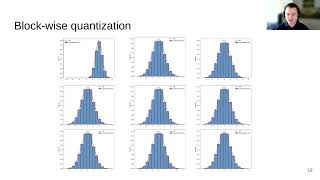
8-bit Methods for Efficient Deep Learning
Explore 8-bit methods for efficient deep learning, focusing on quantization techniques, optimizers, and inference for large language models to improve efficiency without performance loss.
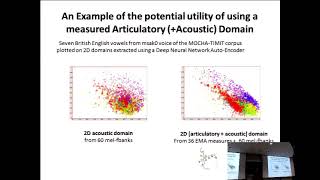
Speech Production Features for Deep Neural Network Acoustic Modeling - 2015
Explore speech production knowledge for improved DNN acoustic modeling in ASR. Learn about vocal tract measurements and phonological embeddings to enhance recognition accuracy.
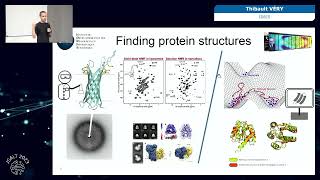
Deep Learning for Protein Structure Discovery
Explore deep learning techniques for uncovering protein structures, revolutionizing molecular biology and drug discovery.
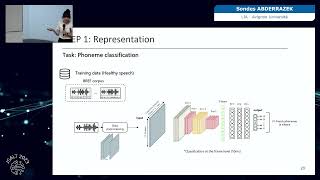
Deep Learning Interpretability and Explainability of Speech in a Clinical Context
Explore deep learning interpretability and explainability of speech in clinical settings, focusing on advanced techniques and their practical applications.
Foundation Models and the Transfer of Embodied Autonomy
Explore challenges in developing foundation models for sequential decision-making, including transfer learning, and discuss future research directions in embodied autonomy.
Unsupervised Environment Design
Explore automatic generation of environments for training RL agents, from GenIE to Unsupervised Environment Design, bridging classical decision theory and deep learning.
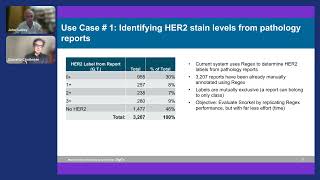
The Art of Building AI Systems - Rapid Training Data Creation
Learn techniques for rapidly creating annotated training data to build accurate and robust AI systems using clinical reports.
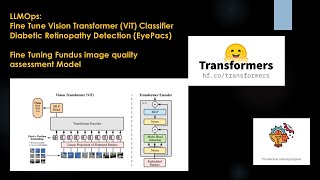
Fine-Tuning Vision Transformer Classifier for EyePacs Dataset Quality Model - Part 1
Fine-tune a Vision Transformer for image quality assessment using the EyeQ dataset, a subset of EyePacs, to enhance diabetic retinopathy detection capabilities.
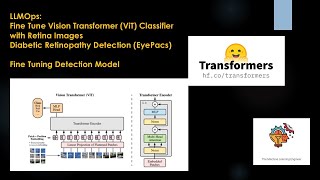
Fine-Tuning Vision Transformer for Diabetic Retinopathy Detection - Part 2
Fine-tune a Vision Transformer for diabetic retinopathy detection using EyeQ dataset. Learn to adapt pretrained models for specialized medical image classification tasks.