RAG Quality Starts with Data Quality - Enhancing Retrieval-Augmented Generation Systems
Explore data quality's crucial role in Retrieval-Augmented Generation (RAG) systems. Learn data prep essentials, overcome challenges, and enhance performance while ensuring privacy and governance in enterprise settings.
Azure ML: Python SDK v2 - Creating Machine Learning Applications
Develop ML applications using Azure Machine Learning Studio Python SDK v2. Train models and publish to Azure ML model repository.
Neo4J GDS: Community Detection Algorithms
Explore Neo4J GDS library and community detection algorithms for graph data science, enhancing your machine learning and data analysis skills.
Vertex Model for Tissue Mechanics - Part I
Explore vertex models for tissue mechanics, focusing on fundamental concepts and applications in biological systems.
AI and the Second Revolution in Weather and Climate Prediction
Explore AI's transformative impact on weather and climate prediction, revolutionizing forecasting techniques and enhancing our understanding of atmospheric dynamics.
Retrieval Augmented Generation (RAG) - Tutorial 4
Explore Retrieval Augmented Generation (RAG) techniques to enhance AI models' knowledge and responses using external data sources, improving accuracy and relevance in various applications.
AI Agents for Autonomous Labs - Tutorial 4
Explore AI agents for autonomous labs, focusing on their applications and potential in scientific research and experimentation.
Neural Scaling Laws - Fitting Scaling Laws for Scientific Foundation Models - Tutorial 3
Explore neural scaling laws and learn techniques for fitting scaling laws to scientific foundation models in this advanced tutorial.
Foundation Models for Science
Explore foundation models' potential in scientific research, focusing on their applications and impact on various scientific disciplines.

Discovery in High Dimensions - 2008
Explore statistical methods for uncovering hidden structures in high-dimensional data from various fields, including genetics, astronomy, and consumer behavior.

Machine-Learning Enabled Imaging: From Microscopy to Medical Imaging to Astronomy - Kirk Lecture
Explore machine learning's impact on imaging across microscopy, medical imaging, and astronomy. Learn how neural networks leverage training data and physical models for improved image quality and resolution.
Game Programming: C++ Visual Code Profiling - Lecture 20
Explore C++ game programming profiling techniques, including Singletons, event-based, statistical, and instrumentation profilers. Learn to implement a Profiler class and use macros for efficient code timing and analysis.

How to Rangify Your Code - C++ on Sea 2022
Learn to apply C++20 ranges to real-world code examples, using standard library and range-v3 library. Explore techniques for refactoring existing algorithms and thinking in terms of ranges.
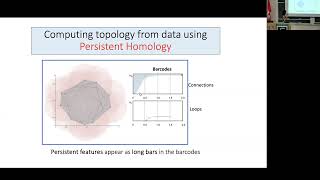
Applications of Topological Data Analysis in Cancer - Lecture 2
Explore applications of topological data analysis in cancer research, focusing on mathematical modeling of treatments, resistance, and optimization.

The Atomic Human - Understanding Ourselves in the Age of AI
Explore the impact of AI on human understanding and society through Professor Neil Lawrence's insightful keynote at the ELLIS Community Event in Helsinki.
Follow the Data: Memory-Centric Designs for Modern Datacenters
Explore data-driven approaches for memory architecture in exascale supercomputing and cloud memory disaggregation. Gain insights into system-level memory problems and their solutions.

ML for High-Performance Climate: Data Post Processing, Compression, and Earth Virtualization Engines
Explore advanced ML techniques for climate data processing, compression, and Earth virtualization, enhancing high-performance computing in climate science.
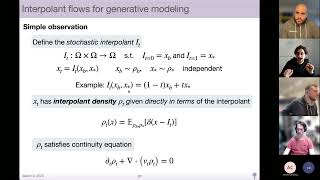
Building Normalizing Flows with Stochastic Interpolants
Explore advanced techniques for constructing normalizing flows using stochastic interpolants, enhancing generative modeling capabilities.

Robust Parameter Estimation in Computer Vision
Explore robust parameter estimation in computer vision, focusing on algorithms for handling outliers in large-scale data and recent developments in the field.

Towards AI-Aided Decision Making: Preference Learning and Recommendations from Multimodal Data
Explore AI-aided decision making through preference learning and recommendations, leveraging multimodal data for personalized user experiences in the era of pervasive digitization.

Machine Learning in Medical Diagnostics and Drug Discovery
Explore machine learning applications in genomics and proteomics for medical diagnostics and drug discovery. Learn how advanced analytics improve sequencing projects and translate technologies into practice.