
Equivariant Machine Learning from Classical Physics
Explore equivariant machine learning techniques inspired by classical physics, presented by Soledad Villar from John Hopkins University.
Machine Learning for Gravitational Wave Astronomy
Explore machine learning applications in gravitational wave astronomy, focusing on advanced detection and analysis techniques for cosmic phenomena.
Mastering Retrieval for LLMs - BM25, Fine-tuned Embeddings, and Re-Rankers
Enhance LLM retrieval with advanced techniques: BM25, fine-tuned embeddings, and re-rankers. Learn document chunking, semantic search, and performance optimization for improved AI-powered information retrieval.
Quantifying Dinosaur Pee - Expressing Probabilities as Floating-Point Values in C++ - Lecture
Explore floating-point precision in C++ through probability calculations, from birthday paradoxes to dinosaur urine, with insights on numerical pitfalls and expected value concepts.
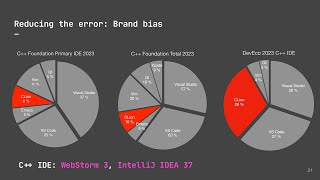
Tips on Surveying the C++ Community
Explore insights on conducting effective C++ community surveys, including methodology, bias removal, and data interpretation. Learn to leverage research findings for informed decision-making.
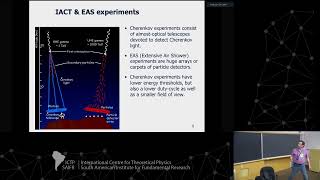
Introduction to the IACT Technique - Class 1
Explore the fundamentals of Imaging Atmospheric Cherenkov Telescope (IACT) technique in this comprehensive lecture by Francesco Longo from the Latin-American School on CTA Science.
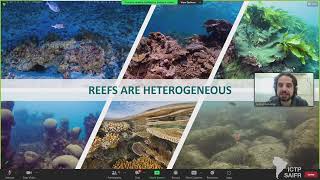
Can We Predict the Future of Brazilian Reefs? - QEco Program Seminar
Explore Brazilian reef ecosystems, their future predictions, and conservation strategies through expert insights and quantitative ecological approaches.
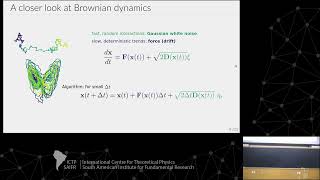
From Trajectories to Models: Data-Driven Approaches to Decipher the Dynamics of Living Systems
Explore data-driven methods for deciphering living systems' dynamics, focusing on transforming trajectories into models for deeper biological insights.
Characterizing Networks and Phase Transitions with Classical and Quantum Machine Learning
Explore network characterization and phase transitions using classical and quantum machine learning techniques in this comprehensive lecture by Rafael Chaves.
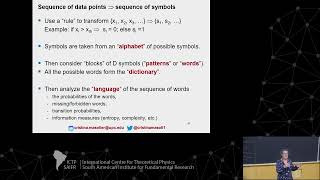
Time Series Analysis - Class 3 of 4
Explore advanced time series analysis techniques for socio-economic complexity in this comprehensive lecture by Cristina Masoller.
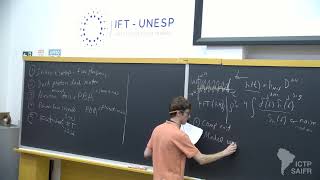
Diving into the Details of Continuous Wave-Searches and Prospects for the Future
Explore continuous wave-searches in gravitational wave astronomy, examining current techniques and future prospects for detecting long-duration signals from rotating neutron stars.
Hands-On CTA Likelihood Analysis - Lecture
Aprenda a análise de probabilidade CTA com exercícios práticos guiados por especialista, explorando técnicas avançadas para dados de telescópios Cherenkov.
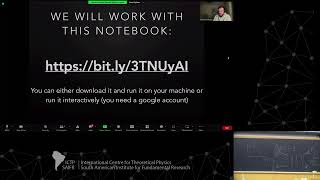
Hands-On Guide to Searching for ALPs, Lorentz Violation, and Related Phenomena
Explore techniques for detecting axion-like particles and Lorentz violation in high-energy astrophysics, with hands-on guidance from expert Manuel Meyer.
Quantitative Foundations of Ecological and Evolutionary Dynamics - Class 02
Explore quantitative foundations of ecology and evolution through advanced mathematical concepts and modeling techniques in this comprehensive lecture.
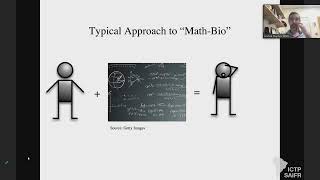
Quantitative Foundations of Ecological and Evolutionary Dynamics - Class 01
Explore quantitative foundations of ecology and evolution with Joshua Weitz, covering key concepts and mathematical approaches for understanding complex biological systems.
Let's Talk Python: How to Program a Computer - From Fundamentals to Python Basics
Learn Python programming from scratch: explore computer basics, coding fundamentals, and essential Python concepts like variables, loops, and data manipulation using Jupyter notebooks on nanoHUB.
Strengthening Software Operations: Observability, Encryption, and SSO - Operator Day Insights
Strengthen software operations with predictive observability, certificate-based encryption, and simplified SSO. Learn to integrate tools, secure communications, and automate identity management for enhanced efficiency and security.
Mastering Software Operators for Data and AI - PostgreSQL, Apache Spark, and Kubeflow
Explore software operators for PostgreSQL, Apache Spark, and Kubeflow. Learn to simplify complex operations, streamline data processing, and navigate MLOps setups for optimal AI workload performance.
Complete DevOps Project: Deploy GoLang App with Kubernetes, ArgoCD, Prometheus and Grafana
Deploy a secure GoLang app with Kubernetes, ArgoCD, Prometheus & Grafana. Learn modern DevOps practices for automated, secure, and scalable deployment pipelines using various tools and technologies.

Comparing LLAMA 3, Phi 3, and GPT-3.5 Turbo AI Agents for Web Search Performance
Benchmark open-source AI models against Perplexity AI in web search performance. Compare Llama 3 70b, GPT-3.5 turbo, and Phi-3 medium using a custom web search agent.
Data Preparation Tips and Tricks for Machine Learning
Master data preparation techniques for AI models, including filtering, balancing, and synthetic dataset creation. Explore clustering methods, chat templates, and handling mixed-language data for improved model performance.