Mapping Brain Dynamics and Trajectories with Geometric and Topological Machine Learning
Explore geometric and topological machine learning techniques for mapping brain dynamics and trajectories, enhancing understanding of neural processes.

Validation of AI Techniques in MRI for Clinical Studies
Explore AI validation techniques for MRI in clinical studies, focusing on enhancing accuracy and reliability in medical imaging analysis.
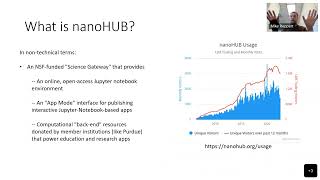
Hands-on Teaching with Jupyter Notebooks on nanoHUB
Explore hands-on teaching using Jupyter Notebooks on nanoHUB for chemistry courses. Learn to create interactive simulations, visualizations, and programming projects for enhanced student engagement and learning.
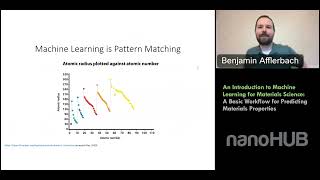
Introduction to a Basic Machine Learning Workflow for Predicting Materials Properties
Learn a basic machine learning workflow for predicting material properties, covering data cleaning, feature engineering, model training, and optimization using decision trees to forecast material bandgaps from compositions.
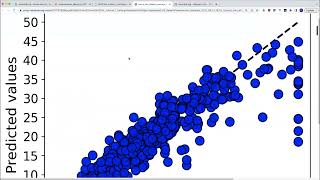
The Materials Simulation Toolkit for Machine Learning (MAST-ML): Automating Development and Evaluation of Machine Learning Models for Materials Property Prediction
Automate machine learning model development for materials property prediction using MAST-ML. Learn data import, feature engineering, model evaluation, and uncertainty quantification through hands-on activities.
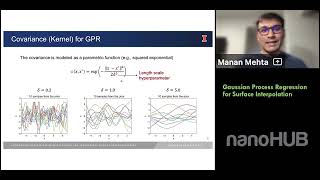
Gaussian Process Regression for Surface Interpolation
Explore Gaussian Process Regression for surface interpolation in manufacturing. Learn fundamentals, applications, and the innovative filtered kriging technique for improved performance in nanomanufacturing contexts.
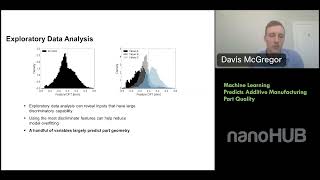
Machine Learning for Predicting Additive Manufacturing Part Quality - Tutorial on Support Vector Regression
Learn to predict additive manufacturing part quality using support vector regression. Explore data analysis, hyperparameter tuning, and cross-validation techniques for machine learning in 3D printing applications.
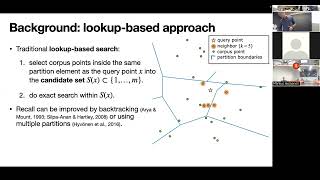
Multilabel Classification Framework for Approximate Nearest Neighbor Search
Explore multilabel classification for approximate nearest neighbor search, enhancing space partitioning trees and enabling supervised classifiers as index structures for ANN search.
Challenges in ML Engineering
Explore challenges in ML engineering, including cost-efficient inference, automation, accuracy monitoring, and anomaly detection for real-world AI applications.
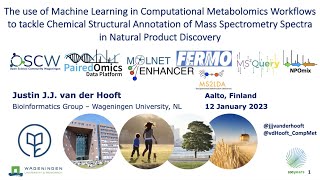
The Use of Machine Learning in Computational Metabolomics Workflows
Explore machine learning applications in computational metabolomics for metabolite structure analysis. Learn about tools like MS2LDA, MotifDB, Spec2Vec, and MS2DeepScore for improved metabolite discovery and characterization.
Heterogeneous Serverless Computing for High-Performance Computing and AI Workloads
Explore heterogeneous serverless computing for efficient HPC, HPDA, and AI workloads. Learn about innovative accelerator uses and flexible deployment models from edge to exascale.
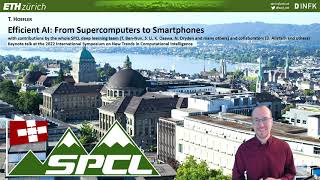
Efficient AI: From Supercomputers to Smartphones
Explore techniques for efficient AI training and inference, from data ingestion to model compression, enabling powerful models on supercomputers and smartphones.

Improving Pareto Front Learning via Multi-Head HyperNetwork
Explore multi-objective optimization and Pareto front learning through a novel Multi-head HyperNetwork architecture, improving solution quality for machine learning applications.

Nonlinear Statistical Modeling for High-Dimensional and Small Sample Data
Explore nonlinear feature selection methods for high-dimensional, small sample data. Learn about HSIC Lasso, kernel PSIs, and feature selection networks for advanced machine learning applications.

Tackling Fairness, Change, and Polysemy in Word Embeddings
Explore fairness, change, and polysemy in word embeddings with Felipe Bravo's presentation on cutting-edge research in natural language processing and machine learning.

Augmenting the Prediction of Extubation Failure Using Measures of Complexity
Explore innovative techniques for predicting extubation failure in critical care using complexity measures and advanced data analysis methods.
Probabilistic Machine Learning in Bioinformatics
Explore probabilistic machine learning applications in bioinformatics, focusing on cutting-edge techniques and their impact on biological data analysis.

Java Me Smarter: Unleashing AI Power with Quarkus
Explore Quarkus for building AI-powered Java microservices. Learn to integrate AI capabilities, from machine learning to chatbots, and discover the future of Java development with AI.

Amr Awadallah's Journey: Data, Cloud Computing, AI, and Entrepreneurship
Explore Amr Awadallah's tech journey from Yahoo to Vectara, covering data processing, cloud computing, AI, and entrepreneurship. Gain insights on open-source models, GenAI adoption, and startup success factors.
A Cloud-Native Parallel Data Processing Application in Julia
Explore cloud-native parallel data processing in Julia, covering design, debugging, and profiling techniques for high-performance applications. Learn AWS integration, containerization, and performance optimization strategies.
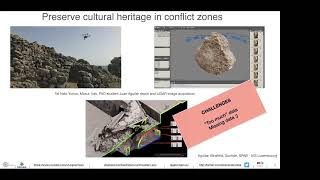
Digital Twins in Mechanics and Medicine - Data-Centric Engineering Webinar
Professor Stéphane Bordas explores digital twins in mechanics and medicine, highlighting data science applications for improving engineered systems' reliability, safety, and efficiency.