
Computer Vision
Explore machine learning and computer vision fundamentals, advanced neural network architectures, and applications in object detection and semantic segmentation.
Linear Regression Analysis and Forecasting
The accuracy of forecasting depends upon the goodness of obtained model. What are the steps and checks required to obtain a good model and in turn, how to do forecasting is being aimed to be taught in this course.
Sidney Redner on Statistics and Everyday Life
Explore everyday phenomena through statistical analysis, revealing hidden patterns in parking, elevators, and sports. Learn how complex systems research uncovers universal principles in daily life.

Fractal Conflicts & Swing Voters with Eddie Lee
Explore the fractal nature of armed conflicts, swing voters, and pivotal components in society through complex systems research, revealing hidden patterns and influential factors shaping human behavior.

Narrative in Five Centuries of Classical Music - Time's Arrow - Gustavo Martinez
Explore the evolution of classical music narratives across five centuries, analyzing structural complexity, temporal directionality, and the concept of irreversibility in musical compositions.
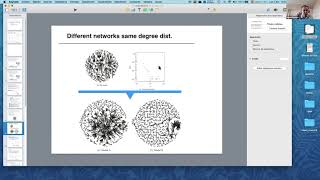
Conditional Degree Matrix in Musical Analysis - Miguel Fuentes
Explore the application of conditional degree matrices in musical analysis, focusing on complexity, universal features, and evolutionary perspectives across cultures.
The Science of Measuring Quality and Value in Health Care - Complexity and Vulnerability
Explore the complexities of measuring healthcare quality and value, focusing on challenges, opportunities, and innovative approaches to improve healthcare delivery and outcomes.
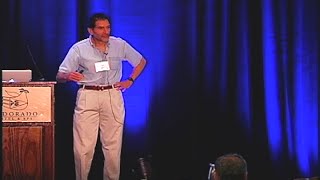
A Statistical Physicist Looks at Some Complex Systems
Explore complex systems through statistical physics, examining random walks, lead changes in sports, and data analysis techniques for understanding dynamic processes.

Maria del-Rio Chanona on Modeling Labor Markets & Tech Unemployment
Exploring labor market dynamics and technological unemployment through network analysis and agent-based modeling. Insights on job security, skill transferability, and adapting to automation in the evolving workforce.

Jennifer Dunne on Reconstructing Ancient Food Webs
Exploring ancient food webs to uncover ecological patterns, extinction dynamics, and sustainability insights. Reconstructed trophic networks reveal hidden order conserved for half a billion years, offering new perspectives on ecosystem structure and evol…
Data + Art - Better Science Communication
Explore data visualization through art with Kirell Benzi, enhancing science communication. Learn innovative techniques to present complex information visually and engage audiences effectively.
Rational Ignorance - Optimal Learning from Complex Mechanistic Models
Explore optimal Bayesian learning from complex models, challenging traditional approaches and proposing a new method to maximize expected information while avoiding bias in multiparameter systems.
Tina Eliassi-Rad on Democracies as Complex Systems
Exploring democracy as a complex system, examining its challenges and potential solutions through the lens of complexity science and machine learning.
Mathematical and Computational Foundations for Enabling Predictive Digital Twins at Scale
Explore mathematical foundations for scalable digital twins, focusing on probabilistic graphical models and physics-based reduced-order models in scientific and engineering applications.
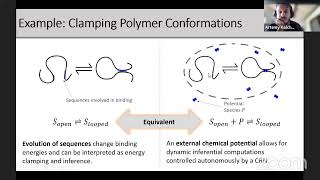
Detailed Balanced Chemical Reaction Networks as Generalized Boltzmann Machines
Explore the intersection of chemical reaction networks and machine learning, focusing on detailed balanced systems and their relation to generalized Boltzmann machines.
The Science of Pandemics - C4 Public Lecture
Explore global pandemics, influenza threats, and the role of mathematical modeling in disease surveillance and control through advanced computing techniques.
The Individual Within the Crowd: How Individual Forecasters Contribute to Ideal Group Forecasts
Explores optimal group forecasting by analyzing individual biases, errors, and diversity. Presents a statistical model for estimating forecaster features and discusses when to use optimal weighting versus simple averaging.
Patterns and Surprises in Rich but Noisy Network Data
Explore patterns in noisy network data, focusing on social and biological examples. Learn techniques for estimating network structure and uncovering insights about underlying systems from error patterns.
Social Networks, Protest, and Repression
Explores the relationship between social network structures and protest dynamics, revealing nonlinear patterns in mobilization and offering insights into state repression strategies.
Estimating Indirect Effects in a Wild and Anti-Social Mammal
Exploring indirect genetic effects in wild red squirrels, examining how spatial and temporal neighbors influence phenotypes and potential evolutionary impacts in varying population densities.
The Question Concerning Technology, Revisited - The Dark Side of a Big Data World
Exploring the dark side of big data and its impact on democracy, privacy, and national security, with insights from Heidegger's philosophy to address ethical challenges in the digital age.